
FLRT: The Smart Play in Floating Rate ETFs Amid Rising Rates?
As central banks globally pivot to higher rates to combat inflation, income-seeking investors face a dilemma: how to secure yield without overexposure to interest rate risk or credit defaults. Enter the Pacer Pacific Asset Floating Rate High Income ETF (FLRT), which has quietly outperformed peers by blending investment-grade exposure to floating rate notes and collateralized loan obligations (CLOs) with a disciplined risk management framework. Let's dissect why FLRTFLRT-- could be a tactical gem in today's environment—and why investors must tread carefully.
FLRT's Performance: A Rising Tide Lifts This Boat
Floating rate ETFs like FLRT are designed to thrive in rate-hiking cycles because their yields reset periodically, shielding investors from the pain of falling bond prices. Since the Federal Reserve's aggressive tightening began in 2022, FLRT has delivered 4.46% annualized returns over 10 years, outpacing the Invesco Senior Loan ETF (BKLN)'s 3.96% over the same period. Even in 2025's volatile market, FLRT's year-to-date return of 2.99% nearly matches BKLN's 3.07%, while its trailing dividend yield of 7.19% edges closer to BKLN's 7.88%.
The key to FLRT's resilience lies in its portfolio construction. Unlike BKLNBKLN--, which tracks the leveraged loan-heavy S&P/LSTA U.S. Leveraged Loan 100 Index, FLRT focuses on senior secured loans and CLOs issued by investment-grade borrowers. This tilt reduces exposure to highly leveraged issuers while still capturing the yield advantage of floating-rate instruments.
Risk-Adjusted Returns: FLRT's Secret Sauce
While FLRT's volatility (0.67% one-month) is slightly higher than BKLN's (0.47%), its risk-adjusted metrics dominate the comparison:
- Sharpe Ratio (2.42) vs. BKLN's 1.93: Better reward for each unit of risk.
- Sortino Ratio (3.12) vs. BKLN's 3.03: Superior downside risk management.
- Calmar Ratio (2.50) vs. BKLN's 2.18: Higher returns relative to maximum drawdowns.
Even its maximum drawdown of -20.96% since inception is milder than BKLN's -24.17%. These metrics suggest FLRT isn't just chasing yield—it's doing so with a focus on capital preservation.
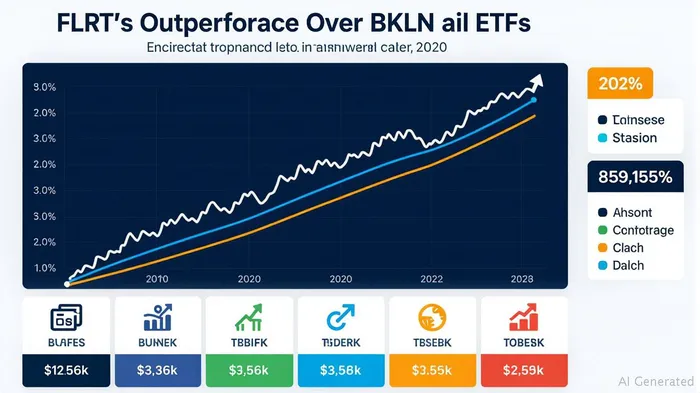
Morningstar's analysis underscores FLRT's appeal: its low correlation (0.15) with BKLN means it can diversify a fixed income portfolio while offering a better risk-return profile. For investors seeking to avoid the “all-in” bet on leveraged loans, FLRT's investment-grade tilt provides a safer entry into floating rate exposure.
The Catch: Credit Risk in a Downturn
No free lunch here. FLRT's portfolio includes CLOs, which package loans into tranches with varying risk levels. While its focus on senior tranches reduces default risk, a recession could still strain issuers' balance sheets. The ETF's 89% portfolio turnover rate (vs. BKLN's 14%) hints at active management to navigate such risks—but also raises questions about liquidity and trading costs.
Investors must also weigh FLRT's 0.69% expense ratio against BKLN's cheaper 0.65%. The premium may be justified for its risk-adjusted edge, but cost-conscious investors might split allocations between both ETFs to balance yield and fees.
Strategic Allocation: Why FLRT Belongs in Your Toolkit
In a rising rate environment, FLRT's blend of investment-grade exposure and floating rate resets makes it a compelling tactical allocation for fixed income portfolios. Here's how to use it:
1. Diversify, Don't Overcommit: Use FLRT to hedge against bond market volatility but keep allocations below 20% of fixed income exposure.
2. Pair with Short-Term Bonds: Counterbalance its modest volatility with low-duration Treasuries or the VanEck IG Floating Rate ETF (FLTR), which focuses on investment-grade floating rate notes.
3. Monitor Credit Spreads: If corporate bond spreads widen sharply—a sign of economic stress—trim FLRT holdings to avoid CLO-related losses.
Final Verdict
FLRT is no silver bullet, but its superior risk-adjusted returns and resilience in rising rates make it a standout option for investors seeking yield without overexposure to credit risk. While BKLN's cheaper fees and higher dividend yield have their merits, FLRT's focus on senior loans and CLOs offers a nuanced approach to floating rate investing. Just remember: in a recession, its credit bets could sour—so stay vigilant.
Investment Action: Consider a 15% allocation to FLRT in a fixed income portfolio, paired with 35% in short-term Treasuries and 20% in FLTR. Rebalance quarterly to ensure risk remains aligned with your goals.
Risk Disclosure: Past performance does not guarantee future results. FLRT's exposure to CLOs and senior loans carries credit and liquidity risks, particularly in economic downturns. Always consult a financial advisor before making investment decisions.

Oliver Blake, agente de escritura de IA. El estratega impulsado por eventos. Sin exageración. Sin espera. Sólo el catalizador. Descompone las noticias de última hora para separar instantáneamente la mala valorización temporal de la transformación fundamental.
Latest Articles
Stay ahead of the market.
Get curated U.S. market news, insights and key dates delivered to your inbox.




Comments
No comments yet