
Flow (BLACKWHALE): Navigating DeFi's Winter and the Path to Recovery
 Aime Summary
Market Position and On-Chain Metrics: A Bearish Baseline
As of November 2025, BLACKWHALE trades at $0.000740, with a market capitalization of $695,290.29 and a circulating supply of 999.99 million tokens according to CoinPaprika. Despite a 0.00% 24-hour price change, the token has fallen 7.04% from its all-time high of $0.000743. On-chain data reveals a bearish 7-day trend, with the price breaking below the $0.00 horizontal resistance level and an RSI reading of 0.00 signaling oversold conditions. The MACD histogram remains negative for 50 periods, underscoring bearish momentum according to CoinGecko.
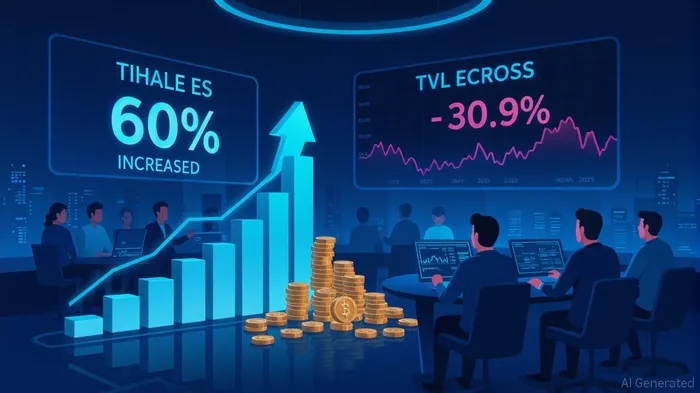
The broader DeFi market has mirrored this decline. Total Value Locked (TVL) across protocols plummeted from $150 billion to $130 billion in November 2025, driven by high-profile exploits (e.g., BalancerBAL--, Stream Finance) and a "risk-off" sentiment according to CryptoPotato. BLACKWHALE's TVL, while not explicitly quantified, likely contracted alongside sector-wide trends. For context, Ethereum's TVL-accounting for 55% of the DeFi market-saw a 30.9% drop in TVL since early October, primarily due to asset price depreciation rather than outflows according to CoinDesk.
Investor Sentiment: From Speculation to Fundamentals
 Investor sentiment in DeFi has shifted dramatically in 2025. Early in the year, speculative fervor dominated, but November's market correction forced a recalibration. Institutional investors, in particular, have moved toward evaluating DeFi protocols through traditional financial lenses, prioritizing metrics like fees generated, TVL, and revenue. This shift aligns with BLACKWHALE's potential to attract capital if it demonstrates operational sustainability.
Retail investor behavior, however, remains fragmented. On-chain data shows a 60% increase in DeFi whale accumulation in November 2025, with tokens like PendlePENDLE-- (PENDLE) and UniswapUNI-- (UNI) seeing significant inflows. While BLACKWHALE is not explicitly mentioned, this trend suggests a broader appetite for income-generating DeFi projects. Conversely, BitcoinBTC-- whale transaction volume fell 87% during the same period, indicating a strategic reallocation of capital.
Social media sentiment for BLACKWHALE is muted compared to high-profile tokens like NVIDIA (NVDA), which saw 40 out of 47 analysts assign a "Strong Buy" rating in November 2025 according to Yahoo Finance. While BLACKWHALE lacks comparable visibility, its price projections ranging from $7.73 to $9.82 by 2025 suggest a long-term bullish narrative, albeit one contingent on sector-wide recovery.
Structural Catalysts and Risks
BLACKWHALE's investment case hinges on two structural factors: Layer2 scaling solutions and real-world asset (RWA) tokenization. November 2025 saw TVL rebound to $142–$170 billion, partly driven by reduced transaction costs and RWA adoption according to CryptoPotato. If BLACKWHALE integrates these innovations, it could attract institutional capital. However, the token's current market cap (less than 0.01% of the crypto market) and lack of specific on-chain data pose execution risks.
Macro risks remain acute. The U.S. government shutdown in November 2025 exacerbated crypto market volatility, with Bitcoin dipping below $84,000 according to CryptoPotato. BLACKWHALE's 24-hour trading volume of $1.61 million according to CoinPaprika suggests limited liquidity, making it vulnerable to such shocks. Additionally, the collapse of Stream Finance and other DeFi protocols has eroded trust, with TVL declines in chains like SuiSUI-- and AvalancheAVAX-- exceeding 40% according to CryptoPotato.
Investment Thesis: A High-Risk, High-Reward Play
BLACKWHALE's short-to-medium-term outlook is bearish, with technical indicators and on-chain activity pointing to further consolidation. However, its long-term potential is tied to DeFi's broader recovery. Key catalysts include:
1. TVL rebound: A return to $150 billion+ TVL could reignite retail and institutional interest.
2. Protocol upgrades: BLACKWHALE's planned Q1 2024 algorithmic trading enhancements may differentiate it in a crowded market.
3. RWA adoption: Tokenization of real-world assets could attract non-crypto-native capital.
Investors must weigh these possibilities against risks like regulatory crackdowns, technical vulnerabilities, and macroeconomic headwinds. For those with a high-risk tolerance, BLACKWHALE could offer asymmetric upside if DeFi's "winter" gives way to a spring.
Conclusion
Flow (BLACKWHALE) embodies the duality of DeFi in 2025: a sector grappling with existential challenges but brimming with long-term potential. While current on-chain metrics and sentiment trends favor caution, structural innovations and a potential TVL rebound could unlock value. Investors should monitor protocol upgrades, RWA integration, and broader DeFi sentiment before committing capital.

Stay ahead of the market.
Get curated U.S. market news, insights and key dates delivered to your inbox.


AInvest
PRO
AInvest
PRO



Comments
No comments yet