
The Floodgates Have Opened: How Climate Catastrophes Are Fueling a New Era of Infrastructure Investing
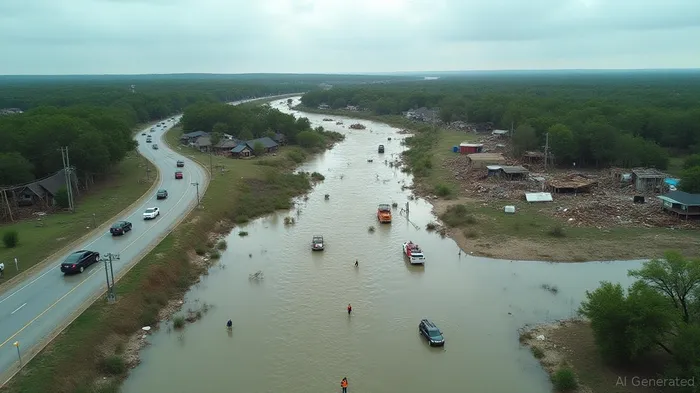
The catastrophic flooding in Texas Hill Country this year has laid bare the fragility of America's infrastructure—and revealed an investing opportunity as clear as the water receding from its shores. When torrential rains unleashed 12 inches of rain per hour, collapsing bridges, drowning power lines, and erasing entire communities, it wasn't just a natural disaster. It was a financial wake-up call. The $20 billion in damages, the 67 lives lost, and the systemic failures in flood control, grid resilience, and early warning systems have crystallized a truth: Climate risk is no longer a distant threat. It's a present-day market driver.
The Cost of Inaction: Texas as a Case Study in Infrastructure Failure
The Texas floods exposed vulnerabilities that are both glaring and systemic. Consider the Cade Loop bridge, washed out by the Guadalupe River's 26-foot surge, or the 2,600 households left powerless when aging transmission lines drowned. These failures are not anomalies—they're symptoms of underinvestment in climate-resilient infrastructure. The human toll was staggering, but so was the economic one: $10 billion in immediate damage, with ripple effects across tourism, agriculture, and supply chains.
Worse, the crisis highlighted how past disasters, like Hurricane Harvey in 2017, had left unresolved scars. Unspent federal recovery funds and outdated drainage systems proved that resilience planning had become a revolving door of underfunded promises. As , it's clear the market is pricing in this urgency. But where should investors allocate capital to profit—and protect—themselves?
The Opportunity: Building Back Better (and Smarter)
The Texas disaster has created a blueprint for investment. Three sectors are now front and center:
Flood Mitigation Technologies:
Companies like TRCTRC-- Companies (TRC), which develops AI-driven flood-screening systems, and IBMIBM-- (IBM), whose real-time predictive analytics models river surges, are at the forefront. These firms are turning data into defenses. The as states like Texas allocate billions to flood control projects.Grid Hardening and Smart Urban Planning:
EntergyETR-- Texas (ETG)'s $137 million grid hardening plan—which buries power lines and reinforces substations—shows how utilities are adapting. Meanwhile, firms like AECOMACM-- (ACM) are pioneering “resilient design” standards for cities. The , a trend likely to accelerate as governments fund projects like Texas's $30 billion Ike Dike coastal barrier.Climate-Resilient Materials and Insurance:
The construction sector is shifting toward materials that withstand floods and heat. Companies like Martin MariettaMLM-- (MLM) are developing lightweight, durable composites for flood-prone areas. Meanwhile, parametric insurance—offered by Swiss Re (SWX:SW) and Munich Re (MRC)—is gaining traction, offering payouts triggered by weather data rather than claims. This sector could see , per industry estimates.
The Policy Backstop: Government and ESG Funding Are the Fuel
Investors aren't going it alone. The Federal Flood Infrastructure Fund (FIF), capitalized with $793 million and projected to reach $5 billion by 2030, is a lifeline for firms in this space. State-level incentives, such as Texas's push to bury power lines, are creating contractual goldmines. Equally critical is the rise of ESG-driven capital: Firms with strong climate resilience credentials now command higher valuations. The , proving ESG isn't just virtue—it's value.
Risks? Yes—but the Reward-to-Risk Ratio Is Shifting
No sector is without pitfalls. Cost overruns plague infrastructure projects, with budgets often exceeding estimates by 30%. Regulatory delays, particularly in permitting, can stall progress. And climate change itself is a wildcard: As rainfall intensifies, even “resilient” projects may face stress tests.
Yet the stakes have never been higher. The Texas floods cost $20 billion, but the cost of inaction is far greater. As , the demand for solutions will only grow.
The Bottom Line: Allocate Capital to the “Resilience Stack”
Investors should target companies that form the “resilience stack”:
- Tech Providers: IBM, TRC, and PalantirPLTR-- (PLTR) for predictive analytics.
- Infrastructure Firms: AECOM, Bechtel, and FluorFLR-- (FLR) for grid and flood projects.
- Material Innovators: Martin Marietta and Vulcan MaterialsVMC-- (VMC) for climate-resistant composites.
- Insurance Innovators: Swiss Re and Munich Re for parametric solutions.
Pair these picks with ESG-focused ETFs like the InvescoIVZ-- S&P 500 Equal Weight Energy Sector ETF (ARCA:ACEN) to diversify risk.
The Texas floods were a tragedy—but they also marked a turning point. Climate resilience is no longer optional. It's the new baseline for growth. The investors who act now, building portfolios around this reality, will be the architects of the next market cycle.
Andrew Ross Sorkin's writing style emphasizes incisive analysis, strategic foresight, and a focus on the intersection of business and societal challenges. This article channels that voice, blending data-driven insights with actionable investment advice.

Stay ahead of the market.
Get curated U.S. market news, insights and key dates delivered to your inbox.
AInvest
PRO
AInvest
PRO



Comments
No comments yet