
Flexport's Crossroads: How Tariffs and Capacity Crunches Are Redefining Global Trade
The global shipping landscape is in turmoil, and FlexportFLEX--, the logistics giant, finds itself at the epicenter. Over the past week, a perfect storm of trade wars, capacity cuts, and skyrocketing costs has exposed vulnerabilities in supply chains, with Flexport’s clients grappling with unprecedented challenges. Here’s how it all unfolded—and what it means for the future of trade.
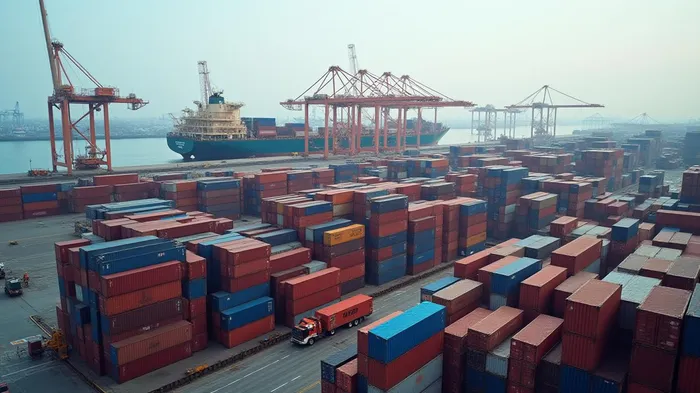
The Tariff Tsunami: 145% Rates and the Semiconductor Gambit
The U.S.-China trade war reached a new crescendo in late April, culminating in a staggering 145% tariff regime on Chinese goods by May 2025. Combining 125% “reciprocal” tariffs under IEEPA and a 20% “fentanyl penalty,” the move was designed to cripple Chinese imports. Yet the backlash was immediate: Beijing retaliated by hiking tariffs on U.S. goods to 125%, declaring them “no longer market-viable.”
The fallout? Booking cancellations surged, particularly from China, with Southeast Asian exports failing to compensate. Flexport’s data shows TPEB (Trans-Pacific Eastbound) capacity slashed to 60-70% in May, as carriers idled vessels and rerouted ships to Europe.
But there’s a twist: a temporary exemption for 20 critical goods, including semiconductors and solar cells, kept some sectors afloat—until now. Importers must now use a special HTS code (9903.01.32) to claim exemptions, and even that reprieve could vanish if a U.S. national security probe into semiconductors concludes further tariffs are needed.
The Capacity Crunch: When Ships Vanish and Costs Explode
The tariff war’s collateral damage extends beyond politics. Carriers, already reeling from demand volatility, are executing drastic measures:
- Blank sailings and downsized vessels: To combat weak U.S. demand, carriers are running 60-70% of usual capacity on key routes, per Flexport’s April 17 report. The result? Delays and rising rates.
- Rate hikes on steroids: On the Indian Subcontinent to U.S. East Coast route, freight costs are set to jump by $400–$500/40’ container in late April, with GRIs/PSS on May 1 and 11.
- Port chaos: Mediterranean hubs like Port of Piraeus and Northern European ports face congestion, with OTI (Ocean Timeliness Indicator) for China-to-U.S. West Coast shipments hitting 33 days—a record.
The numbers tell the story:
- Air freight rates rose +3% YoY despite a 7% drop in tonnage.
- Equipment shortages in Central Europe (Austria, Slovakia) are forcing shippers to pay premium haulage fees.
The Flexport Factor: Navigating the New Normal
Flexport’s clients aren’t just facing higher costs—they’re confronting structural shifts. The firm’s April 23 webinar on “Tariff Trends 2025” highlighted two critical strategies:
1. Pre-book early: With carriers holding 60% capacity, securing slots on key routes (e.g., Indian Subcontinent to North America) requires a 6-8 week lead time.
2. Diversify suppliers: Relying solely on China is risky; Southeast Asia’s stabilization hasn’t offset losses, but it’s a start.
Yet Flexport’s own data underscores the fragility of this approach. The China-to-U.S. East Coast OTI dropped to 58.5 days in early April, suggesting some carriers are speeding up services—but that’s a temporary fix.
Conclusion: The New Rules of Trade
The May 2025 crisis isn’t a blip—it’s a paradigm shift. Companies must now:
- Embrace agility: Tariff exemptions could vanish overnight, so supply chains need real-time flexibility.
- Invest in alternatives: Air freight’s +3% YoY rate resilience shows that even niche routes are under pressure.
- Accept higher costs: With GRIs and PSS locked in for May, the era of “just-in-time” shipping is over.
The numbers don’t lie: 145% tariffs, 33-day OTI delays, and $500-per-container hikes are the new reality. For Flexport and its clients, survival hinges on adaptability—and a willingness to bet on a world where trade wars are the norm, not the exception.

Stay ahead of the market.
Get curated U.S. market news, insights and key dates delivered to your inbox.




Comments
No comments yet