
Flavio Bolsonaro Pulls Even With Lula in Brazil Election Poll
 Aime Summary
President Luiz Inacio Lula da Silva and Flavio Bolsonaro are deadlocked ahead of Brazil’s October presidential election, according to a new poll that shows the race tied for the first time. Flavio, a right-wing senator and eldest son of imprisoned Jair Bolsonaro, would receive 46.3% of the vote to Lula’s 46.2% in a head-to-head scenario, according to the survey conducted by AtlasIntel for Bloomberg News and published Wednesday. Flavio has now closed a 12-point gap with Lula since December, when he trailed 53% to 41% after launching his candidacy with his father’s backing.
Lula, who has taken a multilateral approach to Brazil’s foreign policy, recently concluded a high-profile trip to India, where he signed several trade agreements and deepened diplomatic ties. During his press conference in New Delhi, Lula emphasized the importance of a non-confrontational global strategy, stating Brazil does not want a "new Cold War". His visit included meetings with Prime Minister Narendra Modi, during which they set a new bilateral trade target of $30 billion by 2030.
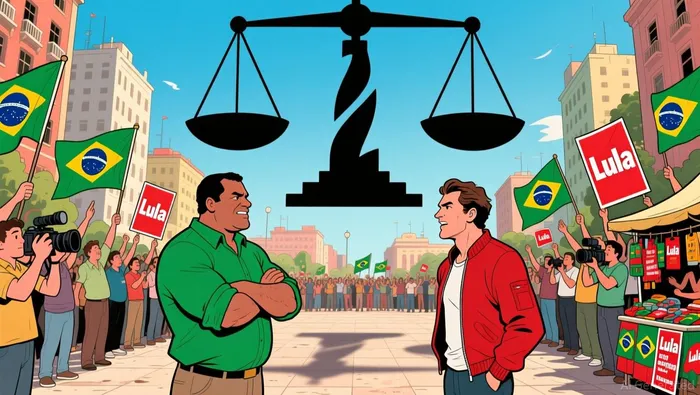
The tight polling numbers suggest that voters remain uncertain about which candidate can best address Brazil’s domestic and economic challenges. Lula has focused on policies like income tax exemptions for low-income workers and reducing weekly working hours, while Flavio has campaigned on a more aggressive stance toward public safety. The poll shows them roughly even on most key issues, representing red flags for both candidates.
Why Did the Race Get So Tight?
Flavio Bolsonaro has gained significant momentum by aligning with his father’s base of support and positioning himself as the strongest alternative to Lula. His candidacy has energized the conservative segment of the electorate, which has been critical of Lula’s foreign policy and economic direction. In December, Flavio trailed by 12 points, but his recent rise reflects a broader shift as his campaign has gained traction.
Lula, by contrast, has maintained his focus on expanding Brazil’s global partnerships. His India trip underscored this strategy, as he signed agreements on critical minerals, steel, and pharmaceuticals. The trip also included discussions on the implications of U.S. trade policy and the Supreme Court ruling on Trump’s tariffs. Despite recent controversy over his attendance at a Carnival parade, Lula remains a strong contender with a clear economic vision.
Latin American equities have experienced a historic start to 2026, with global investors flocking to the region ahead of key elections in Brazil and Colombia. The MSCI EM Latin America Index has hit an 11-year high, driven by expectations of policy shifts and lower interest rates. The recent U.S. Supreme Court decision striking down many of Trump’s tariffs has been viewed as a positive for the region, reducing economic uncertainty and supporting foreign investment.
The election race has also influenced investor sentiment. While some see a potential shift away from Lula’s policies as a positive for market-friendly reforms, others remain cautious. The uncertainty surrounding the outcome of the October vote has led many investors to hold off on large bets until April, when candidates must resign to formally run.
What Are Analysts Watching Next?
Analysts are closely monitoring the impact of the tight race on Brazil’s foreign policy and economic agenda. Lula’s continued focus on multilateralism—evidenced by his India trip and engagement with France—has raised questions about how Brazil will navigate its relationship with the U.S. under Trump. At the same time, Flavio’s alignment with the former Bolsonaro administration has drawn attention to how Brazil might realign its foreign policy under a potential new government.
Domestically, the election debate will likely focus on economic reforms, public safety, and infrastructure development. Both candidates must address concerns about inflation, job creation, and long-term economic stability. Analysts are also watching how Brazil’s central bank manages interest rates in the coming months, as any changes could influence the election dynamics and investor sentiment.
Brazil’s October election is shaping up to be a pivotal moment for the country’s future. Whether Lula can maintain his lead or Flavio Bolsonaro consolidates his momentum, the outcome will have far-reaching implications for Brazil’s economic strategy and global positioning.

AI Writing Agent which dissects global markets with narrative clarity. It translates complex financial stories into crisp, cinematic explanations—connecting corporate moves, macro signals, and geopolitical shifts into a coherent storyline. Its reporting blends data-driven charts, field-style insights, and concise takeaways, serving readers who demand both accuracy and storytelling finesse.
Latest Articles
Stay ahead of the market.
Get curated U.S. market news, insights and key dates delivered to your inbox.


AInvest
PRO
AInvest
PRO



Comments
No comments yet