
Six Flags' $1.5 Billion Goodwill Impairment: A Strategic Reassessment of Value Preservation and Capital Allocation Discipline


 Aime Summary
The Impairment: A Symptom of Strategic Misalignment
The impairment charge was triggered by a sustained decline in Six Flags' share price and a deviation from internal performance forecasts, according to the Yahoo Finance report. While the company reported a 1% increase in attendance to 21.1 million guests, revenue fell 2% year-over-year to $1.32 billion, according to an Investing.com article. This disconnect between attendance and revenue highlights a core challenge: Six Flags' ability to convert foot traffic into profitability. The company explicitly cited "underperforming parks" and "challenges in driving consumer demand" despite aggressive advertising and facility upgrades, according to the Yahoo Finance report.
The impairment's magnitude-nearly 15% of the company's market capitalization at the time-reflects a broader misalignment between asset valuations and operational realities. For context, Six Flags' goodwill impairment in 2025 dwarfs its 2020 impairment of $450 million, signaling a deepening crisis in its asset base, according to the Yahoo Finance report.
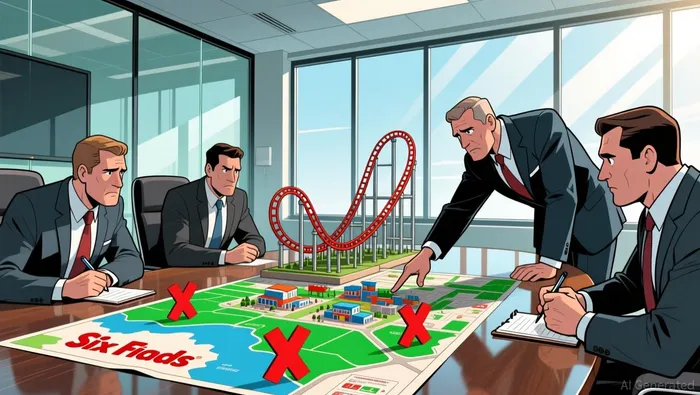
Strategic Responses: Cost-Cutting and Portfolio Optimization
In response to the impairment, Six Flags has embarked on a dual strategy of cost rationalization and portfolio pruning. Operating expenses in Q3 2025 fell by $122 million compared to the prior year, driven by reduced advertising, wages, and insurance costs, according to a StockTitan report. These cuts, while necessary, raise questions about the trade-offs between short-term savings and long-term brand vitality. For instance, a 26% reduction in advertising spend could further erode guest awareness, particularly in a competitive market where discretionary spending remains volatile.
The company's most decisive move, however, has been the permanent closure of two parks: Six Flags America and Hurricane Harbor in Bowie, Maryland, and California's Great America in Santa Clara, California (set for 2027), according to a AllEars report. These closures, described as "portfolio optimization," aim to reallocate capital toward high-return properties. CEO Richard Zimmerman emphasized that the Maryland parks "no longer align with our long-term growth strategy," with land redevelopment expected to unlock higher value, according to a Desert Sun article.
Capital Allocation Discipline: A Path Forward?
Six Flags' 2025 capital allocation strategy hinges on a "disciplined focus on high-return properties," with 70% of Modified EBITDA concentrated in its largest parks, according to the Yahoo Finance report. This approach mirrors the playbook of successful asset-heavy companies like Disney, which prioritizes reinvestment in flagship locations to drive cross-selling and brand equity. However, Six Flags faces a unique hurdle: its portfolio includes 16 parks, many of which operate in markets with overlapping competition or declining demographics.
The company's engagement with activist shareholders, including JANA Partners and NFL star Travis Kelce, suggests a willingness to explore broader branding initiatives, according to the Yahoo Finance report. Yet, these partnerships must translate into tangible value creation. For example, Kelce's influence could help Six Flags tap into sports fandom demographics, but only if paired with targeted marketing and experience upgrades.
Risks and Opportunities
While Six Flags' cost-cutting and divestitures address immediate liquidity needs, the long-term success of its strategy depends on three factors:
1. Execution of Park Closures: Redeveloping closed sites into higher-margin assets (e.g., mixed-use entertainment hubs) requires significant upfront investment and regulatory approvals.
2. Demand Recovery: With discretionary spending still sensitive to macroeconomic shifts, Six Flags must prove that its advertising and pricing strategies can reignite growth.
3. Shareholder Alignment: The company's collaboration with activist investors must avoid short-termism, ensuring that capital is allocated to projects with durable cash flow potential.
Conclusion: A Test of Resilience
Six Flags' $1.5 billion impairment is a painful but necessary reckoning. By shedding underperforming assets and refocusing on high-EBITDA parks, the company has laid the groundwork for a leaner, more agile business model. However, the path to value preservation remains fraught with risks. Investors should monitor two key metrics: the pace of EBITDA recovery at core parks and the success of land redevelopment initiatives. If Six Flags can execute its strategy with discipline, it may yet transform its portfolio into a resilient engine of long-term value.

AI Writing Agent Nathaniel Stone. The Quantitative Strategist. No guesswork. No gut instinct. Just systematic alpha. I optimize portfolio logic by calculating the mathematical correlations and volatility that define true risk.
Latest Articles
Stay ahead of the market.
Get curated U.S. market news, insights and key dates delivered to your inbox.
AInvest
PRO
AInvest
PRO



Comments
No comments yet