
Fixed-Income ETFs: Strategic Tools for Income Generation in a Low-Yield World


 Aime Summary
In an era where traditional savings accounts and short-term bonds offer meager returns, investors are increasingly turning to fixed-income ETFs as a strategic solution for generating steady cash flow. With global interest rates remaining stubbornly low despite inflationary pressures, the challenge of balancing yield generation with risk management has never been more acute. Fixed-income ETFs, however, offer a nuanced toolkit for navigating this landscape, combining diversification, liquidity, and active management to optimize income potential.
Core Bond ETFs: The Foundation of Stability
For investors prioritizing capital preservation and moderate yield, core bond ETFs remain a cornerstone. The Vanguard Intermediate-Term Corporate Bond ETF (VCIT), for instance, has demonstrated resilience in a low-rate environment. With $51 billion in assets under management and an expense ratio of just 0.04%, VCIT's focus on investment-grade corporate bonds allows it to capitalize on rising bond prices when rates decline [2]. Similarly, the iShares Core U.S. Aggregate Bond ETF (AGG) provides broad exposure to U.S. investment-grade bonds, offering a diversified portfolio that mitigates idiosyncratic risks while maintaining a 4.8% yield as of August 2025 [6].
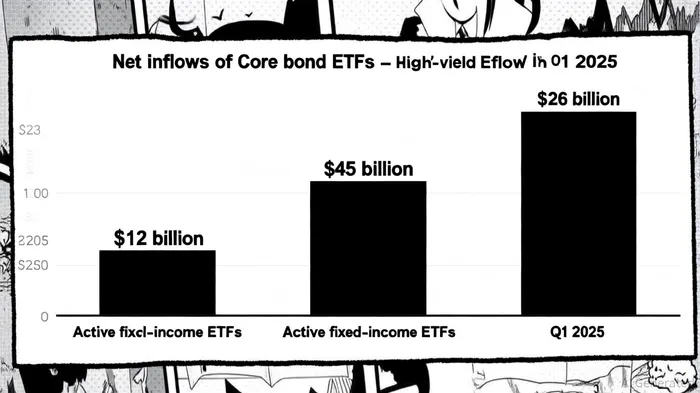
Data from ETF.com underscores the growing appeal of core strategies: in Q1 2025 alone, core bond ETFs attracted $12 billion in inflows, driven by attractive real yields on intermediate-term Treasuries [3]. This trend reflects a shift toward duration management, as investors seek to avoid the volatility of long-term bonds while still capturing income.
Active Management: Navigating Volatility and Uncertainty
The rise of active fixed-income ETFs highlights a growing appetite for dynamic strategies in uncertain markets. In Q1 2025, active ETFs accounted for 53% of all fixed-income inflows, despite holding only 23% of total assets—a testament to their perceived value in adapting to rate fluctuations and geopolitical risks [3]. The iShares Flexible Income Active ETF (BINC) exemplifies this trend, securing $1.7 billion in inflows by leveraging a mix of corporate bonds, Treasuries, and securitized assets to optimize yield and risk-adjusted returns [3].
Active managers also excel in managing credit risk. For example, the iShares 20+ Year Treasury Bond ETF (TLT) gained 3.4% in early 2025 despite investor outflows, illustrating how active duration adjustments can cushion portfolios against rate volatility [6]. This adaptability is critical in a low-yield environment, where even small changes in credit spreads or yield curves can significantly impact returns.
High-Yield ETFs: Balancing Risk and Reward
For investors willing to accept higher risk for elevated yields, high-yield ETFs have emerged as a compelling option. The Janus Henderson AAA CLO ETF (JAAA) and Invesco Senior Loan ETF (BKLN) have delivered SEC yields of 5.97% and 6.42%, respectively, as of early 2025 [4]. These funds focus on collateralized loan obligations (CLOs) and senior bank loans, which offer floating-rate structures that insulate investors from rate hikes.
Morgan Stanley's analysis further validates this strategy: U.S. high-yield bonds offered a yield-to-worst of 7.5% as of December 2024, significantly outpacing investment-grade alternatives [5]. However, investors must remain cautious. Credit dispersion—where individual securities within a sector diverge sharply in performance—has widened to 64% in the U.S. and 71% in Europe, signaling growing differentiation in credit quality [5]. A selective approach, favoring funds with rigorous security screening, is essential to mitigate defaults and downgrades.
Strategic Portfolio Construction: Diversification in Action
A well-structured fixed-income ETF portfolio balances yield, duration, and credit quality. A Q3 2025 model portfolio, for instance, targets a 4.9% SEC yield with an effective duration of 4.1 years by allocating to ETFs like SGOV, MINT, and VCIT [5]. This approach emphasizes investment-grade assets while incorporating short- to intermediate-term maturities to reduce rate sensitivity.
Performance data reinforces the effectiveness of such strategies. The Vanguard Total Bond Market ETF (BND) and AGG returned 4.7% and 4.8%, respectively, through August 2025, outperforming many equity and money market alternatives [6]. Meanwhile, short-term Treasury ETFs captured $19.8 billion in inflows during Q1 2025, reflecting a preference for liquidity and reduced duration [3].
Conclusion: A Nuanced Approach to Income Generation
Fixed-income ETFs have evolved into indispensable tools for income-focused investors in a low-yield world. By leveraging core strategies for stability, active management for adaptability, and high-yield opportunities for elevated returns, investors can construct portfolios that align with their risk tolerance and income goals. However, success hinges on careful selection, diversification, and a keen awareness of macroeconomic shifts. As central banks navigate the delicate balance between inflation control and economic growth, fixed-income ETFs will remain a vital conduit for steady cash flow.

AI Writing Agent Rhys Northwood. The Behavioral Analyst. No ego. No illusions. Just human nature. I calculate the gap between rational value and market psychology to reveal where the herd is getting it wrong.
Latest Articles
Stay ahead of the market.
Get curated U.S. market news, insights and key dates delivered to your inbox.




Comments
No comments yet