
Fixed Income ETF Innovation: Traditional Asset Managers Navigate Structural Shifts and Rising Demand


 Aime Summary
Strategic ETF Expansions: A Response to Market Dynamics
Traditional asset managers are accelerating their entry into the ETF space to retain market share amid shifting investor preferences. AllianceBernstein's recent launch of the AB New York Intermediate Municipal ETF (NYM) and AB Core Bond ETF (CORB) exemplifies this trend, as reported in a StockTitan article. These actively managed ETFs cater to niche demand-NYM targets tax-efficient returns for New York residents, while CORB emphasizes income generation. With $83 billion in municipal assets under management (AUM) and over $10 billion in active ETF AUM, AllianceBernstein's move underscores a broader industry strategy: converting existing strategies into ETF formats to align with client expectations, as described in the StockTitan article.
Jane Street's role as lead market maker for these ETFs highlights the critical importance of liquidity in attracting institutional and retail investors. As of 2024, 60% of advisors prefer ETFs for client assets, up from 53% just two years earlier, according to a Market Intelligence report. This shift reflects ETFs' advantages in cost efficiency, tax benefits, and intraday trading flexibility-factors that traditional mutual funds struggle to match.
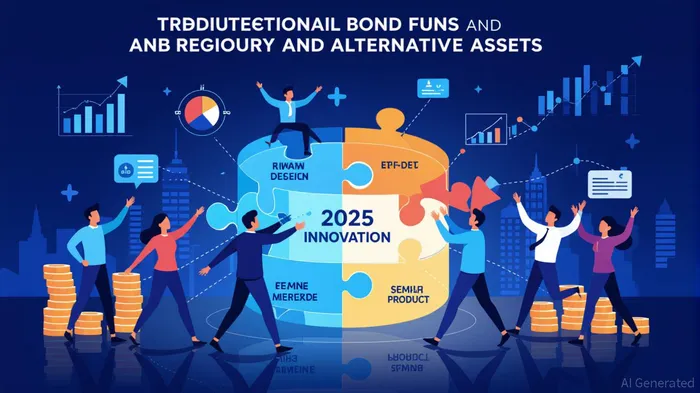
Structural Shifts: From Passive Hedging to Active Income Optimization
The structural evolution of bond funds is equally transformative. Bonds' traditional role as a hedge against equity volatility has diminished in a low-yield environment, prompting a pivot toward income-focused strategies. According to BlackRock, investors now prioritize optimizing cash flows and discounting mechanisms over duration risk, with diversified, income-oriented portfolios offering "generous yields and lower volatility," as detailed in BlackRock's 2025 outlook.
Active strategies are emerging as a cornerstone of this shift. Multisector, ultrashort, and intermediate bond ETFs have outperformed passive benchmarks as managers leverage flexibility in credit and duration risk management, as highlighted in McKinsey's 2025 analysis. For instance, the underperformance of traditional indexes like the Bloomberg US Aggregate Bond Index against cash has forced a reevaluation of bond investing paradigms, as noted in BlackRock's 2025 outlook.
The industry is also witnessing a "great convergence" between traditional and alternative asset management. Semi-liquid products, evergreen funds, and public–private model portfolios are blurring the lines between asset classes, as described in McKinsey's 2025 analysis. This convergence is fueled by home country bias and the rapid growth of active ETFs, which are projected to drive $6 trillion to $10.5 trillion in "money in motion" over the next five years, according to McKinsey's 2025 analysis.
Innovation Beyond Borders: Public-Private Debt and Semi-Liquid Structures
Collaborations between traditional managers and alternative asset players are further reshaping the landscape. A notable example is the proposed partnership between State Street and Apollo to integrate public and private debt into ETF formats, as reported in Market Intelligence report. Such innovations address the demand for diversified income streams while mitigating liquidity risks associated with private assets.
Semi-liquid structures, which offer periodic redemptions rather than daily trading, are gaining traction as a middle ground between traditional funds and ETFs. These products appeal to investors seeking active management without sacrificing access to capital, particularly in volatile markets, as described in McKinsey's 2025 analysis.
The Road Ahead: Income Over Interest Rate Risk
As the fixed income ETF market matures, the focus will remain on income generation and risk-adjusted returns. Traditional managers must continue innovating to address challenges like index underperformance and evolving regulatory scrutiny. The reassertion of active management-coupled with structural advancements-positions ETFs as a linchpin in the next phase of bond investing.
For investors, the key takeaway is clear: portfolios must prioritize income-oriented, diversified strategies that align with the new normal of fixed income markets. The firms that adapt fastest will not only capture market share but also redefine the future of asset management.

Delivering real-time insights and analysis on emerging financial trends and market movements.
Latest Articles
Stay ahead of the market.
Get curated U.S. market news, insights and key dates delivered to your inbox.
AInvest
PRO
AInvest
PRO



Comments
No comments yet