
Fiserv Leads Market in Turnover as Investors Brace for Critical Earnings
 Aime Summary
Market Snapshot
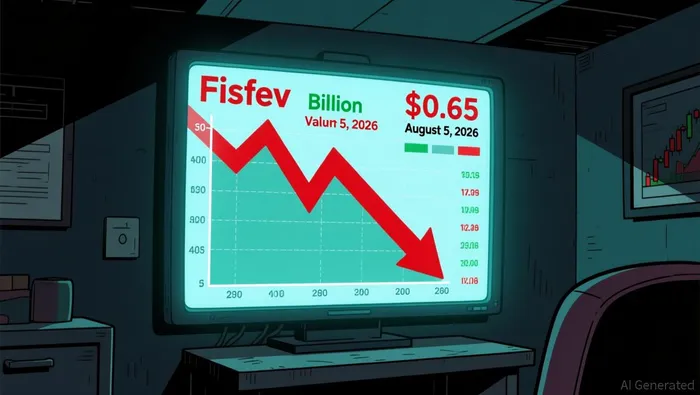
Fiserv Inc. (FISV) experienced a notable decline in trading activity on Thursday, August 5, 2026, as the financial technology provider prepared for a critical earnings release scheduled for the following day. Shares of the Madison, Wisconsin-based company closed down 2.99%, reflecting a cautious sentiment among investors who are weighing the company’s near-term guidance against its long-term strategic initiatives. The stock’s performance was accompanied by significant trading volume, with total turnover reaching $0.65 billion. This substantial liquidity position ranked FiservFISV-- as the most actively traded stock in the broader market for the day, underscoring the heightened attention and uncertainty surrounding its upcoming second-quarter 2026 financial results. The sharp drop in share price, which has contributed to a year-to-date decline of nearly 15%, highlights the market’s sensitivity to the company’s ability to meet its full-year projections amidst a challenging macroeconomic environment for financial services.
Key Drivers
The primary catalyst for the current market volatility is the anticipation of Fiserv’s Q2 2026 earnings report, which is set to be released before the market opens on Friday, August 6. Wall Street analysts have compiled consensus estimates projecting earnings per share (EPS) of $1.92 and revenue of approximately $5.04 billion, representing a year-over-year revenue decline of roughly 8.7%. The market’s apprehension is further exacerbated by a recent trend of negative analyst revisions; over the past three months, EPS estimates have remained stagnant with no upward adjustments, while revenue estimates have seen 19 downward revisions compared to only one upward revision. This pessimistic outlook is rooted in the expectation of a 23.5% year-over-year drop in EPS, driven by higher operating expenses associated with core infrastructure investments and workforce expansion.
Investor sentiment has shifted from bullish to neutral, as retail traders on platforms like Stocktwits actively debate the feasibility of Fiserv’s full-year 2026 guidance. The company has maintained its target for adjusted organic revenue growth between 1% and 3%, with an adjusted EPS range of $8.00 to $8.30. However, skepticism is mounting, with some market participants arguing that the company would need a "total blowout" in Q2 to achieve these targets given the current trajectory. The fear of a potential guidance cut has led to comparisons with other financial firms, such as Mastercard, which saw significant stock pressure after lowering guidance. Consequently, many investors are bracing for a potential downside scenario, with some speculating that shares could face further pressure if the company fails to provide clear signs of margin improvement or revenue stabilization.
Despite the near-term headwinds, Fiserv has taken steps to strengthen its product portfolio and competitive positioning through strategic partnerships. The company recently announced an exclusive partnership with Mastercard to integrate Mastercard Merchant Cloud into its Commerce Hub platform. This collaboration aims to simplify and expand value-added services for enterprise merchants globally, allowing Fiserv to offer a more integrated suite of payments, security, and data-driven tools. This move is viewed as a long-term growth driver, particularly as the company seeks to deepen its relationships with large retailers who might otherwise split their volumes among competitors like Adyen, Stripe, or Block. The integration positions Fiserv to leverage Mastercard’s global reach while enhancing its own merchant acquiring capabilities.
On the operational front, Fiserv continues to secure significant contracts that demonstrate demand for its core processing technologies. In a recent development, UW Credit Union selected Fiserv’s DNA platform as its future core processing system. This decision not only validates the technology’s modern, API-enabled architecture but also includes a multi-year renewal of Fiserv’s card and payment solutions. Such wins are critical for the company’s Financial Solutions segment, even though this segment is currently facing headwinds. Analysts project a 6.3% year-over-year decline in Financial Solutions revenue due to non-recurring project fees, but the successful acquisition of new clients like UW Credit Union suggests underlying strength in the bank’s ability to retain and expand its customer base.
The market is also closely monitoring Fiserv’s margin trajectory and cost management efforts. While the company reported strong Q1 2026 results, beating EPS and revenue estimates, the stock dropped over 10% post-earnings due to concerns about declining organic revenue and operating margins. For Q2, operating income for the Merchant Solutions segment is expected to fall 13.4% year-over-year, while Financial Solutions operating income is projected to slide 22% due to increased spending on infrastructure projects like Finxact and Vision Next. However, the company’s CFO has reaffirmed the target of achieving a 34% adjusted operating margin by year-end, signaling confidence in the long-term profitability of these investments.
Ultimately, the stock’s performance reflects a tug-of-war between short-term earnings pressure and long-term strategic value. Activist investor Jana Capital has urged Fiserv to review its entire portfolio, adding another layer of complexity to the current valuation debate. While the balance sheet has been criticized as "ugly" in some analyses, the attractive valuation and the company’s history of beating EPS estimates (88% of the time over the last two years) provide a counter-narrative. As the earnings report approaches, all eyes will be on management’s commentary regarding the sustainability of current growth drivers and the clarity of the path toward margin recovery.

Stay ahead of the market.
Get curated U.S. market news, insights and key dates delivered to your inbox.


AInvest
PRO
AInvest
PRO




Comments
No comments yet