
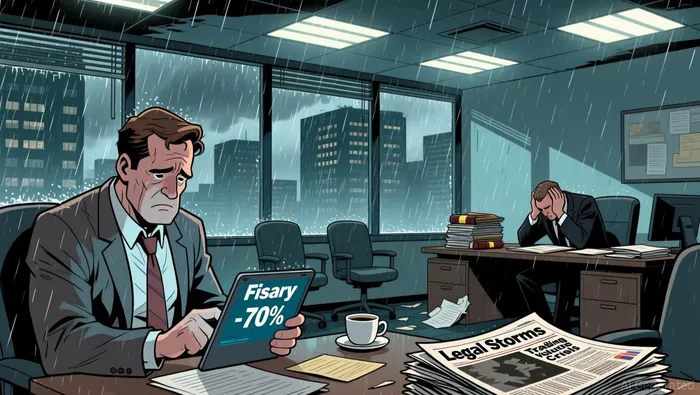
Fiserv’s 70% Plunge Makes It 2025’s S&P 500 Worst Performer Amid Legal Storms and 241st-Ranked Trading Volume
 Aime Summary
Market Snapshot
Fiserv (FISV) closed at a 1.33% decline on December 3, 2025, with a trading volume of $0.49 billion, marking a 50.42% drop from the previous day’s volume and ranking 241st in market activity. The stock remains over 70% below its 52-week high of $238.59, solidifying its status as the worst-performing S&P 500 stock in 2025. Despite a 5–6% intraday rally driven by insider purchases, the broader sell-off reflects ongoing pressure from legal challenges, earnings misses, and revised growth expectations.
Key Drivers
Insider Buying and Management Confidence
Fiserv’s stock rebounded on December 3 amid significant insider purchases by top executives, signaling internal confidence in a potential turnaround. Chief Financial Officer Paul Todd acquired $1.06 million worth of shares, while Chief Legal Officer Adam Rosman bought $500,000, with combined purchases totaling $1.5 million. These transactions occurred at prices between $62.41 and $63.19, representing a 228% and 14.8% increase in their respective holdings. Insider buying, particularly after a 70% drawdown, is often interpreted as a bullish signal, suggesting management believes the stock is undervalued. However, such confidence must be weighed against the company’s recent history of earnings underperformance and governance challenges.
Legal Challenges and Regulatory Risks
A new securities class-action lawsuit filed on December 3 added to the legal overhang, alleging misrepresentations by FiservFISV-- and senior officers during the July 23–October 29, 2025 period. This follows earlier lawsuits tied to the Q3 earnings “reset,” which slashed guidance and triggered a historic 40%+ one-day stock crash in October. Legal actions not only create uncertainty but also divert management attention and potentially inflate risk premiums demanded by investors. The cumulative litigation—now spanning multiple law firms and overlapping class periods—heightens the risk of prolonged reputational and financial damage, even if the lawsuits ultimately result in settlements rather than criminal penalties.
Q3 Earnings Reset and Strategic Overhaul
Fiserv’s October 29 Q3 earnings report and subsequent guidance cut were pivotal in triggering the stock’s collapse. The company reported a 1% year-over-year revenue decline to $5.26 billion, with adjusted EPS of $2.04, well below expectations. Organic revenue growth was slashed to 3.5–4%, and 2025 adjusted EPS guidance was reduced to $8.50–$8.60, down from $10.15–$10.30. This prompted a leadership overhaul, including the appointment of new co-presidents, a new CFO, and board changes. The “One Fiserv” restructuring plan aims to refocus on client service, streamline operations via AI, and double down on Clover’s small-business platform. However, the market remains skeptical, with analysts lowering price targets and reducing growth assumptions.
Mixed Macroeconomic Signals from Small Business Index
Fiserv’s November Small Business Index, released on December 3, highlighted divergent trends in consumer spending. While Black Friday drove a 3.1% rise in core retail sales and 2.9% increase in restaurant sales, overall November retail spending fell 1.1% year-over-year, driven by declining average ticket sizes. The index level of 142, down one point from October, underscores cautious consumer behavior. For Fiserv, this data is critical as its Merchant Solutions and Clover segments—already under scrutiny for pricing missteps—rely on small business transaction volumes. The mixed signals suggest that while short-term holiday demand is robust, broader economic weakness could constrain long-term growth in its core markets.
Analyst Sentiment and Valuation Discrepancies
Analyst ratings and price targets remain split, reflecting uncertainty about Fiserv’s recovery potential. A consensus “Hold” rating persists, with 12-month targets ranging from $50 to $250, averaging $123.25. However, recent downgrades from firms like Susquehanna (from $220 to $99) and UBS highlight concerns about margin compression and structural growth challenges. Fiserv’s current valuation—trading at roughly 8–10x forward earnings, well below its historical 25–38x range—reflects deep pessimism. Yet, institutional investors and hedge funds remain divided, with some viewing the stock as a “distressed value” opportunity if the company can stabilize margins and deliver on its restructuring plans.
Leadership Changes and Market Perception
The October 29 leadership shakeup—appointing Paul Todd as CFO, Takis Georgakopoulos and Dhivya Suryadevara as co-presidents, and adding new board members—was framed as a reset to rebuild credibility. However, the market’s muted reaction suggests skepticism about whether these changes can reverse the damage from Q3. Fiserv’s return to Nasdaq and ticker change from “FI” to “FISV” also aimed to simplify trading but had no material impact on fundamentals. Institutional investors remain cautious, with credit rating agencies like S&P Global adopting a negative outlook due to leverage concerns, while Moody’s maintained an investment-grade rating with a stable outlook. The disconnect between strategic overhauls and market confidence underscores the high stakes of Fiserv’s 2026 execution.

Stay ahead of the market.
Get curated U.S. market news, insights and key dates delivered to your inbox.
AInvest
PRO
AInvest
PRO



Comments
No comments yet