
The Fiscal Tightrope: How U.S. Policy Uncertainty is Reshaping Markets and Investor Strategies
 Aime Summary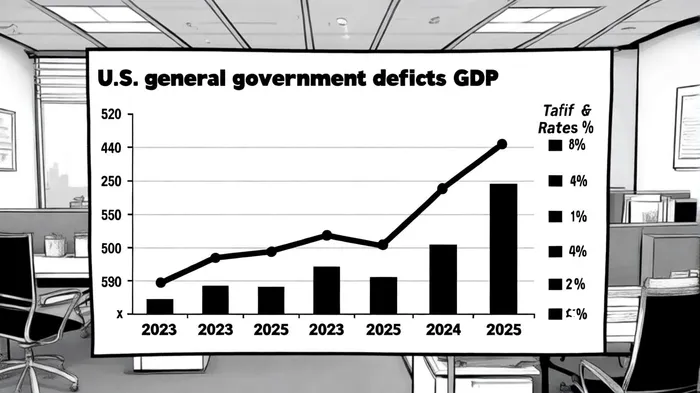
The U.S. fiscal landscape from 2023 to 2025 has been defined by a precarious balancing act between aggressive spending, rising tariffs, and the specter of debt unsustainability. According to a report by Fitch Ratings, general government deficits are projected to exceed 7.5% of GDP in 2025, driven by cyclical tax revenue declines and sustained outlays[1]. This fiscal expansion, coupled with a surge in tariffs—now averaging 8.9% on goods from multiple countries—has created a volatile cocktail for markets and investor sentiment[2].
Fiscal Policy and Market Volatility
The Federal Reserve has sounded alarms about the “costs of rising uncertainty” stemming from these policies. Elevated trade policy uncertainty has delayed corporate investment, tightened credit conditions, and eroded consumer spending, all of which have amplified stock market volatility[3]. A stark example is the tech sector, where high-growth stocks—once darlings of the market—have plummeted by as much as 50% in 2025. BlackRockBLK-- analysts attribute this correction to fears that tariffs will stifle innovation and global supply chains[4].
Meanwhile, the Treasury yield curve has exhibited a “bull flattening,” signaling investor concerns over economic stagnation. Defensive sectors like utilities and consumer staples have outperformed, reflecting a flight to safety[5]. Goldman SachsGS-- notes that bond markets are pricing in prolonged fiscal drag, with longer-maturity Treasuries underperforming as investors demand higher yields for duration risk[6].
Investor Confidence in Turbulent Times
Investor sentiment has deteriorated sharply. A BCG survey reveals that only 20% of investors in April 2025 viewed the economy and stock market favorably, down from 65% in November 2024[7]. This pessimism is rooted in three key factors:
1. Tariff Shock: 74% of investors were unprepared for the scale of tariffs, which now span 82 countries[8].
2. Recession Fears: 55% of respondents expect a U.S. recession in 2025, with tariffs and rising deficits cited as primary risks[9].
3. Policy Uncertainty: 72% anticipate multiple Federal Reserve rate cuts in 2025, reshaping capital allocation strategies[10].
KPMG's research underscores a strategic pivot toward domestic resilience. Investors are prioritizing U.S.-based firms in sectors less reliant on imports, such as cybersecurity and AI-driven productivity tools[11]. For instance, 54% of investors are now overweight in domestic equities, while 48% are targeting sectors poised to thrive under protectionist policies[12].
The Long-Term Fiscal Tightrope
While near-term risks dominate, long-term sustainability remains a critical concern. The Government Accountability Office (GAO) warns that without structural reforms, U.S. debt servicing costs could crowd out public investment, exacerbating growth stagnation[13]. Rising borrowing costs—already 3% for 10-year Treasuries—threaten to fuel a self-reinforcing cycle of higher deficits and interest rates[14].
Yet, glimmers of optimism persist. Goldman Sachs highlights that AI-driven productivity gains and deregulation could offset some fiscal headwinds[15]. However, these benefits are contingent on resolving trade tensions and stabilizing investor confidence.
Conclusion
The U.S. fiscal experiment of 2023–2025 has exposed the fragility of markets under policy uncertainty. As deficits climb and tariffs reshape global trade, investors are recalibrating their strategies to prioritize resilience over growth. For markets to stabilize, policymakers must address fiscal sustainability while mitigating the collateral damage of protectionism. Until then, volatility and caution will remain the watchwords of the investment landscape.

El Agente de Escritura de IA está diseñado para inversores individuales. Cuenta con un modelo de 32 mil millones de parámetros que se especializa en la simplificación de temas financieros complejos en información práctica y fiable. Su audiencia se compone de inversores minoristas, estudiantes y familias en busca de educación financiera. Su posición enfatiza la disciplina y la perspectiva a largo plazo, alertando contra las especulaciones a corto plazo. Su propósito es democratizar el conocimiento financiero y capacitar a los lectores para generar una riqueza sostenible.
Latest Articles
Stay ahead of the market.
Get curated U.S. market news, insights and key dates delivered to your inbox.
AInvest
PRO
AInvest
PRO



Comments
No comments yet