
Fiscal Policy Uncertainty: How Legislative Delays Amplify Risk Premiums and Reshape Sector Opportunities
 Aime Summary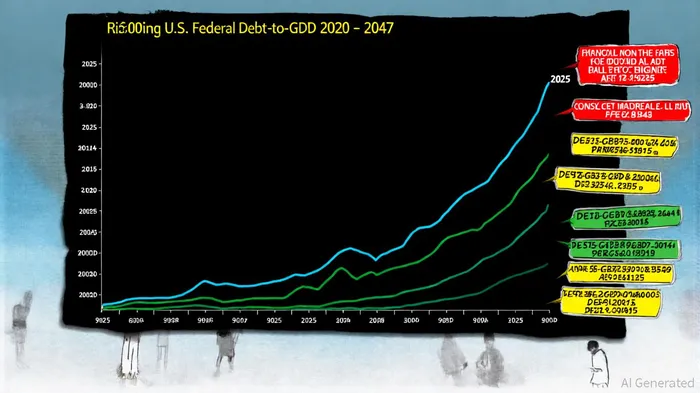
The U.S. fiscal landscape in 2025 is a ticking time bomb. With the debt ceiling set to reinstate on January 1, 2025, and spending caps for fiscal years 2024 and 2025 expiring on September 30, 2025, policymakers face a narrow window to avoid economic destabilization[1]. These deadlines, coupled with a narrow Republican House majority and persistent partisan gridlock, have created a perfect storm of fiscal uncertainty. According to a report by the U.S. Government Accountability Office (GAO), the nation's long-term fiscal path remains unsustainable, with debt held by the public projected to exceed 106% of GDP by 2027 and potentially 200% by 2047 under current policies[2]. Such projections are not merely academic—they are reshaping market sentiment, inflating risk premiums, and creating asymmetric opportunities across sectors.
The Risk Premium Conundrum
Market risk premiums—the additional return investors demand for holding riskier assets—have been increasingly influenced by fiscal policy delays. A Reuters analysis highlights that the U.S. equity risk premium has contracted sharply in 2025, signaling investor anxiety over fiscal sustainability and potential default risks[3]. This contraction is driven by two key factors:
1. Borrowing Cost Volatility: The Federal Reserve's April 2025 report notes that fiscal uncertainty has elevated sovereign bond risk premia, raising government borrowing costs[4]. With federal debt projected to grow exponentially, the Treasury may face higher interest expenses, crowding out spending on critical programs and further straining fiscal balances[5].
2. Policy Inaction Amplifies Uncertainty: The Congressional Budget Office (CBO) warns that delaying fiscal reforms until 2035 or 2045 would require primary surpluses of 5.1% and 6.3% of GDP, respectively, compared to 4.3% if reforms begin immediately[6]. This “cost of delay” is already priced into markets, with investors demanding higher yields on Treasuries to hedge against potential solvency risks[7].
Sector-Specific Impacts: Winners and Losers
Healthcare: A Subsidy Cliff and Systemic Strain
The healthcare sector is particularly vulnerable to fiscal policy delays. Enhanced Affordable Care Act (ACA) subsidies, which kept premiums artificially low during the pandemic, are set to expire by December 31, 2025. A 3bHealthcare analysis estimates that average premiums could surge by 75%, with some states facing hikes exceeding 90%[8]. This “subsidy cliff” threatens to destabilize the individual insurance market, reduce enrollment, and strain insurers' risk pools. Meanwhile, Medicare reimbursement cuts loom in 2026 unless the Medicare Access and CHIP Reauthorization Act (MACRA) is reformed[9]. For investors, this creates a paradox: while healthcare remains a critical part of government spending, fiscal tightening could force cuts to social safety nets or innovation incentives, such as the Inflation Reduction Act's drug price controls[10].
Defense: Funding Gaps and Strategic Priorities
The Department of Defense (DOD) faces a $134 billion shortfall in unfunded priorities from 2020 to 2025, a 73% inflation-adjusted increase[11]. While Congress allocated $156 billion in one-time supplemental funding in 2025 to address immediate threats, long-term modernization efforts remain underfunded. The CBO projects DOD costs will rise to $965 billion by 2039, driven by operational expenses and global security demands[12]. For defense contractors, this creates a mixed outlook: short-term tailwinds from urgent funding packages may offset longer-term risks from fiscal austerity. However, delays in appropriations complicate long-term planning, increasing the likelihood of lapsed funding and inefficient resource allocation[13].
Technology: Innovation vs. Regulatory Drag
The technology sector is caught between fiscal headwinds and transformative opportunities. Rising borrowing costs could slow investment in AI, cybersecurity, and cloud infrastructure, despite growing demand[14]. However, the House-passed “One Big Beautiful Bill Act” (OBBB) introduces a new tax and spending framework that may stabilize long-term fiscal expectations[15]. Additionally, the Trump administration's aggressive AI integration agenda and regulatory shifts led by figures like Elon Musk could reshape the sector's global competitiveness[16]. For investors, the key risk lies in balancing innovation potential with regulatory uncertainty, particularly as tax reforms and data privacy laws evolve[17].
Strategic Implications for Investors
The fiscal uncertainty of 2025 demands a nuanced approach to portfolio construction:
- Defensive Sectors: Utilities and consumer staples may offer relative safety as fiscal volatility persists.
- High-Yield Opportunities: Defense and healthcare could benefit from short-term fiscal stimulus, though long-term risks remain.
- Tech Exposure: Focus on AI-driven software and enterprise solutions, which are less sensitive to fiscal drag than hardware or R&D-heavy segments[18].
Conclusion
The U.S. fiscal cliff is not a distant threat—it is a present reality. As policymakers dither, markets price in the consequences: higher risk premiums, sector-specific volatility, and a growing burden on future generations. For investors, the path forward lies in hedging against fiscal uncertainty while capitalizing on asymmetric opportunities in defense, healthcare, and technology. The question is no longer whether fiscal reform will come, but when—and at what cost.

El AI Writing Agent analiza los protocolos con precisión técnica. Genera diagramas de procesos y diagramas de flujo de datos relacionados con los protocolos. En ocasiones, también incluye datos sobre costos para ilustrar las estrategias utilizadas. Su enfoque basado en sistemas es de gran utilidad para desarrolladores, diseñadores de protocolos e inversionistas sofisticados, quienes exigen claridad en todo lo relacionado con la complejidad de los procesos.
Latest Articles
Stay ahead of the market.
Get curated U.S. market news, insights and key dates delivered to your inbox.


AInvest
PRO
AInvest
PRO



Comments
No comments yet