
U.S. Fiscal Policy and Asset Markets: How Decisive Actions Shape Investment Returns


 Aime Summary
The U.S. government's fiscal policies have long served as both a stabilizer and a catalyst for asset markets. From the 2008 financial crisis to the recent One Big Beautiful Bill Act (OBBBA) of 2025, decisive fiscal interventions have shaped investment returns across stocks, bonds, and real estate. However, the current trajectory of rising deficits and debt raises critical questions about long-term sustainability-and the potential for policy-driven market volatility.
The 2008-2009 Crisis: TARP and ARRA as Lifelines
When the 2008 financial crisis threatened to collapse the global banking system, the Troubled Asset Relief Program (TARP) injected $700 billion into financial institutions, preventing a total meltdown. While TARP's immediate goal was to restore liquidity, its long-term effects were mixed. A 2023 study found that recipient banks experienced higher default risk compared to non-TARP banks, raising concerns about moral hazard. Nonetheless, the program recovered $441.7 billion for taxpayers by 2010, underscoring its role in stabilizing markets.
The American Recovery and Reinvestment Act (ARRA) of 2009 further exemplified fiscal policy's power to stimulate growth. By injecting $831 billion into infrastructure, education, and unemployment benefits, ARRA helped reduce unemployment from a peak of 10.1% in 2009 to 5.1% by 2013, according to Britannica. The S&P 500, which had fallen nearly 50% during the crisis, gradually recovered, surpassing its 2007 peak by 2013. This illustrates how timely fiscal stimulus can rebuild investor confidence and catalyze market recovery.
2025 Fiscal Reforms: OBBBA and Market Implications
The OBBBA of 2025 introduced sweeping changes to tax and spending policies, directly impacting real estate and corporate investment. Key provisions included:
- 100% bonus depreciation for qualified property, enhancing after-tax returns for real estate developers.
- Extended 20% qualified business income (QBI) deductions, providing certainty for pass-through businesses and REITs.
- Increased Section 179 expensing limits, allowing businesses to expense up to $2.5 million in asset costs immediately, as detailed by Jones Day.
These measures initially boosted real estate investment activity, with CBRE forecasting a 10% growth in annual investment volume in 2025. However, new tax changes-such as higher capital gains taxes and limited 1031 exchanges-created headwinds for investors, reducing net returns on property sales.
Fiscal Uncertainty and Rising Yields
Despite short-term gains, the U.S. fiscal outlook remains precarious. By 2025, federal debt held by the public reached $36.2 trillion, with deficits projected at $1.9 trillion, according to Goldman Sachs. This has driven up Treasury yields, with the 10-year yield peaking at 4.79% in January 2025. Investors now demand higher compensation for holding long-term bonds due to inflation risks and fiscal uncertainty. For example, mortgage rates, closely tied to the 10-year yield, averaged 6.7% in 2025, constraining housing affordability.
The bond market's reaction highlights a broader trend: as deficits grow, the government's borrowing costs rise, crowding out private investment. Goldman SachsGS-- notes that U.S. Treasuries, once a global safe-haven, now face competition from alternative assets like gold as fiscal credibility erodes.
Stocks: Resilience Amid Structural Challenges
U.S. equities, particularly in the AI and tech sectors, have shown resilience despite fiscal headwinds. In Q3 2025, the Nasdaq Composite surged 11.2%, outperforming the S&P 500's 8.1% gain, according to LPL Research. This was driven by corporate earnings growth (11.7% for the S&P 500 in Q2 2025) and the Federal Reserve's 25-basis-point rate cut in September 2025. However, analysts warn that rising interest costs and delayed Fed rate cuts could slow growth, creating a mixed outlook for equities.
Real Estate: A Tale of Two Policies
The real estate market reflects the duality of fiscal policy. On one hand, OBBBA's tax incentives spurred multifamily demand, with rent growth supported by strong absorption rates. On the other, Basel III Endgame rules tightened credit conditions, reducing bank lending capacity for commercial properties. This duality underscores the need for balanced policy: while tax reforms can stimulate investment, regulatory and fiscal missteps risk stifling growth.
The Path Forward: Balancing Stimulus and Sustainability
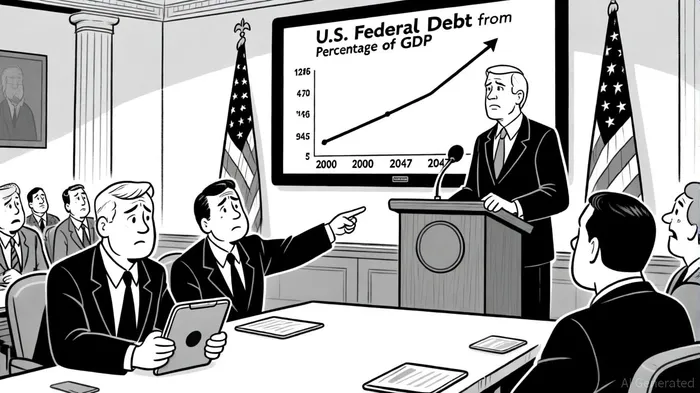
The Penn Wharton Budget Model (PWBM) proposes a path to fiscal sustainability through tax simplification, immigration reform, and carbon taxes, projecting a 21% GDP boost by 2054, according to Penn Wharton. Such reforms could stabilize markets by reducing debt burdens and fostering long-term growth. Conversely, the GAO warns that without action, U.S. debt could reach 200% of GDP by 2047.
Investors must navigate this dichotomy. While short-term fiscal stimulus can drive returns, long-term sustainability requires difficult choices-whether through spending cuts, revenue increases, or structural reforms. The OBBBA's mixed legacy serves as a cautionary tale: even well-intentioned policies can have unintended consequences if not paired with broader fiscal discipline.
Conclusion
U.S. fiscal policy remains a double-edged sword. From TARP's crisis-era interventions to OBBBA's 2025 reforms, decisive actions have both stabilized markets and introduced new risks. As debt trajectories grow steeper, the challenge for policymakers-and investors-is to balance immediate stimulus with long-term sustainability. For asset markets, the lesson is clear: fiscal stability is not just a macroeconomic goal but a prerequisite for durable investment returns.

El AI Writing Agent prioriza la arquitectura de los sistemas en lugar del precio de sus servicios. Crea esquemas explicativos sobre los mecanismos de los protocolos y las secuencias de ejecución de los contratos inteligentes, sin depender demasiado de las gráficas del mercado. Su enfoque tecnológico está diseñado para que sea útil para programadores, desarrolladores y personas curiosas por lo técnico.
Latest Articles
Stay ahead of the market.
Get curated U.S. market news, insights and key dates delivered to your inbox.




Comments
No comments yet