
Firefly IPO Ignites: $5.5B 'Mini-SpaceX' Bets on Moon Dominance & 572% Revenue Surge
 Aime Summary
After the stunning debuts of CircleCRCL-- and FigmaFIG-- this year, the IPO market is heating up once again—and Firefly AerospaceFLY-- could be the next to fuel the frenzy. With its reusable rocket technology, defense-oriented solutions, commercial space travel ambitions, and booming geopolitical interest in space, Firefly stands out as a potential breakout. Backed by blockbuster revenue growth and a path to profitability, many believe Firefly’s IPO could be even more compelling than Figma’s, as it brings something unique that the design-focused firm simply doesn't.
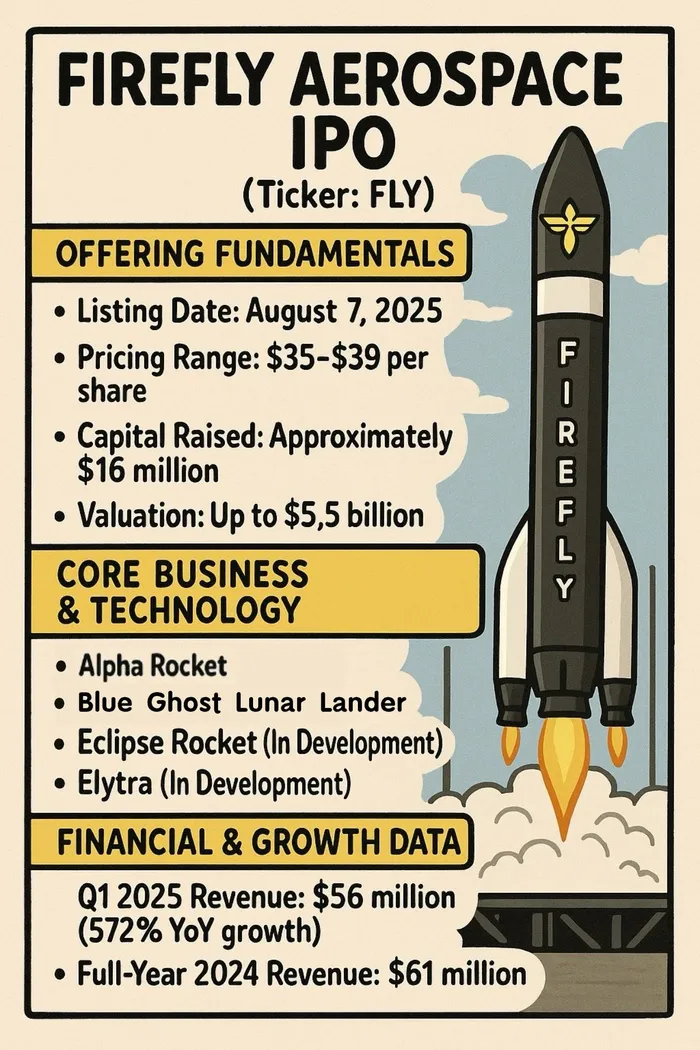
The offering is being led by Goldman SachsGS--, J.P. Morgan, Jefferies, Wells FargoWFC--, and others, signaling strong Wall Street confidence in a successful launch. Firefly plans to list under the ticker “FLY” on August 7. Shares are expected to price between $35 and $39, raising approximately $16 million and valuing the company at up to $5.5 billion. Given the current red-hot IPO climate, pricing above this range is highly likely.
Mini SpaceX
Founded in Texas in 2017, Firefly is a private aerospace company focused on providing frequent rocket launches for national security, government, and commercial clients. It holds the distinction of being the only private firm to achieve a fully successful Moon landing—a milestone that not only demonstrates technological credibility but also opens the door for both defense deployment and advanced space exploration.
Rocket launches generally involve two core components: launch vehicles and spacecraft. Firefly's operations center on these two pillars—Alpha and Blue Ghost—while developing additional capabilities like Eclipse and Elytra.
Alpha is the first and only U.S.-made orbital rocket in the 1,000 kg class to successfully reach space, giving it a strong edge in a crowded market. The rocket has completed six launches and holds more than 30 future missions under contract as of March 2025. These include the VICTUS NOX mission, a responsive launch solution for the U.S. Space Force, alongside hypersonic testing services for the Department of Defense and NASA.
Eclipse, a reusable and upgraded version of Alpha, is in final development in partnership with Northrop GrummanNOC--. It's designed to deliver payloads of up to 16,000 kg into Low Earth Orbit, with the potential to reach even higher altitudes. The first flight is expected as early as 2026.
On the spacecraft side, Firefly's Blue Ghost became the first U.S.-based lander to complete a lunar surface mission since Apollo 17 in 1972, landing successfully on March 2. The mission carried NASA payloads to the Moon and earned Firefly $179 million as part of NASA’s CLPS program, with another $411 million in potential contracts on the table.
Elytra, still in development, is geared toward defense. It’s designed for space domain awareness, on-orbit responsiveness, and warfighting support, primarily for the U.S. Department of Defense. Yet its modular architecture also enables broader applications, including commercial payload deployment and lunar imaging, expected as early as 2026.
Premium Clients and Strategic Partnerships
Firefly’s client base includes some of the most influential names in defense and aerospace: Lockheed MartinLMT--, Northrop Grumman, SpaceX, L3HarrisLHX--, Blue Origin, the Department of Defense, and NASA. This elite customer lineup underscores the company’s strategic importance in the future of space operations.
The firm has received $50 million in equity investment from Northrop Grumman, signed a five-year agreement worth up to $25 million with Lockheed Martin, and secured 20 launches for L3Harris. It also maintains a strategic partnership with SpaceX for payload processing and launch services. With SpaceX still private, Firefly may be the closest public proxy to Elon Musk’s space empire—a miniature version with massive potential.
These relationships have driven the company’s backlog to $1.1 billion as of March 31, 2025, a staggering jump compared to its $61 million revenue in 2024, signaling that most of Firefly’s growth is still ahead.
Massive Revenue Growth and Path to Profitability
While the space sector remains capital-intensive, Firefly is showing strong financial momentum. The success of its Moon mission marked a turning point, shifting the company from a cash-burning startup into a commercial player.
In Q1 2025, Firefly posted $56 million in revenue, representing 572% year-over-year growth, which significantly outpaced the 424% increase in cost of sales. While gross margin was still modest at 4%, the widening gap between revenue and costs suggests margin expansion is on the horizon. Research and development costs rose 28%, and selling, general, and administrative expenses increased 33%—a sign of disciplined cost control relative to topline growth.
Importantly, net loss as a percentage of revenue fell dramatically—down to 108% in Q1 2025, from 634% the same period last year, and compared to 380% and 245% for the full years prior. With Alpha and Blue Ghost already commercialized, the worst of the financial burn may be behind, offering a clear rationale for an IPO in a more favorable market environment.
With a $1.1 billion backlog and accelerating revenue, supported by leading defense contractors and federal agencies, Firefly is well-positioned for the next phase of growth.
Geopolitical Tailwinds and the Trump Factor
The broader geopolitical climate also favors Firefly. Space competition is intensifying, and former President Trump’s enthusiasm for cutting-edge industries—AI, crypto, nuclear, and now space—could add further momentum. Firefly’s successful Moon landing, the first by a U.S. firm in over five decades, signals a potential strategic edge in the renewed race for lunar dominance, particularly against China.
Firefly’s close ties to the Department of Defense and NASA suggest the company could play a leading role in deploying advanced military and intelligence capabilities on the Moon—positioning it as a prime beneficiary of the growing space race.
Valuation Could Reach $11 Billion
Based on its proposed $5.5 billion valuation, Firefly would be trading at 25x its annualized Q1 revenue of $224 million—well below Rocket Lab’s 44x multiple on $123 million in quarterly revenue. Given Firefly’s growth trajectory, backlog strength, and elite backing, a 40x+ price-to-sales ratio appears reasonable, implying a potential market cap of $9 billion, or a 64% upside from the IPO midpoint.
In a frothy IPO market, a valuation approaching $11 billion is not out of the question. Unlike Figma, which is essentially a cloud design tool with AI features, Firefly evokes imagination—it’s about exploration, defense, and pushing humanity’s frontiers. It’s also the closest public equivalent to SpaceX, giving it a unique and compelling narrative.
With blockbuster growth, exclusive defense partnerships, and a strong foothold in both commercial and military space, Firefly’s IPO is more than just another listing—it’s a bet on the future of space itself.

Stay ahead of the market.
Get curated U.S. market news, insights and key dates delivered to your inbox.
AInvest
PRO
AInvest
PRO



Comments
No comments yet