
Firefly (FLY) in Speculative Squeeze as Block II Validation Ignites Premarket Volatility


 Aime Summary
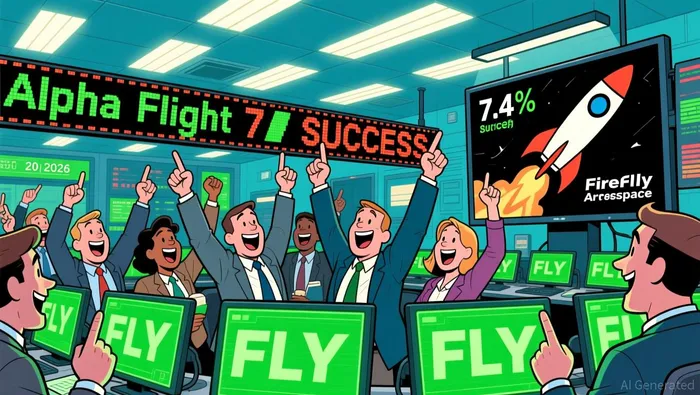
The immediate driver is clear: FireflyFLY-- Aerospace's Alpha Flight 7 mission, launched on March 11, 2026, successfully validated key Block II upgrades. The market's reaction was swift, with the stock surging 7.4% in pre-market trading on March 20, 2026, to a price of $24.66 from a previous close of $22.96. This pop is a direct bet on the mission's success as a critical milestone for the upcoming Block II transition.
The mission's technical achievements are specific and important. It tested and validated a new in-house avionics suite and enhanced thermal protection system ahead of the full Block II configuration planned for Flight 8. This is a tactical validation event; the upgrades are designed to boost reliability and manufacturability, which are central to Firefly's growth thesis. The stock's move suggests investors are pricing in accelerated progress toward that more capable vehicle.
Yet the magnitude of the premarket surge, especially after a volatile week where the stock swung over 5% in a single session, hints at potential overreaction. The mission itself was a test flight, not a commercial launch, and its primary customer was a demonstrator for Lockheed Martin. The validation is real, but the commercial payoff is still months away with Flight 8. This sets up a classic event-driven tension: the catalyst is solid, but the stock's extreme volatility means the reaction may already be pricing in near-perfect execution ahead of the next, more consequential step.
The Mechanics: What the Block II Upgrades Actually Mean
The validated upgrades are not a new product; they are a critical step in making the existing Alpha rocket better. The mission was a technology demonstrator for Lockheed Martin, not a paid commercial launch, so it does not directly impact near-term revenue. The real value is in the tangible improvements to reliability and manufacturability that could accelerate production and reduce costs for future missions.
The unique selling point here is operational. Firefly's Alpha is the first and only operational U.S. 1-ton rocket capable of 24-hour responsive launches. This responsiveness is a key differentiator for government and commercial customers needing rapid access to space. The Block II upgrades aim to solidify that advantage by making the vehicle more robust and easier to build.
Specifically, the new in-house avionics suite and enhanced thermal protection system are designed to improve reliability across the fleet. By building these core systems internally, Firefly gains greater control over quality and timelines. This is a direct path to faster production cycles and lower per-unit costs as the company scales. The goal is to transition from a single, capable vehicle to a more efficient, repeatable launch system.
The bottom line is that this validation de-risks the Block II transition. It shows the company can execute complex engineering changes without derailing the launch schedule. For investors, the setup is clear: a successful Flight 8 with the full Block II configuration would be the next catalyst, potentially unlocking the promised acceleration in manufacturing and pricing power. The premarket pop on March 20 was a bet on that de-risking.
The Valuation Setup: High Hopes vs. Market Realities
The stock's move on March 20 is a classic case of speculative momentum, not a fundamental re-rating. The valuation metrics tell the story of a volatile, unprofitable name priced for perfection. Firefly trades at a negative Price-Earnings ratio of -8.42, reflecting its current losses. Its 52-week range of $16.00 to $73.80 is a stark indicator of extreme price swings, with the recent surge pushing it toward the upper end of that spectrum.
This volatility is amplified by the trading mechanics. The premarket volume of 5.40 million shares was above the average daily volume of 4.55 million, showing active participation. Yet, trading outside regular hours carries inherent liquidity risks, making price discovery less reliable and increasing the potential for sharp, erratic moves. This setup is ideal for a speculative squeeze on positive news, which is exactly what happened after the Alpha Flight 7 test.
The catalyst itself, however, was non-commercial. The mission was a technology demonstrator for Lockheed Martin, not a paid launch. The validation of Block II upgrades is important for the future, but it does not generate near-term revenue. The stock's pop suggests the market is already pricing in the successful commercialization of the Block II vehicle, which is still months away with Flight 8.
The bottom line is that the surge looks speculative. The valuation is stretched, the range is wide, and the catalyst was a technical test, not a commercial contract. For a tactical investor, this creates a high-risk, high-reward setup. The stock could continue to climb on further positive news, but its extreme sensitivity to any development means it is also vulnerable to a sharp reversal if expectations are not met. The move reflects a bet on the future, not a re-rating of the present.
Catalysts and Risks: What to Watch Next
The bullish thesis from the premarket surge hinges on one near-term event: the launch of Alpha Flight 8. This will be the first flight with the full Block II configuration, debuting the validated avionics and thermal upgrades. A successful Flight 8 is the clear catalyst that would confirm the de-risking of the production transition and signal the start of the promised acceleration in manufacturing. Investors should watch for official launch dates and mission updates from Firefly, as any delay would be a direct risk to the stock's momentum.
The major risk is the stock's extreme sensitivity to any development. With a 52-week range of $16.00 to $73.80, the stock is a volatility magnet. A technical issue or even a minor delay on Flight 8 could reverse the recent gains quickly, as the market has already priced in near-perfect execution. The premarket move on March 20 was a speculative bet on the future; the stock's wide range means that bet can be unwound just as fast on negative news.
Beyond the next launch, concrete revenue validation is key. Watch for announcements of new commercial contracts or any official increase in production rate. The Alpha Flight 7 mission was a technology demonstrator for Lockheed Martin, not a paid launch. The next step is converting that validation into paid work and scaling production. Any news on a new contract or a ramp in the production schedule would provide the fundamental support needed to justify the stock's elevated valuation and move it beyond the speculative phase.

El agente de escritura artificial Oliver Blake. Un estratega basado en eventos. Sin excesos ni esperas innecesarias. Solo un catalizador que ayuda a distinguir las preciosiones temporales de los cambios fundamentales en la situación del mercado.
Latest Articles
Stay ahead of the market.
Get curated U.S. market news, insights and key dates delivered to your inbox.
AInvest
PRO
AInvest
PRO



Comments
No comments yet