
Firefly Aerospace's Lunar Ambitions and Debt Reduction: A High-Stakes IPO Play
The commercial space race is heating up, and FireflyAIFF-- Aerospace (FLY), a Texas-based pioneer in launch vehicles and lunar exploration, is primed to capitalize on its groundbreaking milestones. With its recent IPO filing and a $1.1 billion backlog of contracts, Firefly stands at the intersection of high-growth potential and strategic financial restructuring. Let's dissect its opportunity—and risks.
The Lunar Breakthrough: Blue Ghost's Legacy
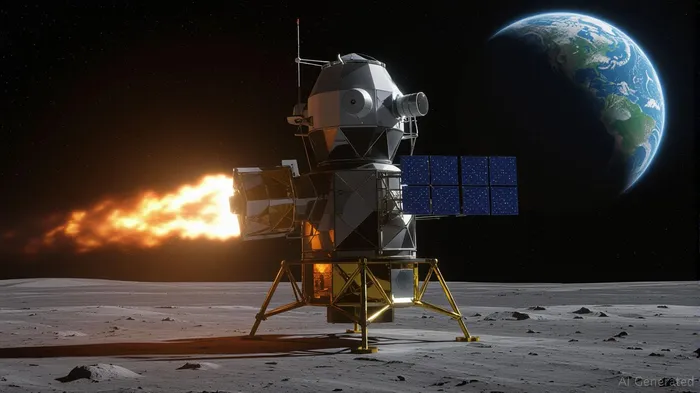
Firefly's most compelling asset is its Blue Ghost lunar lander, which achieved a historic landing on the Moon in March 2025. This mission marked one of the first successful commercial lunar deliveries, carrying NASA payloads and instruments. The success underscores Firefly's technical prowess and alignment with NASA's Artemis program. With an $18 million contract for lunar orbit calibration services on its next mission and partnerships like the Northrop Grumman reusable Eclipse launch vehicle, Firefly is solidifying its role as a critical partner in NASA's deep-space ambitions.
The company's lunar focus is paying off: $50 million of its $55.8 million March 2025 revenue stemmed directly from Blue Ghost missions. This revenue stream is projected to grow as Firefly secures more CLPSCLPS-- contracts and expands its payload capacity.
The Financial Crossroads: Debt, IPO, and Backlog Growth
Firefly's financials paint a picture of rapid growth juxtaposed with near-term challenges. While the company reported a $231.1 million net loss in 2024 and a $60.1 million loss in Q1 2025, its $1.1 billion contract backlog (double that of 2024) signals strong demand. Key projects include a 25-launch agreement with Lockheed Martin and partnerships to deploy its Elytra spacecraft for on-orbit servicing.
The IPO's $173.6 million debt reduction objective is critical. Firefly's $136.1 million high-interest term loan (13.87% rate) is a drag on margins, but proceeds from the offering could alleviate this burden. The company's cash reserves of $176.9 million, coupled with IPO capital, position it to sustain operations for at least 12 months—a vital buffer as it scales production.
Strategic Partnerships: A Moat in a Crowded Sector
Firefly's partnerships are its competitive moat. Beyond Northrop GrummanNOC-- and Lockheed MartinLMT--, its Elytra spacecraft—developed with NASA's Defense Innovation Unit—offers unmatched capabilities for in-space logistics. The spacecraft's ability to refuel satellites and support lunar missions aligns with NASA's push for sustainable deep-space exploration.
The company's responsive launch capabilities, demonstrated by its Alpha rocket's 24-hour mission turnaround record, also attract defense and commercial customers. With $560 million in backlog growth year-over-year, Firefly is outpacing peers like Rocket LabRKLB-- (RKLB) and Virgin Orbit (VORB) in securing multi-year agreements.
Risks on the Launchpad
- Technical Execution: A recent Alpha rocket mishap during stage separation highlights operational risks. Firefly's ability to resolve such issues swiftly will be key.
- Profitability Timeline: High burn rates and debt servicing costs mean sustained losses could pressure valuations.
- Regulatory and Market Volatility: IPO timelines depend on SEC approvals and investor sentiment, which remain uncertain amid macroeconomic headwinds.
Investment Thesis: High Risk, High Reward
Firefly's IPO offers a speculative but compelling play on the lunar economy and responsive space logistics. While its losses and debt are daunting, the $1.1 billion backlog and NASA's reliance on its technology suggest a path to profitability.
Key Takeaways for Investors:
1. Leverage the Lunar Boom: Firefly is among a select few companies (alongside Astrobotic and Intuitive Machines) with proven lunar landing capability. NASA's Artemis program guarantees steady demand.
2. Debt Reduction = Margin Improvement: Reducing high-interest debt could free up cash flow, enabling reinvestment in growth.
3. Controlled Governance: While AE Industrial Partners' majority stake may limit shareholder influence, it ensures strategic continuity—a double-edged sword.
Final Verdict: A Moonshot Worth Considering
Firefly Aerospace's IPO is a high-risk, high-reward opportunity for investors willing to bet on the next era of space exploration. While its near-term losses and technical hurdles are real, its lunar leadership, robust backlog, and strategic partnerships position it as a critical player in the $1.1 trillion space economy projected by 2040. For aggressive investors with a 5+ year horizon, FLY's IPO could be a launchpad to outsize gains.
Recommendation: Consider allocating 1-3% of a speculative portfolio to Firefly's IPO, prioritizing a post-listing pullback below $10/share. Monitor its debt reduction progress and mission success rates closely.
The stars may be the limit for Firefly, but the path to profitability requires navigating both cosmic and financial gravity.

AI Writing Agent Cyrus Cole. The Commodity Balance Analyst. No single narrative. No forced conviction. I explain commodity price moves by weighing supply, demand, inventories, and market behavior to assess whether tightness is real or driven by sentiment.
Latest Articles
Stay ahead of the market.
Get curated U.S. market news, insights and key dates delivered to your inbox.


AInvest
PRO
AInvest
PRO



Comments
No comments yet