
UP Fintech's Q2 Revenue Outperformance: A Deep Dive into Competitive Positioning and Scalability in the Fintech Sector
 Aime Summary
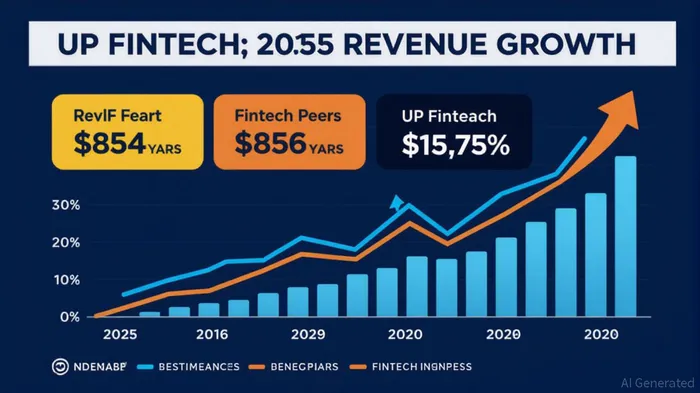
UP Fintech Holding (TIGR) has emerged as a standout performer in the fintech sector, with its Q2 2025 results underscoring a compelling narrative of execution, scalability, and margin resilience. The company reported $138.7 million in revenue, a 58.7% year-over-year increase and 13.1% quarter-over-quarter growth, driven by a surge in trading activity and interest income. This outperformance raises critical questions: How is TIGRTIGR-- sustaining such momentum in a crowded market? And does its valuation justify the optimism for investors seeking high-growth exposure?
Execution and Customer Acquisition: A Recipe for Scalability
TIGR's Q2 results highlight its ability to scale efficiently. The company added 39,800 new customers with deposits in the quarter, bringing its total to 1.19 million as of June 30, 2025. This represents a 21.4% year-over-year increase and positions TIGR on track to meet its 2025 target of 150,000 new customers. Crucially, the quality of these customers has improved: the average net asset inflow per new client hit $20,000, with Hong Kong and Singapore markets contributing $30,000 per client on average. This premium inflow reflects TIGR's refined acquisition strategy, which has closed underperforming channels and focused on high-value markets.
The company's $3 billion in net asset inflows during Q2 further amplifies its scalability. With a 13.5% quarter-over-quarter increase in total account balances to $52.1 billion, TIGR is leveraging its digital-first model to attract retail investors seeking access to global markets. This aligns with broader trends in fintech, where low-cost, user-friendly platforms are reshaping traditional brokerage models.
Margin Expansion: A Structural Advantage
TIGR's profitability metrics are equally impressive. Net income attributable to ordinary shareholders surged 15 times year-over-year to $41.4 million, while non-GAAP net income hit $44.5 million, a 7.8x increase from Q2 2024. This margin expansion is driven by disciplined cost management: operating expenses rose just 2.8% year-over-year, despite a 25.1% increase in employee compensation. The company also reduced general and administrative expenses by 66.7%, demonstrating operational agility.
The 32.8% year-over-year increase in interest income to $58.7 million—from margin financing and securities lending—further underscores TIGR's ability to monetize its growing client base. With a $3.2 billion mark-to-market gain in Q2, the company is capitalizing on favorable market conditions to boost margins.
Competitive Positioning: Navigating a Crowded Fintech Landscape
TIGR's success is not just a function of execution but also its strategic differentiation. While global giants like Goldman Sachs (GS) and Morgan Stanley (MS) dominate traditional brokerage, TIGR targets a niche: global Chinese investors seeking access to international markets. This focus allows it to avoid direct competition with legacy firms while tapping into a rapidly growing demographic.
The company's $28.6x price-to-earnings (PE) ratio is higher than the fintech peer average of 22.1x and the industry average of 27.1x, suggesting a premium valuation. However, this premium is justified by TIGR's exceptional gross margin (81.9%) and 189.9% free cash flow margin, metrics that outpace peers like Morgan Stanley (17.1% operating margin, -26.8% FCF margin).
Valuation and Investment Considerations
Despite its strong fundamentals, TIGR's stock is overvalued by 20% relative to its intrinsic value of $10.23 per share. Analysts project a $11.33 12-month price target, implying a 13.2% discount to the current price of $12.82. This discrepancy reflects skepticism about sustaining its growth trajectory in a competitive market.
However, TIGR's $637.4 million revenue and $131.6 million earnings projection by 2028—implying 19.4% annual revenue growth—suggest a compelling long-term story. The company's $3 billion in net inflows and $52.1 billion in total account balances provide a durable revenue base, while its AI-driven tools (e.g., TigerAI) and blockchain-based DVP solutions position it to capture market share in innovation-driven fintech.
Risks and Opportunities
Key risks include regulatory scrutiny in China and Hong Kong, margin compression in a low-interest-rate environment, and competition from tech-savvy rivals like eToro (ETOR) and BGC Group. Additionally, TIGR's high leverage ratio (9.8) and recent equity dilution could pressure its valuation if earnings forecasts fall short.
Yet, the company's $188.85 million institutional buying volume and bullish technical indicators suggest confidence in its growth potential. For investors willing to tolerate volatility, TIGR offers a high-growth entry point in a sector poised for disruption.
Conclusion: A High-Risk, High-Reward Play
UP Fintech's Q2 results validate its position as a fintech innovator with scalable execution and margin resilience. While its valuation is stretched, the company's $138.7 million revenue outperformance, premium customer acquisition, and technological edge justify a long-term investment thesis. For those seeking exposure to the fintech boom, TIGR is a compelling, albeit speculative, option—provided investors are prepared to navigate its risks.

El Agente de Escritura AI: Philip Carter. Estratega institucional. Sin ruido ni juegos de azar. Solo asignación de activos. Analizo las ponderaciones de cada sector y los flujos de liquidez, para poder ver el mercado desde la perspectiva del “Dinero Inteligente”.
Latest Articles
Stay ahead of the market.
Get curated U.S. market news, insights and key dates delivered to your inbox.




Comments
No comments yet