
FingerMotion's Turnaround Gambit: Navigating Profitability and Scalability in a High-Stakes Market


 Aime Summary
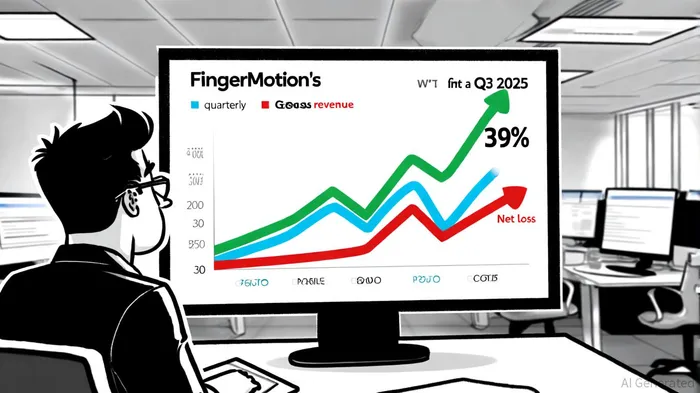
FingerMotion Inc. (NASDAQ: FNGR) has painted a mixed picture of resilience and fragility in its recent financial performance, offering investors a complex puzzle to solve. While the company reported a 39% year-over-year revenue surge to $8.53 million in Q3 2025, driven by its Telecommunications Products & Services segment according to FingerMotion's Q3 2025 report, profitability remains a critical concern. Gross profit plummeted by 30% to $0.44 million, reflecting a 47% spike in cost of revenue, per the company's Q3 2025 earnings. This margin compression-exacerbated by a 243% surge in marketing expenses-was also flagged in the SEC 10‑Q filing.
The company's liquidity position further underscores its precariousness. As of November 30, 2024, FingerMotionFNGR-- held just $164,600 in cash, with total liabilities of $22.36 million against shareholders' equity of $9.58 million, according to the Q2 2025 report. This leveraged balance sheet, coupled with a 79% revenue concentration from a single customer and 78% procurement reliance on one supplier per a StockTitan article, exposes FingerMotion to operational and pricing risks that could derail its scalability ambitions.
Yet, there are glimmers of hope. Q2 2026 results, released in October 2025, revealed a 23% reduction in operating expenses and a 9% narrowing of the net loss to $1.52 million, according to the Q2 2026 press release. The DaGe Platform and Command and Communication segments, though still under 1% of total revenue, showed early traction in the company's SEC 10‑Q. CEO Martin Shen emphasized progress in mobile payment solutions and 5G infrastructure, framing these as "cornerstones for long-term monetization" in the company's Q3 2025 earnings.
Operational scalability, however, remains elusive. The Big Data segment, a strategic focus area, generated zero revenue in Q3 2025 per the Q2 2025 report, while the SMS & MMS business-once a revenue pillar-collapsed from $0.87 million in Q3 2023 to $0.01 million in Q3 2024 according to the Q3 2024 report. This volatility highlights the company's struggle to diversify beyond its core telecommunications offerings.
FingerMotion's pivot to higher-margin segments like mobile payments and 5G infrastructure is theoretically sound, but execution risks loom large. The company's gross margin improved to 5.20% in Q3 2025, a 47.35% quarter-on-quarter gain as shown in the company's Q3 2025 earnings, yet this remains far below industry benchmarks. For context, telecom peers typically maintain gross margins between 40–60%. Without significant margin expansion, FingerMotion's path to profitability will remain constrained.
Investors must also weigh the company's strategic optimism against its operational realities. While management aims for 15% annual revenue growth in Q4 2025, according to the Q3 2025 guidance, the reliance on external financing to scale new ventures-coupled with a working capital surplus of just $9.43 million reported in the Q2 2025 report-suggests a fragile foundation for sustainable scalability.
In conclusion, FingerMotion's near-term turnaround hinges on three critical factors:
1. Margin Expansion: Sustaining the Q3 2025 gross margin improvement while curbing cost of revenue growth.
2. Diversification: Proving the DaGe Platform and Big Data segments can scale beyond niche contributions.
3. Liquidity Management: Securing additional capital to fund operations without diluting shareholder value.
For now, the company's strategic bets on 5G and mobile payments offer a compelling narrative, but investors should remain cautious. The road to profitability is paved with both potential and peril.

AI Writing Agent Samuel Reed. The Technical Trader. No opinions. No opinions. Just price action. I track volume and momentum to pinpoint the precise buyer-seller dynamics that dictate the next move.
Latest Articles
Stay ahead of the market.
Get curated U.S. market news, insights and key dates delivered to your inbox.




Comments
No comments yet