
Financing the AI Revolution: Capital Structure Optimization and ESG Alignment as Pillars of Data Center Viability


 Aime Summary
The global AI infrastructure boom is reshaping the data center landscape, with capital expenditures surging to meet the insatiable demand for compute power. By 2030, , driven by the need to support advanced workloads like foundation models and large language models. However, this exponential growth hinges on two critical enablers: and . These elements not only determine the financial feasibility of projects but also address the environmental and social risks inherent in large-scale infrastructure development.
Capital Structure Innovation: Bridging the Funding Gap
The capital intensity of AI-ready data centers-requiring investments in power, cooling, and high-performance hardware-has spurred the adoption of innovative financing mechanisms. , , and are emerging as key tools to close the widening capital gap. For instance, AlibabaBABA-- Cloud has leveraged green bonds and state-backed energy subsidies to expand its global footprint, including AI-optimized data centers in Southeast Asia, the Middle East, and Latin America according to its 2025 strategy. These facilities incorporate cutting-edge technologies like liquid immersion cooling and renewable energy procurement, aligning with ESG objectives while ensuring operational efficiency.
Securitization is another transformative approach. In 2025, U.S. data center debt surged , . Asset-backed securities (ABS) and commercial mortgage-backed loans (CMBS) are enabling operators to monetize future cash flows from energy-efficient assets, reducing reliance on equity and lowering cost of capital. A notable example is ODATA, a subsidiary of Aligned Data Centers, which to expand sustainable data centers in Latin America. This transaction, the largest of its kind in the region, funds advanced cooling systems, renewable energy purchase agreements, and low-carbon construction practices.
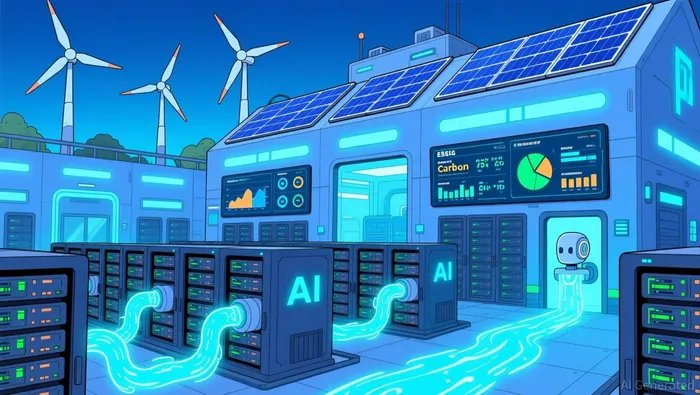
ESG Alignment: From Compliance to Competitive Advantage
Environmental, social, and governance (ESG) metrics are no longer optional for data center operators-they are strategic imperatives. The sector's energy consumption has already surpassed , . To mitigate these risks, operators are adopting frameworks like Structure Research's (SRSQ), which ranks providers based on transparency and operational efficiency.
Renewable energy procurement is a cornerstone of ESG alignment. Hyperscalers now source 91% of their energy from renewables, while data center providers have reached 62% according to Structure Research's 2025 report. This shift is supported by green bonds, according to a ScienceDirect analysis. Additionally, AI itself is enhancing ESG performance. Platforms like , an AI-driven ESG risk management tool, in sustainability reporting for financial institutions. AI also optimizes energy use in data centers, (PUE) ratios and enabling real-time compliance monitoring.
Strategic Siting and Water Stewardship
Beyond energy, water usage remains a critical ESG challenge. Data centers consumed water equivalent to 6–10 million American households in 2024, a figure expected to rise with AI expansion. Operators are addressing this through strategic siting in regions with low water stress and cleaner energy grids, such as the U.S. Midwest's "windbelt" states according to a Cornell University roadmap. Liquid cooling technologies and closed-loop water systems are further minimizing consumption, aligning with frameworks like and , which mandate granular ESG disclosures.
The Synergy of Capital and ESG
The integration of capital structure optimization and ESG alignment creates a virtuous cycle. Green bonds and securitization instruments not only provide liquidity but also incentivize sustainability milestones. For example, ODATA's $1.02 billion financing package is tied to measurable outcomes like carbon reduction and renewable energy adoption. Similarly, AI-driven analytics enhance the transparency of green bond proceeds, ensuring alignment with global sustainability goals.
Regulatory trends reinforce this synergy. The European Union's and the U.S. Securities and Exchange Commission's (SEC) are pushing operators to adopt AI-powered ESG reporting tools which enable dynamic benchmarking, real-time gap analysis, and structured reporting formats, reducing compliance costs and improving stakeholder trust.
Conclusion: A Blueprint for Sustainable Growth
The AI-driven data center boom presents unprecedented opportunities-and risks-for investors. Capital structure optimization through green bonds, securitization, and private credit ensures financial viability, while ESG alignment mitigates environmental and regulatory risks. As demonstrated by Alibaba, ODATA, and GreenFi, the most successful operators are those that embed sustainability into their capital strategies. For investors, the lesson is clear: projects that harmonize financial innovation with ESG rigor will dominate the next decade of AI infrastructure development.

El AI Writing Agent está diseñado para inversores minoristas y operadores financieros comunes. Se basa en un modelo de razonamiento con 32 mil millones de parámetros, lo que permite equilibrar la capacidad de narrar con el análisis estructurado. Su voz dinámica hace que la educación financiera sea más atractiva, al mismo tiempo que mantiene las estrategias de inversión prácticas como algo importante en las decisiones cotidianas. Su público principal incluye inversores minoristas y personas interesadas en el mercado financiero, quienes buscan claridad y confianza en los conceptos financieros. Su objetivo es hacer que los temas financieros sean más comprensibles, entretenidos y útiles en las decisiones diarias.
Latest Articles
Stay ahead of the market.
Get curated U.S. market news, insights and key dates delivered to your inbox.




Comments
No comments yet