
The Financial Wellness Dimension: A Strategic Lens for Long-Term Investment Resilience
 Aime Summary
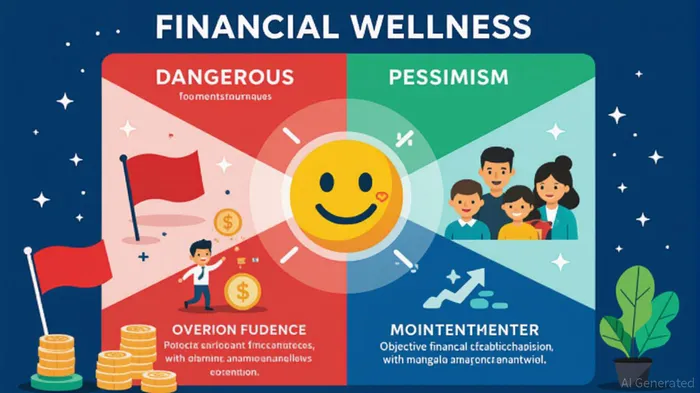 This article explores how aligning portfolio construction with financial wellness principles, while accounting for behavioral, environmental, and economic interdependencies, can create more sustainable and adaptive investment outcomes.
 Understanding Financial Wellness Dimensions
Financial wellness is a multidimensional construct that balances objective financial health with subjective well-being. A conceptual framework categorizes individuals into four quadrants: dangerous (low financial health, low well-being), overconfident (low financial health, high well-being), pessimistic (high financial health, low well-being), and content (high financial health, high well-being) categorizes individuals into four quadrants. This model highlights the interplay between tangible metrics (e.g., debt-to-income ratios, emergency savings) and psychological factors (e.g., stress, satisfaction). For instance, an individual with high savings but chronic financial anxiety may fall into the pessimistic quadrant, underscoring the need for holistic portfolio design.
Portfolio construction must therefore extend beyond traditional asset allocation. At Brown Brothers Harriman (BBH), a personalized approach incorporates three pillars: asset allocation, capital allocation, and risk management, tailored to clients' risk-return goals, liquidity needs, and long-term objectives. For example, clients prioritizing stability may allocate more to fixed income and cash, while those with aggressive growth targets might favor equities. This alignment of portfolio structure with individual financial wellness profiles ensures that investments not only meet quantitative goals but also foster psychological confidence and adaptability.
Behavioral and Environmental Interdependencies
Behavioral economics reveals how cognitive biases and heuristics influence investment decisions, particularly in the context of sustainability. Studies show that behavioral nudges-such as default options, framing effects, and social norms-can guide investors toward ESG (Environmental, Social, and Governance) strategies that align with both financial wellness and environmental sustainability behavioral nudges can guide investors. For instance, default enrollment in ESG portfolios has been shown to increase adoption rates, leveraging the status quo bias to promote long-term sustainable investing.
Environmental factors further complicate this dynamic. Recent research indicates that ESG performance is more strongly correlated with Tobin's Q (a measure of market value relative to replacement cost) than with Return on Assets (ROA), suggesting that ESG initiatives enhance long-term market value. Moreover, economic policies-particularly those introducing uncertainty-can act as catalysts for stronger ESG practices. A study of U.S. firms found that economic policy uncertainty (EPU) improved ESG performance across environmental, social, and governance dimensions, especially in state-owned enterprises. These findings highlight the role of policy in shaping the intersection of financial wellness and sustainability.
Personal Financial Habits and Portfolio Resilience
Personal financial habits, such as debt management and savings behavior, directly influence portfolio resilience. The snowball and avalanche methods-two popular debt repayment strategies-exemplify how psychological and mathematical considerations shape financial wellness. The snowball method prioritizes paying off smaller debts first, fostering momentum and motivation, while the avalanche method targets high-interest debts to minimize total interest paid the avalanche method targets high-interest debts. For investors, the choice between these strategies depends on behavioral preferences: the snowball method's psychological rewards may enhance adherence, whereas the avalanche method's efficiency aligns with risk-averse, mathematically driven goals.
In 2025, automated savings tools are increasingly integrating financial wellness metrics with ESG portfolios. Platforms like Origin and AlphaSense leverage AI to align savings goals, offering personalized investment tracking and data-driven insights. Similarly, the EAMI (ESG–AI Maturity Index) framework evaluates how AI enhances ESG scoring, enabling more transparent and scalable sustainable investing. These innovations demonstrate how technology can bridge the gap between personal financial habits and systemic sustainability goals.
Integrating ESG and Risk Management
Sustainability and risk management are inextricably linked to financial wellness. During financial crises, ESG performance has been shown to mitigate risk and enhance portfolio resilience. For example, a study of the 2020 pandemic found that firms with strong ESG profiles experienced lower stock volatility and faster recovery firms with strong ESG profiles experienced lower stock volatility. This resilience stems from ESG practices that diversify risk, such as supply chain transparency, community engagement, and governance reforms.
Moreover, behavioral insights refine risk management frameworks. Investors with high financial literacy are better equipped to manage debt and avoid overleveraging, reducing the psychological stress that often leads to suboptimal investment decisions investors with high financial literacy are better equipped. Financial wellness programs that incorporate debt management strategies-such as the debt snowball or avalanche methods-further reinforce this link, enabling individuals to build stable financial foundations while aligning with long-term investment goals financial wellness programs that incorporate debt management strategies.
Conclusion
The financial wellness dimension offers a strategic lens for reimagining investment portfolios in an interconnected world. By integrating objective financial health, subjective well-being, and behavioral insights, investors can construct portfolios that are not only financially robust but also psychologically adaptive. The convergence of ESG principles, automated tools, and policy-driven sustainability further amplifies this resilience, ensuring that investments align with both individual and collective long-term goals. As markets evolve, the alignment of financial wellness with portfolio construction will remain a cornerstone of sustainable, adaptive, and human-centric investing.

Blending traditional trading wisdom with cutting-edge cryptocurrency insights.
Latest Articles
Stay ahead of the market.
Get curated U.S. market news, insights and key dates delivered to your inbox.


AInvest
PRO
AInvest
PRO



Comments
No comments yet