
The Financial Wellness Dimension and Its Impact on Long-Term Investment Behavior
 Aime Summary
Emotional Health and Financial Wellness: A Bidirectional Relationship
The interplay between emotional health and financial wellness is well-documented. A 2025 study highlights that 71% of individuals reported increased spending during periods of poor mental health, while 73% found it harder to make financial decisions under such conditions. Conversely, stable financial behaviors-such as maintaining emergency savings and managing debt-correlate with improved mental health outcomes. This bidirectional relationship suggests that emotional well-being and financial resilience are mutually reinforcing. For instance, individuals with strong financial literacy are 6.7% less likely to have high debt-to-income ratios, a metric linked to reduced stress and greater capacity for long-term planning.
Sustainable investment behaviors may further enhance this dynamic. Research indicates that aligning investments with personal values can boost psychological satisfaction, creating a feedback loop where emotional well-being reinforces financial discipline. This is particularly relevant for sustainable investing, where ethical considerations often drive decision-making alongside traditional financial metrics.
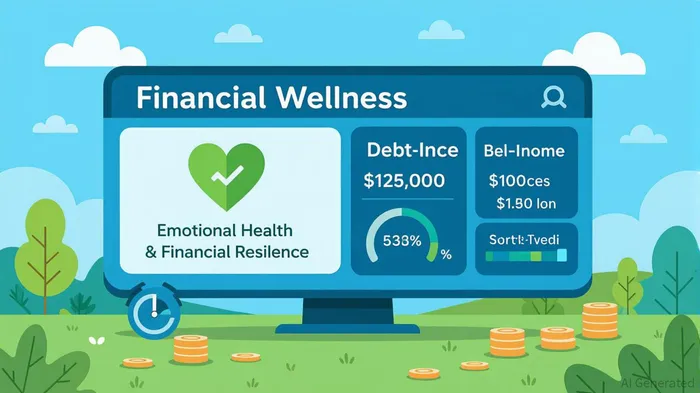
Behavioral Indicators and Long-Term Financial Resilience
Behavioral indicators such as budgeting, saving, and debt management are foundational to financial resilience. A 2025 study by Vanguard underscores the critical role of emergency savings, noting that individuals with at least $2,000 in reserves experience a 21% increase in financial well-being. Those with three to six months of expenses saved see an additional 13% improvement, even after accounting for income and debt type. These savings buffers reduce financial stress, enabling investors to focus on strategic, long-term decisions rather than reactive, short-term fixes.
The correlation between emergency savings and sustainable investment adoption is less direct but still significant. While no explicit statistical link is provided in recent U.S. studies, the broader trend suggests that financially resilient individuals are more likely to engage in sustainable investing. For example, 84% of institutional investors in the U.S. expect to increase their allocation to sustainable assets in the next two years, a shift driven by both financial performance and ethical alignment. This implies that individuals with strong financial wellness-marked by emergency savings and low debt-are better positioned to adopt sustainable strategies without compromising liquidity or stability.
Debt Levels and the Paradox of Financial Priorities
Debt management remains a pivotal factor in long-term investment behavior. The 2025 CFP Board report reveals that 42% of Americans prioritize reducing debt in 2025, with high debt levels cited as a barrier to retirement planning. Student loan debt, in particular, has been shown to hinder emergency savings accumulation, as borrowers allocate resources to repayment rather than long-term goals. This creates a paradox: while debt reduction is essential for financial health, it can delay or limit participation in sustainable investing, which often requires upfront capital or long-term commitment.
However, financial literacy mitigates this challenge. A 1% improvement in financial literacy correlates with a 6.7% reduction in household debt-to-income ratios, suggesting that education can empower individuals to balance debt management with sustainable investment. This is particularly relevant for younger generations, who, despite lower savings rates, are increasingly prioritizing climate literacy as a driver of socially responsible investing.
The Role of Institutional Trends and Policy Implications
While individual behavior is crucial, institutional trends also shape the landscape. By 2025, U.S. sustainable assets under management reached $6.6 trillion, representing 11% of total AUM. This growth is fueled by both financial performance-sustainable funds outperformed traditional ones in the first half of 2025-and evolving regulatory frameworks. However, political pressures, such as the U.S. Department of Labor's dismantling of ESG-related fiduciary rules, introduce uncertainty.
Policy interventions must address these challenges while fostering financial wellness. Culturally nuanced approaches, such as targeted climate education for younger demographics, and employer-sponsored financial inclusion programs, can bridge gaps in savings and debt management. Additionally, longitudinal studies emphasize the need for early intervention, as adverse childhood financial conditions can paradoxically foster resilience in certain contexts.
Conclusion
The correlation between financial wellness metrics and sustainable investment behaviors is neither linear nor universally applicable. Emergency savings, debt management, and emotional health form a triad of interdependent factors that influence long-term investment outcomes. While institutional trends suggest a growing alignment between sustainability and financial returns, individual behavior remains contingent on personal resilience and access to resources. As markets evolve, policymakers and investors must prioritize holistic strategies that integrate financial education, mental health support, and ethical investing frameworks to build a more resilient and sustainable financial future.

Blending traditional trading wisdom with cutting-edge cryptocurrency insights.
Latest Articles
Stay ahead of the market.
Get curated U.S. market news, insights and key dates delivered to your inbox.


AInvest
PRO
AInvest
PRO



Comments
No comments yet