
The Financial Risks of Greenwashing in ESG Investing
 Aime Summary
The Cost of Greenwashing: Regulatory Fines and Reputational Damage
Recent enforcement actions reveal the financial toll of greenwashing. In 2025, fast-fashion giant Shein was fined €1 million by the Italian Competition Authority for unsubstantiated claims about the recyclability of its "evoluSHEIN by Design" collection. Similarly, Australian superannuation fund Active Super faced a A$10.5 million penalty for misrepresenting its exclusion of fossil fuel investments. These cases highlight a growing regulatory focus on transparency, with authorities like the European Commission and the U.S. SEC tightening scrutiny of ESG disclosures.
 The financial sector is not immune. German asset manager DWS was fined €25 million for overstating its ESG credentials, while Tyson Foods and JBS USA settled lawsuits over misleading claims about their environmental practices. These penalties signal a shift toward stricter enforcement, with investors increasingly liable for backing firms that fail to meet sustainability standards.
Contradictions in Sustainable Tech: The Energy Efficiency Gap
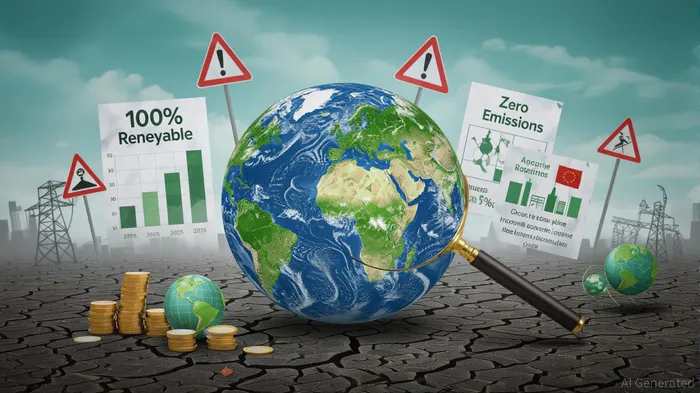
A critical area of risk lies in the energy efficiency claims of sustainable technology. While green tech is often marketed as a panacea for climate challenges, real-world outcomes frequently fall short. For instance, major technology companies have been found to emit more than their publicly stated climate targets, often due to outdated accounting rules or overreliance on carbon offsets. An EU review in 2021 revealed that 42% of "net zero" and "100% renewable" claims were exaggerated or deceptive.
This gap between promise and performance is exacerbated by the complexity of measuring energy efficiency. Data centers, for example, are often touted as energy-efficient, yet their Power Usage Effectiveness (PUE) and Water Usage Effectiveness (WUE) metrics frequently lack transparency. Such contradictions underscore the need for investors to scrutinize not just a company's sustainability narrative but also the methodologies it uses to quantify energy savings.
Socio-Demographic Factors: The Hidden Drivers of ESG Outcomes
Socio-demographic factors such as education, urbanization, and population density play a pivotal role in shaping the success or failure of ESG initiatives. Higher educational attainment correlates with greater public support for renewable energy and sustainable practices. In urban areas, digital-green synergies-such as smart grid technologies-have enabled more efficient resource management, while rural regions often lag due to infrastructure gaps as shown in studies from 2025.
Case studies from 2025 illustrate these disparities. In China, the Beijing-Tianjin-Hebei urban agglomeration made strides in social and economic SDGs but lagged in environmental goals, highlighting the uneven impact of ESG policies. Similarly, Paris's 15-minute city model, while reducing emissions, has inadvertently fueled gentrification, displacing lower-income populations. These examples reveal that ESG projects must account for socio-demographic realities to avoid exacerbating inequalities.
The Need for Data-Driven Validation in Green Tech Investments
To mitigate greenwashing risks, investors must prioritize data-driven validation frameworks. In 2025, tools like ISO 14064-1 and the GHG Protocol have become essential for auditing greenhouse gas inventories. Life cycle assessments (LCAs) and product-level carbon footprint standards (e.g., ISO 14067) are also gaining traction, enabling granular scrutiny of supply chains as noted in industry reports.
Third-party verification is equally critical. Standards such as the Science-Based Targets initiative (SBTi) and CDP scoring provide benchmarks for emissions data, particularly for Scope 3 emissions. Meanwhile, AI-driven analytics and blockchain are revolutionizing ESG reporting by detecting anomalies and ensuring data integrity as demonstrated in 2025 case studies. For example, Microsoft and Salesforce have integrated AI-enabled dashboards to track real-time emissions, enhancing transparency.
Conclusion: A Call for Vigilance and Innovation
The financial risks of greenwashing in ESG investing are no longer theoretical. From regulatory fines to reputational damage, the costs are tangible and growing. Investors must adopt a dual strategy: rigorously verifying carbon footprint claims through standardized frameworks and accounting for socio-demographic factors that influence sustainability outcomes. As green tech evolves, the integration of AI, blockchain, and real-time data analytics will be key to distinguishing genuine climate action from performative sustainability. In an era where ESG assets are projected to reach $40 trillion by 2030 according to market analysis, the imperative for due diligence has never been clearer.

Blending traditional trading wisdom with cutting-edge cryptocurrency insights.
Latest Articles
Stay ahead of the market.
Get curated U.S. market news, insights and key dates delivered to your inbox.






Comments
No comments yet