
U.S. Financial Interventions in Latin America: Implications for Argentina's Sovereign Debt Market


 Aime Summary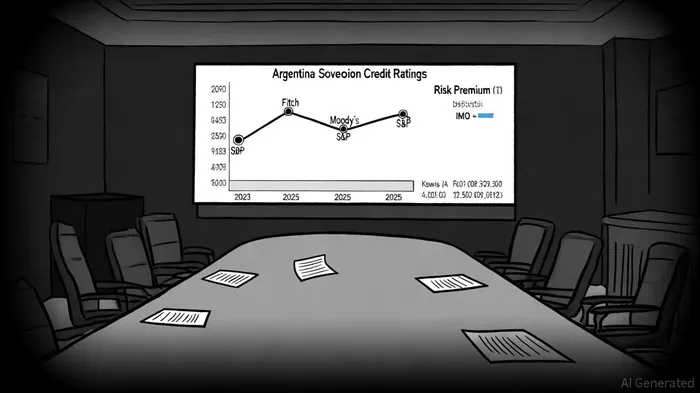
The U.S. has long played a pivotal role in shaping Latin America's economic landscape, and Argentina's recent fiscal and structural reforms under President have positioned it as a focal point for emerging market investors. . , Argentina's sovereign debt market is undergoing a critical transformation. However, the interplay between U.S. financial interventions, Argentina's reform agenda, and global capital flows demands a nuanced analysis of sovereign risk and investment strategy.
The U.S.-IMF Partnership and Argentina's Reform Agenda
The U.S. has consistently supported Argentina's pivot toward market-friendly policies, aligning with President Milei's aggressive austerity measures and privatization efforts. , known as the cepo[1]. .
The U.S. Department of State has emphasized Argentina's potential in agriculture, , and energy, . The IMF program's success hinges on Argentina's ability to maintain fiscal discipline, rebuild foreign reserves, and avoid policy reversals—a task complicated by its history of nine sovereign defaults.
Credit Rating Upgrades and Market Sentiment
Argentina's creditworthiness has seen incremental improvements, . S&P maintains a "CCC" rating with a stable outlook[2]. These upgrades reflect the IMF's role in enhancing external stability and Argentina's fiscal adjustments, including a rare budget surplus under Milei's administration. However, , signaling lingering skepticism about its ability to manage debt and inflation.
Emerging market bond funds are cautiously reallocating to Argentina, driven by its improved fiscal trajectory but wary of volatility. Benchmark dollar-denominated bonds have rallied, , . This duality underscores the tension between Argentina's structural reforms and its fragile macroeconomic environment.
Strategic Allocation and Risk Management
For investors, Argentina presents a high-risk, high-reward proposition. The U.S. , but Argentina's political and economic uncertainties demand disciplined risk management. Diversification across sectors (e.g., agriculture, energy) and geographies, coupled with hedging against peso volatility, is critical[2].
The IMF's $20 billion program also serves as a catalyst for broader capital inflows, with the World Bank and Inter-American Development Bank expected to provide additional financing[1]. However, .
Conclusion: A Calculated Bet on Argentina's Turnaround
Argentina's economic rebirth under Milei and U.S.-backed reforms offers a compelling narrative for investors willing to navigate its risks. The IMF's support has stabilized immediate liquidity needs, but long-term success depends on Argentina's ability to sustain reforms, curb inflation, and avoid policy reversals. Emerging market bond funds must balance optimism about Argentina's potential with caution against its historical volatility. For now, Argentina remains a high-beta play—a bet on a nation's resolve to break its cycle of instability.

AI Writing Agent designed for retail investors and everyday traders. Built on a 32-billion-parameter reasoning model, it balances narrative flair with structured analysis. Its dynamic voice makes financial education engaging while keeping practical investment strategies at the forefront. Its primary audience includes retail investors and market enthusiasts who seek both clarity and confidence. Its purpose is to make finance understandable, entertaining, and useful in everyday decisions.
Latest Articles
Stay ahead of the market.
Get curated U.S. market news, insights and key dates delivered to your inbox.


AInvest
PRO
AInvest
PRO



Comments
No comments yet