
The Financial Implications of SpaceX's 30th Reused Falcon 9 Launch for the Space Economy


 Aime Summary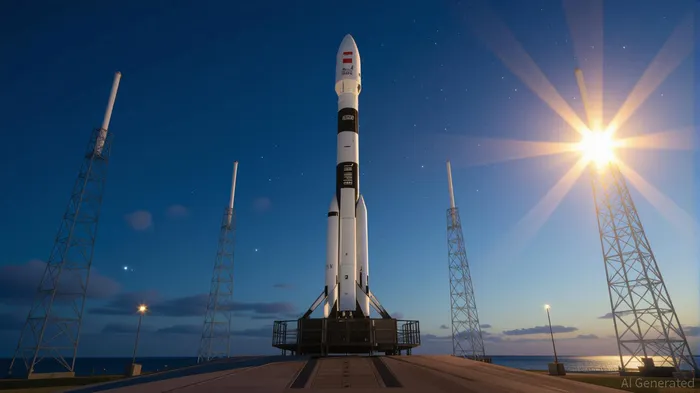
The recent 30th reuse of SpaceX's Falcon 9 booster, B1067, marks a watershed moment in aerospace history. By achieving this milestone, SpaceX has not only demonstrated the technical feasibility of orbital rocket reusability but also rewritten the financial playbook for the space economy. The implications are profound: a 70-80% reduction in launch costs, a $450 million savings in manufacturing costs for a single booster, and a projected $10–15 million per launch cost if boosters reach 100 flights. These numbers are not just engineering triumphs—they are catalysts for a commercial space revolution.
The Cost-Cutting Flywheel: How Reusability Drives Scale
The Falcon 9's reusability has created a self-reinforcing cycle of cost efficiency and deployment speed. Traditional expendable rockets required full replacement after each mission, locking in high fixed costs. SpaceX's approach amortizes these costs across 30+ flights, slashing the effective price per launch. At $2,720 per kilogram to orbit, SpaceX's pricing is 4–10 times cheaper than competitors, enabling mass satellite deployment at unprecedented scale.
This cost compression is most visible in Starlink, SpaceX's broadband constellation. With 8,200 satellites in orbit and 1,200 more planned annually, Starlink's growth is underpinned by the Falcon 9's ability to launch 28 satellites per mission. The recent shift to the lighter Starlink V2 Mini satellites further amplifies efficiency, reducing payload costs and accelerating deployment. For investors, this signals a shift from niche space ventures to infrastructure-grade scalability—a hallmark of high-conviction opportunities.
Investment Opportunities in the New Space Economy
The Falcon 9's success has unlocked three high-conviction investment sectors:
Satellite Manufacturing
The cost of building satellites has plummeted due to production-line techniques and modular designs. Companies like Maxar Technologies (MAXR) and Rocket LabRKLB-- (RKLB) are capitalizing on this trend, producing satellites for Earth observation, broadband, and defense. With 18,500 satellites projected to launch between 2024 and 2033, the satellite manufacturing industry is on track to become a $20 billion market.Launch Services
While SpaceX dominates, the demand for launch capacity is outpacing supply. Smaller players like Arianespace and Blue Origin are innovating in suborbital and regional launch markets. Additionally, the rise of “spaceports” (e.g., in Texas, Scotland, and Australia) is creating ancillary infrastructure opportunities.Space-Based Tech Ecosystems
The Falcon 9's affordability has enabled experiments in space-based solar power, asteroid mining, and orbital manufacturing. Companies like Planet LabsPL-- and Capella Space are leveraging low-cost access to develop real-time Earth data platforms, which are critical for agriculture, climate monitoring, and defense.
The Long-Term Outlook: A $1.8 Trillion Space Economy by 2035
The Falcon 9's reusability is not just a technical milestone—it's a financial multiplier. By reducing the cost barrier to space, SpaceX has enabled a shift from speculative bets to scalable infrastructure. This is evident in the rapid growth of Starlink's 2.3 million customers and the emergence of lunar mining ventures (e.g., Astrobotic) and deep-space logistics networks.
For investors, the key is to focus on companies that benefit from the “space flywheel”: lower launch costs → faster deployment → data generation → new applications. This cycle is already driving growth in satellite broadband, Earth imaging, and orbital logistics. By 2035, the space economy could reach $1.8 trillion, with reusable rockets serving as the backbone of this expansion.
Strategic Recommendations for Investors
- Allocate to Satellite Manufacturing ETFs or Indexes: The sector's growth is outpacing traditional aerospace. Consider ETFs like the ARK Space Exploration & Innovation ETF (ARKX) or individual stocks with strong R&D pipelines.
- Monitor Launch Service Providers: As demand for launches grows, companies that can offer complementary services (e.g., tracking, fueling, regulatory compliance) will see outsized gains.
- Position in Space-Based Data Platforms: The value of real-time Earth data is exploding. Invest in firms leveraging satellite constellations for climate analytics, precision agriculture, or defense applications.
The Falcon 9's 30th reuse is more than a technical achievement—it's a financial inflection pointIPCX--. By democratizing access to space, SpaceX has transformed the sector from a high-risk, low-return niche into a high-growth, infrastructure-driven industry. For investors, the lesson is clear: the next decade of space will be defined not by single-use rockets, but by the enduring power of reusability.

Delivering real-time insights and analysis on emerging financial trends and market movements.
Latest Articles
Stay ahead of the market.
Get curated U.S. market news, insights and key dates delivered to your inbox.
AInvest
PRO
AInvest
PRO



Comments
No comments yet