
Figure and Klarna IPOs Kick Off Next Week: Blockchain Buzz Meets BNPL Valuation Appeal — What You Need to Know
The IPO market is set to welcome three companies next week—Klarna, Figure, and Gemini—but investors will likely focus on the first two. KlarnaKLAR-- is expanding its BNPL business, positioning itself as a challenger to the traditional banking system with an appealing valuation, while Figure is gaining traction with its blockchain-powered home equity loan platform. Backed by competitive business models and solid financials, here’s what investors should know and capitalize on.
Klarna Group (KLAR): Cheap Valuation, but Lack of Vision
Klarna will debut at a valuation of $14 billion, far below its $45.6 billion peak during the pandemic-fueled funding frenzy in 2021.
The BNPL model thrived during the Covid era as e-commerce surged and households sought more flexible payment options. Klarna offers consumers varied choices on a purchase-by-purchase basis: paying in full immediately, delaying payment up to 30 days, splitting into four interest-free installments, or extending repayment over six to 24 months with interest. Unlike credit cards, which consolidate spending into a single bill, Klarna provides flexibility and transparency, putting it in the same league as AffirmAFRM-- while offering a unique edge.

The company’s reach is broad, with more than 790,000 merchants and roughly 111 million active customers as of Q2 2025. Its merchant network spans AmazonAMZN--, WalmartWMT--, SpotifySPOT--, H&M, Samsung, UberUBER--, and other major retailers. In certain cases, users can earn cashback rewards, such as 1% on Macy’s purchases. Klarna processed $105 billion in GMV in 2024, up 14% y/y, and $31.2 billion in Q2 2025 alone, up 19%.
What makes Klarna distinctive is its full banking license from Swedish regulators, which Affirm lacks. This allows Klarna to offer savings accounts in most EU markets, giving it deposit-based liquidity and room for innovation in financial products.
The company’s main revenue sources are transaction and service fees paid by merchants, along with advertising revenue from promoted retailers. Consumers also contribute via administrative fees and limited interest income when opting for longer installment plans.
Financially, Klarna reported $1.5 billion in revenue in the first half of 2025, up 17% year-over-year, largely driven by interest income. However, credit losses are rising. The company reserved $310 million for consumer defaults during the period, a 39% surge, reflecting more aggressive BNPL approvals. This dragged its transaction margin down to 38% from 44% a year earlier. While R&D and corporate expenses remain moderate, the expanding credit risk highlights the fragility of the BNPL model as it broadens to riskier borrowers.
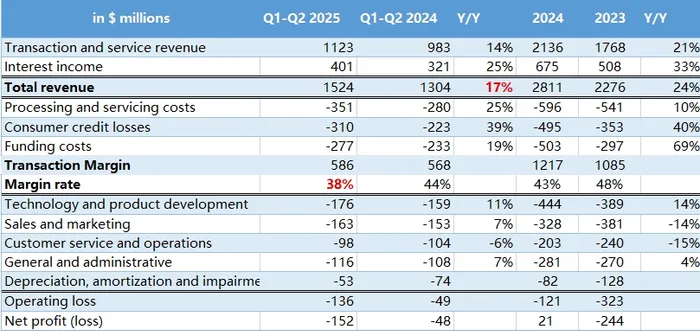
With its $14 billion valuation, Klarna trades at a price-to-sales ratio of roughly 2.3 and 5.6 times book value. Morgan StanleyMS-- has valued it closer to 3.6 times annualized revenue, suggesting the IPO pricing could offer short-term upside. Yet, without the blockchain or AI buzz that fuels market mania, the stock is unlikely to see a dramatic post-IPO surge. Over the longer term, rising credit losses and intensifying competition—particularly as retailers consider launching their own BNPL platforms—make its outlook more uncertain.
Figure Technologies (FIGR): Priced at $4.1 Billion, Further Upside Ahead
Figure may prove to be the most exciting IPO next week, with a model that blends blockchain infrastructure and housing finance—an approach favored by President Trump. The company operates a blockchain-based loan origination system (LOS) for consumer credit and digital assets, with a primary focus on home equity loans. Its platform reduces average loan processing time from 42 days to just 10, while blockchain tracking ensures transparency and efficiency. In 2024, Figure facilitated $5 billion in home equity lending, up 51% year-over-year, and has since expanded through partner-branded strategies that extend its technology beyond real estate.
In February, the company launched YLDS, an interest-bearing, transferable stablecoin. Outstanding YLDS has reached about $4 million, enabling 24/7 transactions in U.S. dollars and other stablecoins via the Figure Exchange. This blockchain-embedded application could unlock significant opportunities in the future.
The company is led by cofounder and CEO Mike Cagney, the former SoFi chief who left amid allegations of misconduct—an overhang for some investors.
Financially, however, Figure looks strong. In the first half of 2025, it generated $191 million in revenue, up 22% y/y, with net income of $29 million and diluted EPS of $0.15. Loan sales brought in $68 million, up 17%, while ecosystem and technology fees surged 250% to $44 million, becoming the second-largest revenue driver. This momentum reflects growing adoption of its cloud-based loan application platform through partner-branded channels. Interest income also rose 66% to $32.6 million from loans and marketable securities, including assets underlying YLDS.
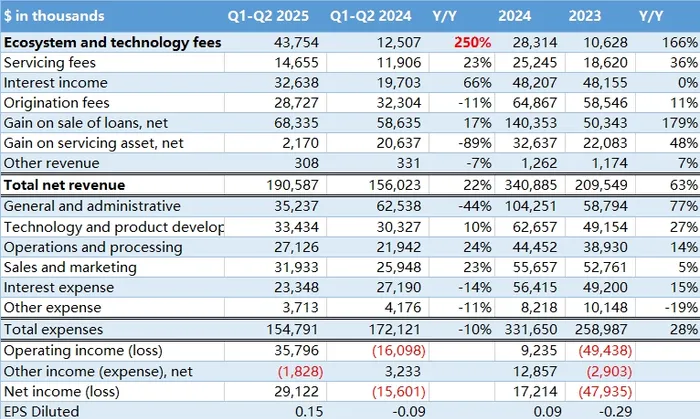
Expenses are well controlled, with total costs falling 10% to $155 million, aided by a 44% drop in general and administrative expenses from reduced stock-based compensation. This underscores the scalability of the business model, which is growing rapidly without runaway costs.
At a $4.1 billion valuation, Figure trades at about 11 times annualized revenue, which is not expensive given its growth trajectory. Investors should expect further upside as real-world blockchain applications gain traction. With Trump advocating rate cuts to support housing, Figure’s core market could see additional momentum. Its ecosystem and technology fees are likely to drive medium-term growth, and if valued at 16 times revenue, the company could be worth $6.1 billion—a 48% upside from its IPO price.
Figure deserves close attention next week as a blockchain company with real-world use cases and solid profitability, supported by fair valuation and strong growth potential. Klarna, while attractively priced, faces longer-term risks from rising credit losses and competitive pressures. Investors may find short-term opportunities in both IPOs, but Figure’s blockchain-enabled model offers the bigger imagination play.

Independent investment research powered by a team of market strategists with 20+ years of Wall Street and global macro experience. We uncover high-conviction opportunities across equities, metals, and options through disciplined, data-driven analysis.
Latest Articles
Unlock Market-Moving Insights.
Subscribe to PRO Articles.
Already have an account? Sign in
Unlock Market-Moving Insights.
Subscribe to PRO Articles.
Already have an account? Sign in
Stay ahead of the market.
Get curated U.S. market news, insights and key dates delivered to your inbox.
AInvest
PRO
AInvest
PRO



