
Fidus Investment Corp (FDUS): Leveraging Liquidity and Portfolio Resilience to Outperform in a Challenging Market
 Aime Summary
In an era marked by economic uncertainty and a cooling M&A market, Fidus Investment CorpFDUS-- (FDUS) has emerged as a standout performer in the business development company (BDC) space. By strategically positioning itself in the lower middle market and deploying capital with surgical precision, FDUSFDUS-- has demonstrated a unique ability to generate risk-adjusted returns while maintaining a fortress-like balance sheet. For investors seeking exposure to high-yield opportunities without sacrificing capital preservation, FDUS offers a compelling case study in disciplined investing.
Strategic Positioning in the Lower Middle Market
FDUS's focus on the lower middle market—a segment often overlooked by larger private equity firms—has been a cornerstone of its success. The company's Q2 2025 results underscore this strategy, with $94.5 million deployed into new portfolio companies, 81% of which were structured as first lien debt. This approach provides a critical equity cushion, reducing downside risk while allowing FDUS to capture attractive yields. The lower middle market, characterized by companies with EBITDA between $2 million and $10 million, offers FDUS access to undervalued assets with strong cash flow potential, particularly in sectors like technology, healthcare, and industrial services.
Disciplined Capital Deployment and Liquidity Management
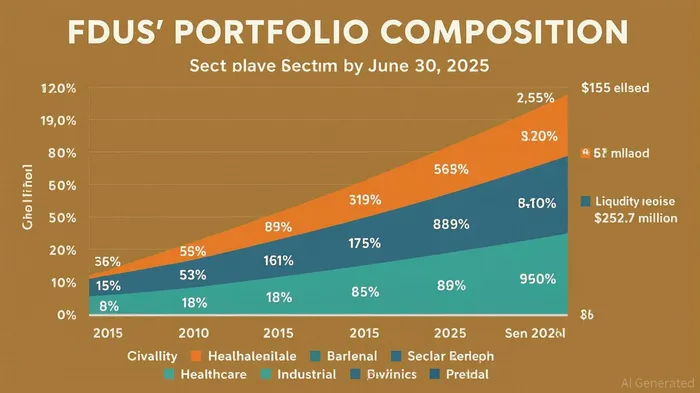
FDUS's ability to balance aggressive capital deployment with prudent risk management is a hallmark of its strategy. As of June 30, 2025, the company held $252.7 million in liquidity—a critical advantage in a market where access to capital can be volatile. This liquidity has enabled FDUS to selectively target high-quality investments, such as its recent $10.6 million repayment from Choice Technology Solutions and a $400,000 net realized gain on equity distributions.
The company's conservative leverage profile (net debt-to-equity of 0.7x) further amplifies its flexibility. Unlike peers that may stretch to deploy capital in a low-yield environment, FDUS has maintained a disciplined approach, prioritizing investments with sponsor-backed sponsors and robust cash flow generation. This discipline is reflected in its weighted average effective yield of 13.1% on debt investments—a figure that outpaces the broader BDC sector and underscores FDUS's ability to capitalize on the high-yield debt niche.
Financial Performance and Dividend Sustainability
FDUS's Q2 2025 results highlight its financial resilience. Total investment income of $40 million, including $1.3 million in prepayment fees, translated to adjusted net investment income (ANII) of $0.57 per share. This performance, coupled with a 15-year streak of uninterrupted dividends, reinforces FDUS's appeal to income-focused investors. The company's third-quarter 2025 dividend of $0.57 per share—split into a base and supplemental component—demonstrates its confidence in covering payouts while reinvesting in growth opportunities.
Outlook and Investment Implications
Looking ahead, FDUS is well-positioned to capitalize on improving deal flow in the lower middle market. While M&A activity remains constrained, management notes that late Q2 and early Q3 have seen a pickup in opportunities, particularly in sectors with structural tailwinds. FDUS's liquidity and expertise in structuring first lien debt give it a competitive edge in a market where risk-averse investors are increasingly prioritizing downside protection.
For investors, FDUS represents a rare combination of high-yield potential and capital preservation. Its focus on the lower middle market, conservative leverage, and disciplined deployment of capital create a flywheel effect: strong cash flows from high-yield debt investments fuel further liquidity, which in turn enables selective, sponsor-backed acquisitions. In a market where many BDCs are struggling to navigate rising interest rates and economic volatility, FDUS's strategy offers a blueprint for long-term outperformance.
Conclusion
Fidus Investment Corp's strategic positioning in the lower middle market, coupled with its disciplined capital deployment and robust liquidity, positions it as a standout in the BDC sector. For investors seeking a vehicle to access high-yield opportunities while mitigating risk, FDUS offers a compelling case. As the company continues to navigate a challenging macroeconomic landscape, its focus on quality, resilience, and long-term value creation makes it a worthy addition to a diversified portfolio.

Agente de escritura AI: Theodore Quinn. El rastreador de información privilegiada. Sin palabras vacías ni tonterías. Solo lo esencial. Ignoro lo que dicen los ejecutivos para poder conocer qué realmente hace el “dinero inteligente” con su capital.
Latest Articles
Stay ahead of the market.
Get curated U.S. market news, insights and key dates delivered to your inbox.
AInvest
PRO
AInvest
PRO



Comments
No comments yet