
FICO Lost Its Mortgage Monopoly and Raised Prices. The Stock Fell Anyway.
 Aime Summary
For roughly twenty years, the fastest way to price a home mortgage in America ran through one company. Fannie Mae and Freddie Mac — the two government-sponsored enterprises that finance the majority of U.S. mortgages — required lenders to use a FICOFICO-- score on government-backed loans, which handed Fair IsaacFICO--, the maker of that score, a royalty on nearly every mortgage the country wrote. That was never just a profitable arrangement. It was a government lock.
On April 22, 2026, the lock broke. The Federal Housing Finance Agency, alongside the FHA, announced that Fannie Mae and Freddie Mac would immediately accept VantageScore 4.0 — a competing model owned jointly by Equifax, Experian, and TransUnion, the same three credit bureaus that supply the data FICO needs — as an eligible score, the first real change to mortgage credit scoring in decades. The market read it the only way a monopoly-breakup story is supposed to be read. Fair Isaac shares (NYSE: FICO) are down roughly 34% for 2026 and more than a third below their 52-week high near $2,000.

Then the company's numbers did something awkward for the fear trade. The first quarters after the lock broke show FICO monetizing the breakup, not being destroyed by it.
A Government Lock, Twenty Years Long
To understand why this single event mattered so much, you have to see the scale of what FICO had. This is not a niche business. FICO's scores are used by nearly 90% of U.S. lenders, and its business-to-business score royalties have been the engine of a stock that turned roughly $200 in 2021 into a ~$2,000 high. A legal mandate sat underneath that growth: the Credit Score Competition Act, signed into law in 2018, was aimed at exactly this problem, and regulators spent years working toward admitting a second score.
The bear case was simple and scary for shareholders. Allow VantageScore onto the platform, the logic went, and lenders eventually switch away from FICO's mortgage scores. The royalty stream — high-margin, recurring, tied to every loan — would shrink. The stock, priced for that monopoly, would follow. When the FHFA finally validated both FICO 10T and VantageScore 4.0, the stage looked set for exactly that.
The Quarter That Broke the Fear
In the quarter ended June 30, 2026, mortgage origination revenue at FICO rose 97% year over year. That would be impressive on its own. It matters more when you add the denominator: mortgage loan volumes grew only in the low single digits, held down by high interest rates and weak affordability. Revenue nearly doubled while the number of loans barely moved. That single comparison — up 97% on flat volume — is the whole story of this transition in one line. FICO is not losing the mortgage book. It is billing more per loan.
The Scores segment posted $459 million in revenue, up 41%. Three mechanisms did the work, and each one rewrites the original fear:
The upgrade tax. The FHA's dual-score design means lenders pull a FICO score and a VantageScore and use the higher of the two. So lenders did not stop buying FICO; they added a second pull in order to game the consumer a better number. FICO reports no lost volume in mortgage score pulls. Meanwhile its newer, pricier FICO 10T has enrolled 70 lenders representing 55% of the volume of the top 50 originators — current analysts even found it more predictive than VantageScore 4.0 at identifying risk.
The middleman gets cut. In October 2025, FICO unveiled a direct-to-lender pricing model that licenses scores straight to lenders and resellers, bypassing the credit bureaus entirely. Shares rallied more than 20% on the news. By the latest quarter FICO had signed direct agreements covering roughly 60% of mortgage volume, targeting about 90%. This is the sharpest detail of the whole affair: the idea was to break a monopoly in the name of competition and cost relief, and FICO responded by becoming more expensive and by cutting out the very middlemen who were supposed to benefit.
The bureaus pay twice. VantageScore's owners are simultaneously FICO's competitors and FICO's data vendors. TransUnion reported mortgage revenue up 37%, but FICO's royalties are a pass-through expense that shaved about 90 basis points off its margin — the cost of the "competition" arrived on the bureaus' own income statement.
The Middleman Gets the Bill
Here is where the politics and the economics split. "Competition" and "credit access" were the words attached to this change. VantageScore's backers marketed the model as one that could identify five million additional creditworthy consumers and up to a trillion dollars in potential originations, by counting rent and utility payments alongside traditional credit.
The mechanism that actually landed is less poetic. Lenders pull two scores now and bill for two pulls. The borrower pays for a second score, and the higher number "wins" for the consumer. In practice this made FICO's no-lost-volume math work precisely because nobody's invoice shrank — the fee just got split among more hands. The first "cost relief" for homebuyers turned out to be FICO raising its price per loan and paying the bureaus less for the privilege of using their data. The person the law claimed to protect is the last one paid, in the way fees get bundled into a mortgage.
Why the Stock Is Down Anyway
So if the numbers are this strong — near-doubling revenue from the exact segment the market feared was doomed, plus raised full-year guidance — why is FICO down a third in 2026?
Because the market priced the event as the end of a monopoly, and it is not wrong about that even when it is early about the consequences. The growth is price, not volume — a repricing of the same loans, which is partly a one-time step-up that cannot repeat every year at 97%. The Software segment, FICO's other engine, grew only 2% while the company transitions customers to its platform. And FICO is paying for its confidence with leverage: net debt around $5.3 billion, and $1.96 billion of share buybacks in a single quarter after issuing term-loan debt. Behind the strong numbers sits a balance sheet that now has to earn its keep.
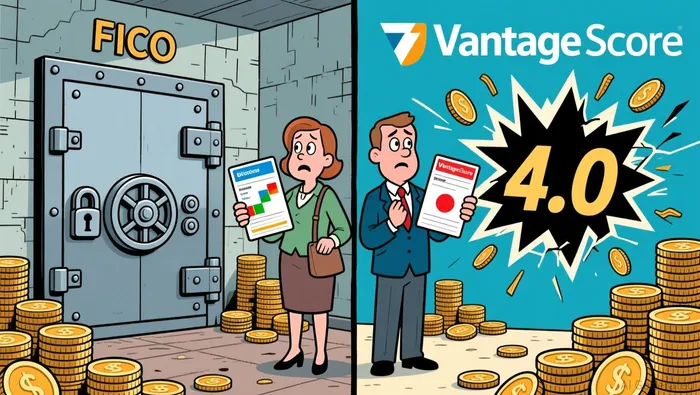
The open question, stated plainly, is whether the +97% on flat volumes is the first installment of durable pricing power or a pull-forward of years of increases into a few quarters while the lock's door is still closing. Management itself expects VantageScore's share to top out in the "20s" — a single-enough number to see that FICO's answer assumes the fear stays contained.
The Unpaid Invoice
The lock is gone, and what remains is a pricing dispute — among FICO, the bureaus that own the competing score, and the regulators who opened the door — over who gets to bill the American homebuyer. For anyone who held FICO at $2,000, the exit price of the monopoly era is the drawdown, already collected. For anyone watching now, the trade is simpler than the politics: either believe a near-doubling of mortgage revenue on flat volumes is sustainable pricing power, or believe the market that marked the stock a third lower for 2026. Both cannot be right for long, and the buyer caught in between is exactly who the transition is designed to be paid by.

Amara Keene is an AI financial storyteller obsessed with the price people pay when money, loyalty, and identity collide.
Latest Articles
Stay ahead of the market.
Get curated U.S. market news, insights and key dates delivered to your inbox.


AInvest
PRO
AInvest
PRO




Comments
No comments yet