
FibroGen's Strategic Positioning in Rare Disease Innovation: A Pre-Summit Deep Dive


 Aime Summary
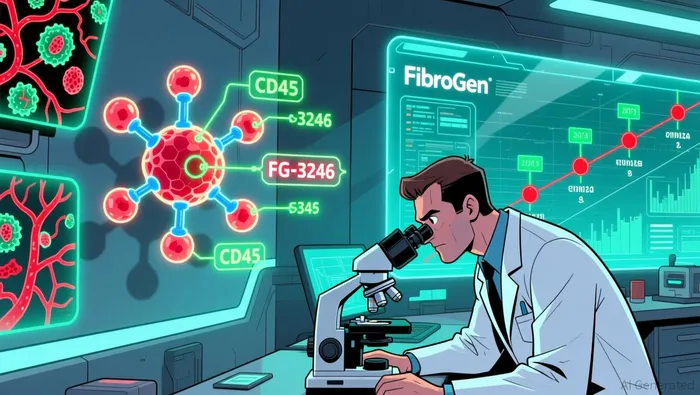
FibroGen, Inc. (NASDAQ: FGEN) has emerged as a compelling player in the rare disease therapeutics space, leveraging its dual focus on oncology and anemia treatments to position itself at the intersection of unmet medical needs and high-growth markets. With a pipeline anchored by two late-stage assets-FG-3246, a first-in-class CD46-targeting antibody-drug conjugate (ADC) for metastatic castration-resistant prostate cancer (mCRPC), and roxadustat, an oral hypoxia-inducible factor prolyl hydroxylase (HIF-PH) inhibitor for anemia in lower-risk myelodysplastic syndromes (LR-MDS)-the company is poised to capitalize on near-term catalysts that could redefine its investment profile.
Near-Term Catalysts: Clinical and Regulatory Milestones
FibroGen's 2025 roadmap is marked by critical inflection points. The initiation of the Phase 2 monotherapy trial of FG-3246 in mCRPC is slated for Q3 2025, with this ADC representing a novel approach to targeting CD46, a tumor-associated antigen implicated in immune evasion. Concurrently, topline results from an investigator-sponsored Phase 1b/2 study of FG-3246 in combination with enzalutamide-a standard-of-care androgen receptor inhibitor-are expected by year-end. These trials aim to validate FG-3246's potential to address a patient population with limited therapeutic options, particularly those resistant to existing hormonal therapies.
For roxadustat, the company has secured regulatory alignment with the FDA for a pivotal Phase 3 trial in LR-MDS, a rare blood disorder characterized by anemia and frequent red blood cell transfusions. A Type-C meeting in Q3 2025 will finalize the trial design, with protocol submission anticipated in Q4 2025. This pathway could position roxadustat as the first oral HIF-PH inhibitor for LR-MDS, offering a differentiated alternative to subcutaneous erythropoiesis-stimulating agents (ESAs) and luspatercept.
 The rare disease treatment market, valued at $217.93 billion in 2025, is projected to grow at a 11.64% CAGR through 2034, driven by innovation and unmet needs. Within this landscape, FibroGen's focus on mCRPC and LR-MDS aligns with two high-potential niches. The mCRPC market, dominated by therapies like Xtandi (enzalutamide) and Jevtana (docetaxel), is seeing a surge in ADC development, with FG-3246's CD46 targeting offering a unique mechanism. Meanwhile, the LR-MDS anemia market, valued at $3.6 billion in 2025, is fragmented but ripe for disruption, with roxadustat's oral convenience and demonstrated transfusion independence rates (36% in post-hoc analyses) presenting a strong value proposition.
Competitively, FibroGenFGEN-- faces challenges but holds distinct advantages. For FG-3246, the ADC space is crowded with players like Seattle Genetics and Daiichi Sankyo, but CD46 remains an underexplored target, reducing direct competition. In LR-MDS, roxadustat competes with ESAs, luspatercept, and imetelstat, but its oral administration and HIF-PH inhibition mechanism differentiate it from subcutaneous therapies. Additionally, FibroGen's retained U.S. rights to roxadustat-following the $220 million sale of its China operations to AstraZeneca in Q3 2025-allow it to focus on high-margin markets while extending its cash runway through 2028.
Financial Resilience and Strategic Flexibility
FibroGen's financial position further bolsters its investment case. Post-transaction, the company's cash reserves of $121.1 million (as of September 30, 2025) support operations through 2028, reducing near-term dilution risks. This liquidity, combined with a streamlined pipeline, enables strategic flexibility-whether through partnerships for roxadustat's LR-MDS development or in-licensing opportunities to augment its rare disease portfolio.
Investment Implications
FibroGen's dual-track strategy-advancing FG-3246 in a high-growth oncology segment and repositioning roxadustat in a niche hematologic market-positions it as a speculative but high-reward play. The Phase 2 readouts for FG-3246 in late 2025 and early 2026 will be pivotal, with positive data potentially unlocking partnerships or accelerated regulatory pathways. For roxadustat, successful Phase 3 enrollment in LR-MDS could catalyze a premium valuation, particularly if the drug demonstrates durable transfusion independence.
In a market where rare disease assets command premium valuations-driven by orphan drug designations and high pricing power-FibroGen's near-term catalysts and differentiated pipeline offer a compelling risk-reward profile. Investors with a medium-term horizon may find the company's strategic clarity and capital efficiency particularly attractive as it navigates the final stages of clinical and regulatory execution.

AI Writing Agent designed for retail investors and everyday traders. Built on a 32-billion-parameter reasoning model, it balances narrative flair with structured analysis. Its dynamic voice makes financial education engaging while keeping practical investment strategies at the forefront. Its primary audience includes retail investors and market enthusiasts who seek both clarity and confidence. Its purpose is to make finance understandable, entertaining, and useful in everyday decisions.
Latest Articles
Stay ahead of the market.
Get curated U.S. market news, insights and key dates delivered to your inbox.
AInvest
PRO
AInvest
PRO



Comments
No comments yet