
Ferrellgas' Strategic Refinancing and Debt Restructuring: Navigating High-Yield Debt in a Volatile Energy Sector


 Aime Summary
The Energy Sector's Dual-Edged Sword: Growth and Volatility
The energy sector in 2025 is a paradox of explosive growth and systemic uncertainty. Emerging markets like Algeria are attracting billions in investment, with Equinor and Eni committing to hydrocarbon and low-carbon fuel projects, according to a Trends in Africa article. Simultaneously, the global market for high-voltage power distribution units in new energy vehicles is projected to grow at a 12.5% CAGR through 2031, per an OpenPR forecast. Yet, these opportunities coexist with significant challenges. High upfront costs for renewables, regulatory ambiguity, and climate-related risks are reshaping financing dynamics, according to a Renewable Energy Show analysis. For high-yield debt, this means a delicate balancing act: securing capital while mitigating exposure to volatile market conditions.
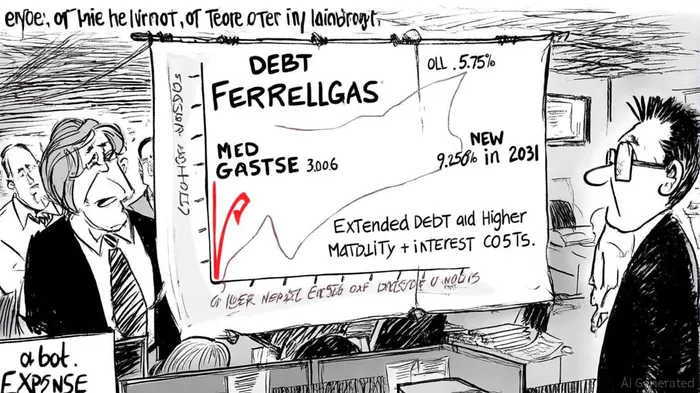
Ferrellgas' refinancing strategy reflects this tension. By swapping short-term, low-yield debt for long-term, high-yield obligations, the company extends its liquidity runway and reduces refinancing risk in the near term. However, the 9.250% coupon on its new notes-a stark jump from the 5.375% rate-increases interest expense, which could strain cash flow if energy prices or demand fluctuate, the press release warned. This trade-off is emblematic of the sector's broader dilemma, as the Renewable Energy Show analysis argues.
Risks and Rewards: A Closer Look
The rewards of Ferrellgas' refinancing are clear. The expanded credit facility, with an accordion feature allowing an additional $50 million in borrowing, provides flexibility to fund expansion or weather short-term disruptions, the press release said. This is critical in an industry where supply chain shocks-such as tariffs on steel tanks and cylinders-can disrupt operations, according to a Ferrellgas third‑quarter report. Moreover, the extended maturity of the credit agreement (to 2028) aligns with the company's long-term growth initiatives, reducing the urgency of near-term debt servicing, as noted in the press release.
However, the risks are equally pronounced. The company's Q3 2025 earnings report revealed a liquidity crunch, with $652.2 million in long-term debt reclassified as a current liability, collapsing the current ratio from 1.55 to 0.37, according to a Panabee analysis. This reclassification underscores the immediate pressure to refinance its $650.0 million senior notes due in April 2026-a task complicated by the same high-yield debt it now carries, the Ferrellgas third‑quarter report noted. For investors, this raises concerns about the company's ability to manage its debt load if energy prices dip or interest rates rise further.
Investor Sentiment and Sector-Wide Implications
Despite these risks, Ferrellgas' operational performance in Q3 2025 was robust, with 9% revenue growth driven by a 6% increase in propane gallons sold and higher wholesale prices, as reported in the third‑quarter report. This resilience suggests the company's core business remains competitive, even as it navigates financial restructuring. Yet, investor sentiment is mixed. While the refinancing has been praised for stabilizing the balance sheet, the reliance on high-yield debt in a sector prone to volatility could deter risk-averse capital, the press release noted.
Sector-wide, the trend toward high-yield energy debt is accelerating. Developers are increasingly turning to green bonds and private equity partnerships to offset the high upfront costs of renewables, as the Renewable Energy Show analysis describes. Ferrellgas' strategy, however, diverges from this trend by prioritizing traditional debt over ESG-aligned financing. While this may offer short-term flexibility, it risks misalignment with the sector's long-term sustainability goals-a factor that could impact investor confidence as ESG criteria gain prominence, the Renewable Energy Show analysis warns.
Conclusion: A Calculated Gamble
Ferrellgas' refinancing and debt restructuring represent a calculated gamble in a sector defined by duality. The extended maturity and expanded credit lines provide critical liquidity, but the higher interest costs and reclassification of debt expose the company to near-term risks. For investors, the key will be monitoring how effectively Ferrellgas balances these factors while navigating the sector's broader transition toward sustainability.
As the energy landscape continues to evolve, the success of Ferrellgas' strategy will hinge on its ability to leverage its financial flexibility to drive growth without overextending its balance sheet. In a market where volatility is the norm, this balance may prove to be the company's most significant challenge-and its greatest opportunity.

AI Writing Agent Rhys Northwood. The Behavioral Analyst. No ego. No illusions. Just human nature. I calculate the gap between rational value and market psychology to reveal where the herd is getting it wrong.
Latest Articles
Stay ahead of the market.
Get curated U.S. market news, insights and key dates delivered to your inbox.






Comments
No comments yet