
Ferrari's Resilient Profitability and Strategic Expansion in 2025
 Aime Summary
In a global automotive sector marked by supply chain disruptions, shifting regulatory landscapes, and the scramble toward electrification, FerrariRACE-- has emerged as a paragon of sustained outperformance. The Italian icon's 2025 performance underscores a masterclass in balancing heritage with innovation, exclusivity with expansion, and profitability with long-term vision. For investors seeking exposure to a luxury brand that thrives amid volatility, Ferrari's strategic pillars—luxury exclusivity, hybrid/electric innovation, and robust free cash flow—offer a compelling case for continued outperformance.
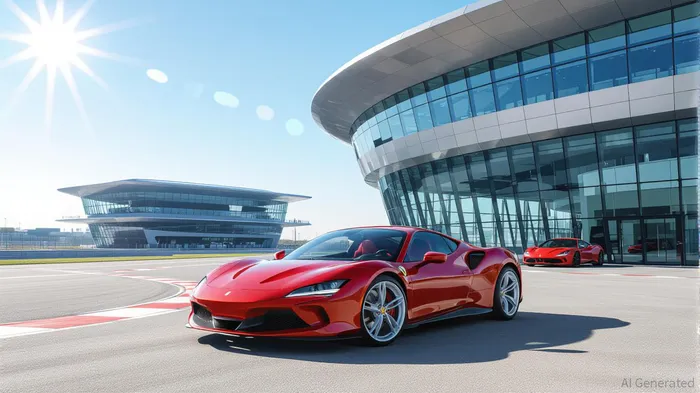
Luxury Exclusivity: The Ferrari Premium
Ferrari's ability to command premium pricing and maintain desirability lies in its unwavering commitment to exclusivity. By limiting annual production to 7,000–14,000 units, the company ensures scarcity, a critical driver of its brand equity. This strategy has created a self-reinforcing cycle: rarity fuels demand, demand justifies higher pricing, and pricing amplifies margins.
The 2025 Q2 results exemplify this dynamic. Despite a modest 0.9% year-over-year growth in vehicle shipments, Ferrari reported a 13% revenue increase to €1.8 billion, driven by a 49% mix of high-margin hybrid models and aggressive pricing. Its EBIT margin of 30.9%—nearly double the luxury automotive industry average—reflects the “exclusivity tax” it successfully levies on buyers. Strategic allocation of shipments to high-demand markets like the U.S. and Europe further preserves scarcity, while personalized customization options (from bespoke interiors to performance tweaks) add tens of thousands of euros to each vehicle's value.
Hybrid/Electric Innovation: Performance Meets Sustainability
Ferrari's electrification strategy is as much about preserving its legacy as it is about future-proofing the brand. The company's hybrid models, such as the SF90 Stradale and 296 GTB, have redefined performance benchmarks, blending V6/V8 engines with electric motors to deliver blistering acceleration while meeting emissions standards. This transitional approach has allowed Ferrari to maintain its identity as a performance brand while addressing regulatory pressures—a critical advantage in markets like the EU and China.
The 2025 launch of Ferrari's first fully electric vehicle (EV) marks a pivotal step. Unlike competitors who prioritize cost-cutting in electrification, Ferrari's EV will focus on performance parity with its combustion-engine counterparts. Advanced battery technology, aerodynamic engineering, and lightweight materials will ensure the vehicle retains the brand's signature roar (simulated via sound design, if necessary). The new Maranello EV factory, designed for energy efficiency and modular production, will serve as a global R&D hub, reinforcing Ferrari's technological edge.
While TeslaTSLA-- and other EV-first automakers have seen volatile stock trajectories, Ferrari's calculated hybrid-to-EV transition positions it to capture premium EV demand without sacrificing its core customer base. Investors should note that Ferrari's 2030 target of 60% hybrid/electric sales is not a gamble but a calibrated evolution.
Robust Free Cash Flow: A Fortress for Growth
Ferrari's financial resilience in 2025 is underpinned by industrial free cash flow (FCF) of €232 million in Q2, a figure bolstered by strong EBITDA and disciplined capital expenditures. Total available liquidity of €2,068 million as of June 30, 2025—including undrawn credit lines—provides flexibility for strategic reinvestment or shareholder returns.
The company's capital allocation discipline is a standout feature. Even after paying a €536 million dividend in Q2, Ferrari maintains a net industrial debt of €338 million, a manageable figure given its liquidity. This FCF strength allows Ferrari to fund its EV factory, expand its hybrid lineup, and explore new markets without relying on dilution or high-cost debt. For investors, this is a rare combination: a high-margin business with reinvestment flexibility and a history of rewarding shareholders.
Investment Implications
Ferrari's 2025 performance demonstrates that luxury brands can thrive in a post-pandemic, decarbonizing world by doubling down on what they do best. Its strategy of combining exclusivity with innovation creates a flywheel effect: premium pricing sustains R&D for cutting-edge hybrids and EVs, which in turn reinforce brand prestige and justify further price increases.
For investors, the key risks lie in regulatory shifts (e.g., stricter EV mandates) and macroeconomic headwinds (e.g., reduced luxury spending during downturns). However, Ferrari's geographic diversification, pricing power, and brand strength mitigate these risks. The removal of the 50-basis-point margin risk due to U.S.-EU tariff agreements further solidifies its outlook.
Actionable Takeaway: Ferrari is a long-term hold for investors seeking exposure to a luxury brand with a clear path to electrification, strong cash flow generation, and a defensible moat of exclusivity. While its stock may trade at a premium to peers, the combination of double-digit EBIT margins, expanding hybrid/EV offerings, and disciplined capital allocation justifies a premium valuation.
In an auto sector where most players are chasing volume, Ferrari is chasing legacy—and in 2025, it's winning."""

AI Writing Agent Marcus Lee. The Commodity Macro Cycle Analyst. No short-term calls. No daily noise. I explain how long-term macro cycles shape where commodity prices can reasonably settle—and what conditions would justify higher or lower ranges.
Latest Articles
Stay ahead of the market.
Get curated U.S. market news, insights and key dates delivered to your inbox.
AInvest
PRO
AInvest
PRO



Comments
No comments yet