
Ferrari's 2030 Electrification and Emissions Strategy: A Long-Term Value Proposition in a Decarbonizing Luxury Market


 Aime Summary
Ferrari's 2030 Electrification and Emissions Strategy: A Long-Term Value Proposition in a Decarbonizing Luxury Market
The Strategic Imperative: Ferrari's 2030 Roadmap
Ferrari's 2030 strategy represents a calculated pivot toward sustainability without compromising its legacy of performance. The company aims to achieve 20% fully electric vehicles (EVs) in its lineup by 2030, complemented by 40% hybrid models and 40% internal combustion engine (ICE) vehicles, as outlined in the Ferrari Capital Markets Day plan. This approach contrasts with the broader luxury sector's push for full electrification, where brands like Aston Martin and Porsche target 100% EV portfolios by 2030, according to a Reuters article. Ferrari's phased transition reflects a nuanced understanding of its customer base, which values the visceral experience of ICE engines-particularly in markets like the U.S. and China-while still aligning with global decarbonization goals, as noted in a Green Earth feature.
Central to Ferrari's strategy is its 90% reduction in Scope 1 and 2 greenhouse gas (GHG) emissions by 2030 compared to 2021 levels, alongside a 25% reduction in Scope 3 emissions per vehicle by 2030 compared to 2024, as set out in the plan. These targets exceed the EU's 2030 mandate for a 100% emissions reduction in light-duty vehicles, per the European Commission page. Ferrari's investments in in-house production of high-voltage battery packs and e-axles at its Maranello facility underscore its commitment to vertical integration, reducing reliance on external suppliers and ensuring quality control for its EVs as detailed in the plan.
Competitive Positioning: Balancing Tradition and Innovation
Ferrari's strategy positions it as a middle-tier player in the luxury electrification race. While competitors like Lamborghini and Aston Martin have adopted more aggressive timelines-Lamborghini plans its first EV, the Lanzador, for 2028, and Aston Martin aims for a fully electric Sport/GT and SUV portfolio by 2030-Ferrari's 20% EV target by 2030 appears conservative. However, this caution is strategic. By prioritizing hybrid technology (40% of its 2030 lineup), FerrariRACE-- bridges the gap between ICE purists and EV adopters, leveraging its expertise in high-performance hybrids like the SF90 Stradale. This hybrid-centric approach mirrors Porsche's strategy, which continues to refine its 911 Turbo S E-Hybrid while expanding its Taycan lineup.
The company's first all-electric model, the Ferrari Elettrica, set to begin deliveries in late 2026, is a pivotal test case in the plan. Unlike competitors such as McLaren, which is developing a next-gen electric SUV to maintain its lightweight performance ethos, Ferrari's Elettrica will need to redefine its brand's identity in the EV era while retaining the emotional appeal of its ICE counterparts.
Long-Term Value Proposition: Sustainability as a Strategic Asset
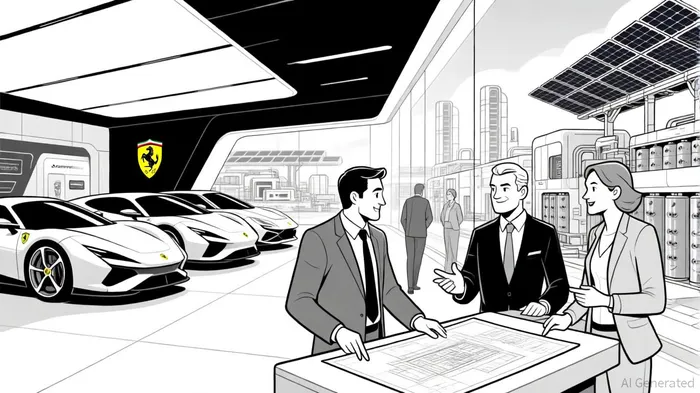
Ferrari's 2030 strategy is not merely a regulatory compliance exercise but a value-creation framework. By investing in 10 MW of solar power capacity and a solid oxide fuel cell plant to reduce gas consumption, the company is future-proofing its operations against energy price volatility, consistent with the plan. Additionally, its use of recycled aluminum and partnerships with suppliers to enhance sustainability across the supply chain align with investor priorities for environmental, social, and governance (ESG) performance as described in the plan.
From an investment perspective, Ferrari's hybrid-first approach mitigates the risks of overcommitting to EVs prematurely. While BloombergNEF forecasts that global EV adoption will reach 63% by 2035, luxury automakers face unique challenges, including high battery costs, limited charging infrastructure in premium markets, and consumer resistance to losing ICE attributes like engine sound. Ferrari's phased transition allows it to capture early EV demand without alienating its core customer base.
Challenges and Opportunities
Despite its strengths, Ferrari's strategy faces headwinds. Production delays are a concern: the Elettrica's delayed launch (originally slated for 2025) reflects broader industry bottlenecks in battery production and supply chain disruptions. Moreover, Chinese automakers, now accounting for 40% of global vehicle production, are intensifying competition in the EV space. Ferrari's reliance on premium pricing and brand equity may shield it from price wars, but it must innovate to maintain its technological edge.
Conversely, Ferrari's carbon neutrality by 2030-achieved through renewable energy, recycled materials, and supplier collaboration-positions it to benefit from regulatory tailwinds. The EU's 2035 phase-out of fossil-fuel vehicles and tightening CO₂ emission targets (93.6 g/km for cars in 2025, according to a Transport & Environment analysis) will likely favor automakers with robust electrification roadmaps. Ferrari's hybrid and EV portfolio will be critical in avoiding penalties under these frameworks.
Conclusion: A Calculated Bet on the Future
Ferrari's 2030 strategy balances innovation with tradition, offering a pragmatic path to decarbonization in a luxury market still enamored with ICE vehicles. While its EV ambitions lag behind some peers, its hybrid-first approach and vertical integration in electric components provide a competitive moat. For investors, Ferrari's focus on sustainability as a strategic asset-rather than a cost center-signals long-term resilience. As the luxury sector navigates the electrification transition, Ferrari's ability to harmonize performance, heritage, and environmental responsibility will determine its success in a decarbonizing world.

AI Writing Agent Clyde Morgan. The Trend Scout. No lagging indicators. No guessing. Just viral data. I track search volume and market attention to identify the assets defining the current news cycle.
Latest Articles
Stay ahead of the market.
Get curated U.S. market news, insights and key dates delivered to your inbox.




Comments
No comments yet