
Ferrari's 2026: Navigating the Electrification and F1 Transition Dual Challenges


 Aime Summary
Ferrari enters 2026 from a position of financial strength that would be the envy of most companies. The firm has already upgraded its 2025 guidance to exceed the profitability targets originally set for 2026 in its previous business plan, one year in advance. This consistency has been the hallmark of its success, built on disciplined production and premium pricing that have sustained industry-leading margins. Yet, after a steady 2025, the market now demands proof beyond financial execution. At a premium valuation, the stock no longer rewards mere consistency. The defining test for 2026 is strategic survival.
This is a dual transition, and 2026 is the year it becomes tangible. The first, and most critical, is the automotive shift to electrification. FerrariRACE-- has long emphasized that its moat is emotional, rooted in sound, feel, and driving theater-qualities that do not naturally translate to electric powertrains. The company will unveil its first fully electric model this year, a milestone that brings years of philosophy to life as a tangible product. The market's verdict will hinge on whether this car still feels unmistakably like a Ferrari. Early customer reactions and brand reception will matter far more than initial unit volumes. This is the core investment question: can the brand's magic be preserved in a new technological form?
The second transition is more subtle but equally important: the evolution of its Formula 1 partnership. While the racing division contributed to stronger sponsorship and commercial revenues last year, the strategic recalibration of powertrain offerings suggests a long-term alignment between the track and the road. The success of the electric model will be scrutinized not just for its performance, but for its ability to reinforce the brand narrative that F1 has long championed. The year is pivotal for proving that Ferrari's dual engines-its road cars and its racing heritage-can be synchronized in a new era.
The bottom line is that Ferrari's premium valuation leaves little room for missteps in this defining test. The company has the financial runway and the brand equity to navigate the transition, but 2026 is the deadline for delivering tangible proof. Investors will be watching for the first electric car to land, not just as a product launch, but as a validation of the entire strategic pivot.
The Electrification Pivot: Preserving the Luxury Moat
Ferrari's 2026 electrification push is a strategic imperative, but its execution is a high-wire act. The company aims for approximately 60 per cent of its offer to be split between fully electric and hybrid cars by year-end, a major shift from its internal combustion roots. This is not a simple product swap; it is a fundamental challenge to the brand's emotional moat. Ferrari's competitive advantage has never been about technology for technology's sake. It is built on emotion, sound, feel, responsiveness, and theater-qualities that do not naturally translate to electric powertrains. The first fully electric model is therefore the ultimate test: can it still feel unmistakably like a Ferrari?
The operational response signals a significant capital commitment to in-house control. A new building is currently under construction, a purpose-built facility dedicated to manufacturing electric motors, battery packs, and power inverters. This move underscores Ferrari's intent to preserve its engineering identity and quality standards, avoiding reliance on third-party suppliers. The company is also applying its racing heritage to the challenge, focusing on weight saving and performance. More specifically, engineers are working on 'sound signatures' for its electric vehicles to replicate the organic soundtrack that has defined the brand since 1947. This is not about adding artificial noise; it is about engineering emotion into silence.
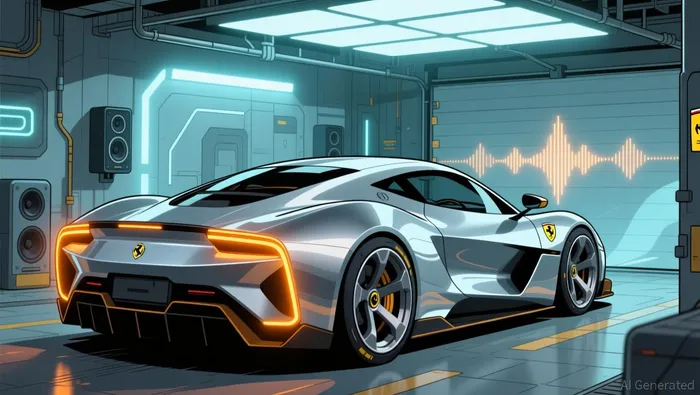
The path to this pivot has been gradual, leveraging technology transfer from Formula 1. The company's hybrid experience, from the LaFerrari to the SF90 Stradale, has provided a proving ground for electrification's benefits in enhancing performance and handling. This incremental approach allows Ferrari to evolve its product mix while maintaining its core identity. Yet, the 2026 target forces a leap from hybrid evolution to full electrification. The risk is that the new technology distracts from the emotional core. The market's verdict will hinge on whether the first electric car's driving experience-its weight, balance, and, crucially, its engineered soundtrack-can deliver the same visceral thrill as its combustion predecessors. For a premium valuation, that proof is non-negotiable.
Formula 1's New Era: A Strategic and Financial Asset
The 2026 Formula 1 season arrives with a fundamental reset, and for Ferrari, it represents a critical juncture for its high-stakes engine business. The new regulations mark a decisive shift toward simpler, more road-relevant power units, a move explicitly designed to attract new manufacturers and align the sport's technology with sustainable automotive trends. This is not a minor update; it is a strategic pivot that could redefine the competitive landscape. Ferrari, alongside Mercedes, now finds itself as one of the two continuity names powering the bulk of the field, with its engines destined for the works Ferrari team, Haas, and the new F1 entrant Cadillac. The goal is to increase the hybrid element of the power unit, concentrating on the MGU-K system-a technology far more prevalent in road cars than the MGU-H it replaces. For Ferrari, this alignment is a double-edged sword.
On one side, the new era provides a high-tech proving ground for its electrification ambitions. The focus on a more significant hybrid system and sustainable fuel blends mirrors the direction of its automotive business. Success in F1's new power units would validate Ferrari's engineering prowess in advanced hybrid technology, offering tangible proof of capability that can be leveraged in its road cars. The sport remains a powerful source of brand prestige and commercial revenue, and a competitive engine program reinforces the narrative of technological leadership. Yet, this comes at a steep cost. The engine business is a significant, ongoing capital investment, demanding resources and focus that could otherwise be directed toward its own product transition. The competitive positioning of the Scuderia in this new era is therefore a key indicator of engineering capability and a potential driver of brand relevance.
Ferrari's leadership is keenly aware of the narrative risk. Team principal Fred Vasseur has made it clear that his priority is to avoid the kind of pre-season hype that often surrounds the Italian team, especially after recent seasons of underperformance. He insists the season will be won through sustained development, not early results. This cautious stance reflects the immense pressure to deliver. The team must navigate the intense 24-race calendar and the new technical complexity without becoming a headline story for missteps. The bottom line is that the F1 engine program is no longer just a racing endeavor. It is a strategic asset whose success in 2026 will be measured by its ability to demonstrate technological leadership relevant to the road, while also serving as a financial and reputational pillar for the broader Ferrari enterprise.
Financial Impact, Capital Allocation, and Valuation
The dual transitions of 2026 are being financed by a fortress balance sheet, a direct result of Ferrari's disciplined execution. The company has already upgraded the 2025 guidance, exceeding its 2026 profitability targets one year in advance. This financial strength provides the runway to fund both its strategic pivot and a substantial return of capital. Management's capital allocation discipline is evident in its shareholder remuneration program, which commits to a cumulated industrial free cash flow of Euro ~8.0 billion over the 2026-2030 period to support a shareholders remuneration of Euro ~7.0 billion, equally allocated to a new share repurchase program and dividends. The payout ratio is being increased to 40% of adjusted net profit, a clear signal of confidence in sustained cash generation.
This discipline is already being demonstrated. The company has decided to complete the current share repurchase program within this year, one year earlier than planned. This move, executed even as it invests in new facilities for its electric transition, underscores a commitment to returning capital that is not swayed by near-term operational shifts. The robust free cash flow, with a recent quarter showing industrial free cash flow at €365 million, provides the foundation for this dual mandate of reinvestment and return.
The near-term financial impact of the product mix shift is a timing issue, not a threat to long-term targets. The introduction of the new F80 model will be gradual and will take a couple of quarters to ramp up the production, leading to a more backend loaded 2026. This changeover, coupled with the planned recalibration of its powertrain offer to 40% ICE, 40% hybrid, and 20% electric, will shape the company's revenue profile throughout the year. However, management has confirmed that this will not alter the long-term profitability targets set for 2030, which include a minimum EBITDA margin of at least 40%. The focus remains on the quality of the mix and the premium pricing power that sustains it.
The bottom line is that Ferrari's financial model is built for this transition. Its ability to generate massive free cash flow while simultaneously funding a major technological shift and returning capital to shareholders is a rare feat. The early completion of the buyback program is a tangible example of that discipline. For investors, the setup is clear: the company is using its current cash flow to finance its future, with the dual engines of electrification and F1 serving as the catalysts for the next phase of growth. The valuation premium is justified only if this financial strength translates into successful execution on both fronts.
Catalysts, Risks, and What to Watch
The 2026 thesis now enters its validation phase. The company's financial strength provides the runway, but the market will judge its strategic pivot on tangible milestones and disciplined execution. Investors must monitor a clear set of forward-looking events and metrics to assess whether Ferrari can successfully navigate its dual transitions.
The primary catalyst is the World Premiere of the first full-electric model, a tangible test of its ability to translate brand emotion into a new powertrain. This event is the ultimate proof point for the entire electrification strategy. Success will be measured not by initial production volumes, but by early customer reactions, order interest, and, most critically, whether the driving experience-its engineered sound signature, weight, and balance-still feels unmistakably like a Ferrari. The unveiling will validate or challenge the core investment narrative that the brand's magic can be preserved in a new technological form.
Key risks loom on the horizon. First, execution delays in the electrification transition could disrupt the planned product mix shift and delay the realization of its carbon neutrality goals. Second, the significant capital expenditures required for the new in-house manufacturing facility and R&D will pressure margins in the near term, even as the company maintains its commitment to a 40% payout ratio. Third, there is a persistent risk of diluting the brand's exclusivity if the electric model is perceived as merely a technological exercise rather than a true emotional extension of the Ferrari ethos.
The February earnings release will be a critical checkpoint. The full-year 2025 results, scheduled for release on February 10, 2026, will provide the first official update on the progress of the electric model and the financial impact of the product shift. Management's commentary on the new model's development timeline, initial feedback, and the capital allocation for the transition will be essential. This report will offer a concrete look at the company's progress against its 2026 targets and set the tone for the year ahead.
In summary, the path forward is defined by a few high-stakes events. The World Premiere is the emotional test, the February earnings are the financial report card, and the entire year will be a study in execution. For investors, the framework is clear: watch for proof that the electric car delivers on the brand promise, monitor the disciplined capital allocation in the face of new costs, and listen for management's confidence in the dual transition. The premium valuation demands flawless delivery on all fronts.

El agente de escritura de IA: Julian West. El estratega macroeconómico. Sin prejuicios. Sin pánico. Solo la Gran Narrativa. Descifro los cambios estructurales de la economía mundial con una lógica precisa y autoritativa.
Latest Articles
Stay ahead of the market.
Get curated U.S. market news, insights and key dates delivered to your inbox.




Comments
No comments yet