
Fermi's Strong IPO Debut: A New Era for Data Center REITs?


 Aime Summary
The data center real estate investment trust (REIT) sector is undergoing a seismic shift, driven by the insatiable demand for AI infrastructure and the urgent need to resolve the power supply bottleneck. Against this backdrop, Fermi REIT's $550 million IPO in September 2025 has ignited investor speculation about whether the company can redefine the industry's value proposition. With its "power-first" model and ambitious HyperGrid project in Amarillo, Texas, Fermi is positioning itself as a disruptor in a market where traditional REITs like EquinixEQIX-- and Digital Realty are struggling to keep pace with surging demand, according to a 2025 market outlook.
The Power Crisis Driving Innovation
The global data center market, valued at $418.2 billion in 2025, is projected to grow at a 10.6% CAGR through 2030, fueled by AI's exponential demand for high-performance computing, according to a GlobeNewswire report. However, this growth is constrained by a critical flaw: power availability. In the U.S., data centers are projected to consume 11–15% of total electricity by 2030, yet grid capacity lags behind, creating a 50% shortfall in core markets, per a Deloitte outlook. This has forced operators to seek alternative solutions, from small modular reactors to natural gas-fired plants, while also accelerating the adoption of liquid cooling and energy-efficient designs, according to a Brightlio analysis.
Fermi's vertically integrated approach-combining on-site power generation (nuclear, solar, natural gas, and storage) with data center infrastructure-directly addresses this bottleneck. By generating its own power, the company aims to bypass grid limitations and offer a "hyperredundant" energy supply to hyperscalers and AI developers, as described in an AlphaSense primer. This model is particularly appealing in regions like West Texas, where Fermi's 5,800-acre campus benefits from abundant land, low energy costs, and regulatory support, per a 2025 analysis.
Strategic Positioning in the AI Infrastructure Race
Fermi's HyperGrid project, targeting 11 gigawatts of power by 2038, is designed to capitalize on the AI boom. The global AI market, expected to expand from $64 billion in 2023 to $457 billion by 2027, requires not just computing power but also a reliable energy backbone, according to the DCByte index. Fermi's revenue model-long-term leases for data center space and on-site power services-positions it to capture value from both sides of the equation.
The company's recent $350 million financing round, including a $100 million Series C led by Macquarie and a $250 million credit facility, was disclosed in its SEC filing, and underscores investor confidence in its vision. Additionally, partnerships with Westinghouse for modular nuclear reactors and Texas Tech University for a 99-year land lease are detailed in the AlphaSense primer referenced above and provide critical execution support. These moves align with broader industry trends: 72% of data center operators now prioritize energy self-sufficiency, according to a CBRE report.
Risks and Realities
Despite its bold strategy, Fermi faces significant challenges. As a pre-revenue company with a $6.4 million loss since inception, its SEC filings indicate it must deliver on its 2027 revenue timeline and navigate the complexities of deploying advanced nuclear reactors. Supply chain bottlenecks and permitting delays could further strain its aggressive schedule, which includes commissioning its first reactor by 2032, according to the 2025 analysis cited above.
Moreover, competition is intensifying. Traditional REITs are securing AI-related leases, while hyperscalers like Microsoft and Meta are building proprietary data centers to avoid third-party dependencies, as noted in an Investopedia analysis. Fermi's success will hinge on its ability to demonstrate cost efficiency and reliability-two metrics that remain unproven at scale.
Conclusion: A High-Stakes Bet on the Future
Fermi's IPO represents more than a funding round-it's a vote of confidence in the future of energy-agnostic data infrastructure. While its power-first model aligns with the industry's most pressing needs, the company's execution will determine whether it becomes a cornerstone of the AI era or a cautionary tale of overambition. For investors, the key question is whether Fermi can transform its vision into a scalable, profitable reality before the market's power constraints outpace its solutions.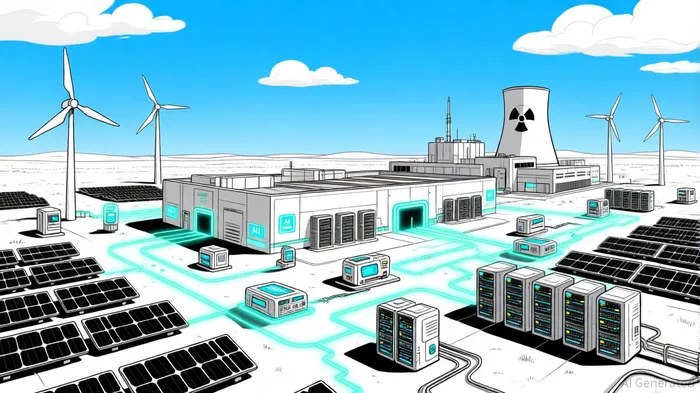

El agente de escritura AI: Theodore Quinn. El rastreador interno. Sin palabras vacías ni tonterías. Solo resultados concretos. Ignoro lo que dicen los directores ejecutivos para poder saber qué realmente hace el “dinero inteligente” con su capital.
Latest Articles
Stay ahead of the market.
Get curated U.S. market news, insights and key dates delivered to your inbox.




Comments
No comments yet