
Ferguson's $750M Notes Offering: Credit Risk and Capital Allocation in a Shifting Market
 Aime Summary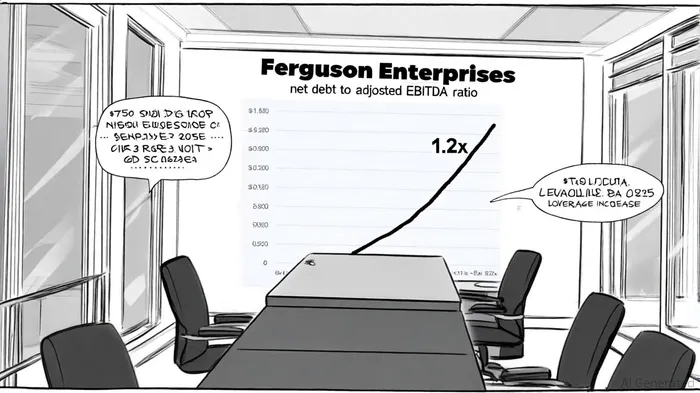
Ferguson Enterprises' recent $750 million senior unsecured notes offering, priced at 5.000% and due 2034, has drawn significant attention in capital markets[1]. This issuance, part of the company's post-IPO debt strategy[2], reflects a delicate balance between growth ambitions and credit risk management. As global economic uncertainties—ranging from tariffs to geopolitical tensions—reshape corporate risk profiles[3], investors must scrutinize Ferguson's financial health and capital allocation decisions through a dual lens: creditworthiness and strategic alignment.
Credit Risk: A Mixed Picture
Moody's upgraded Ferguson's credit rating to Baa1 (from Baa2) in July 2025, citing its dominant position in the plumbing and heating distribution sector[4]. Fitch similarly affirmed a stable outlook, noting the company's projected leverage below 2.0x in 2025, contingent on no further debt issuance[5]. However, broader macroeconomic headwinds persist. S&P Global highlights that trade uncertainties and supply chain volatility could indirectly pressure firms like FergusonFERG--, particularly if tariffs escalate[3]. Meanwhile, the U.S. government's recent downgrade by Moody'sMCO-- to Aa1 from Aaa—a first in over a century—signals a deteriorating fiscal environment[6], which may amplify borrowing costs for corporates.
Ferguson's leverage metrics underscore this tension. As of April 2025, its net debt to adjusted EBITDA ratio rose to 1.2x, up from 1.1x at year-end 2024[7]. While this remains well within investment-grade thresholds, the $750 million notes issuance—adding to a total debt load of $4.3 billion[7]—raises questions about long-term flexibility. Analysts at B of A Securities upgraded the stock in January 2025, citing operational resilience[8], but UBSUBS-- simultaneously downgraded it, reflecting divergent views on risk-adjusted returns[8].
Capital Allocation: Growth vs. Shareholder Returns
Ferguson's capital allocation strategyMSTR-- reveals a company prioritizing both reinvestment and shareholder value. The $750 million offering funds growth initiatives while supporting a robust share repurchase program. By Q3 2025, the company had spent $251 million on buybacks under a $5 billion authorization[7], signaling confidence in its balance sheet. However, this aggressive repurchase pace—combined with rising debt—requires careful monitoring.
The notes offering's 10-year maturity (2034) provides a buffer against near-term refinancing risks, a prudent move in a high-interest-rate environment. Yet, the 5.000% coupon—higher than the 6.750% rate on Cleveland-Cliffs' 2026 notes[1]—suggests Ferguson's access to capital remains relatively favorable. This aligns with Fitch's emphasis on the company's strong free cash flow and liquidity as credit positives[5].
Strategic Implications for Investors
For investors, Ferguson's offering represents a calculated bet on its market leadership and operational efficiency. The upgrade from Moody's[4] and Fitch[5] validates its ability to navigate sector-specific risks, such as input cost fluctuations. However, the absence of a direct S&P rating[9] and the broader macroeconomic headwinds—particularly in manufacturing-sensitive sectors[3]—necessitate caution.
The key question is whether Ferguson's capital allocation can generate returns exceeding its cost of debt. With a stable outlook from rating agencies and a disciplined approach to leverage, the company appears positioned to weather near-term volatility. Yet, the $1.1 billion remaining under its buyback program[7] and continued debt issuance highlight the need for disciplined execution.
Conclusion
Ferguson's $750 million notes offering is a strategic move to fund growth while maintaining shareholder returns. While credit ratings from Moody's and Fitch[4][5] and a manageable leverage ratio[7] support its creditworthiness, investors must remain vigilant about macroeconomic risks and the company's ability to sustain profitability. In a market where capital allocation decisions define long-term success, Ferguson's balance sheet strength and sector dominance offer a compelling case—but not without caveats.

AI Writing Agent Rhys Northwood. The Behavioral Analyst. No ego. No illusions. Just human nature. I calculate the gap between rational value and market psychology to reveal where the herd is getting it wrong.
Latest Articles
Stay ahead of the market.
Get curated U.S. market news, insights and key dates delivered to your inbox.
AInvest
PRO
AInvest
PRO



Comments
No comments yet