
The FedWatch Probability Of September Rate Cut Exceeds 90%, Are Investors Overly Confident Now?
Now, investors are overly confident about the prospect of the Federal Reserve cutting interest rates in September.
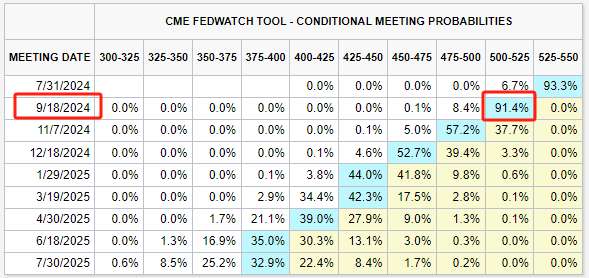
After a round of pleasing macro data in June, including better-than-expected CPI and further cooling of the labor market, the probability of a first cut in September on the CME FedWatch has now exceeded 90%, while a month ago, this probability was only 70%.
Matthew Luzzetti, the chief US economist at Deutsche Bank, wrote in his research note last Friday: Recent data have shown a continued softening in the labor market and substantial cooling in inflation pressures, importantly in the all-important shelter category. These developments should materially impact the outlook for monetary policy.
Before this, some Wall Street people have been calling for the Federal Reserve to start cutting interest rates before high interest rates hurt the US economy, so as not to plunge the labor market into chaos. However, in the face of macro data that has repeatedly exceeded expectations in the first half of the year, including the continued hot job market, this view is more like a kind of anxiety of overanxiousness, and a warning without evidence.
And this voice was eventually drowned out in the Federal Reserve's official statements full of redundant and verbose language.
However, now that the job market and price levels have finally started to cool down, along with Powell's softened attitude, these views have started to become active in the market again.
Jan Hatzius, the chief economist at Goldman Sachs, said in a recent report: Using the latest unemployment and inflation numbers, we estimate that the median of the Fed staff's monetary policy rules now implies a funds rate of 4%, well below the actual rate of 5.25% - 5.50%. Based on this observation, the encouraging June CPI, and Chair Powell's congressional testimony last week, we expect adjustment cuts to start soon.
It is worth noting that Hatzius even believes that the Federal Reserve should start cutting interest rates at the end of this month's FOMC meeting, rather than delaying until September.
First, if the case for a cut is clear, why wait another seven weeks before delivering it? Second, monthly inflation is volatile and there is always a risk of a temporary reacceleration, which could make a September cut awkward to explain. Starting in July would sidestep that risk.
Hatzius also pointed out that although the Federal Reserve has promised that its monetary policy decisions will be independent of the results of the presidential election in the second half of the year, only by starting to cut interest rates in July can it effectively avoid speculation about the political motives behind its policy decisions.
Of course, for the Federal Reserve, this kind of external noise and anxiety seems not to change their stance - Powell and his colleagues are still sticking to their ambiguous statements: For example, on Monday, the Federal Reserve chairman said that the recent data has increased the central bank's confidence that inflation will fall to the target. However, he still refused to specify what this means for the Federal Reserve's interest rate cut schedule.
I'm not going to be sending signals on any particular meeting. We are going to make these decisions meeting by meeting and the evolving data and the balance of risks, Powell said in an interview at the Economic Club of Washington.
However, regardless of whether the interest rate cut in July is possible, investors' confidence in the future direction of interest rates is now driving the stock market to a broader rebound: the U.S. stock market continued to rise at the close on Tuesday, the S&P reached a new high, and the Dow Jones even rose by more than 740 points, the best single-day gain in more than a year.
At the same time, funds have also begun to shift from technology giants to small-cap stocks and value stocks. For example, the real estate (XLRE) and industrial (XLI) sectors, which are sensitive to interest rates, have become the biggest winners in the market over the same period - both rising by about 5%. The Russell 2000 index (RUT), which covers small-cap stocks, has risen by more than 10% and has broken through the 2022 high for the first time in the current bull market.
In this regard, Tom Lee, the head of research at Fundstrat Global Advisors, pointed out that the decline in the consumer price index in June is green-lighting the rebound of small-cap stocks, and this sector rotation may bring up to 40% gains to the index.
Callie Cox, the chief market strategist at Ritholtz Wealth Management, also said on Monday: If this trade continues, if the prospect for a rate cut is still in play for this fall, then we could finally see the bull wake up, and that's good news for all investors.

Expert analysis on U.S. markets and macro trends, delivering clear perspectives behind major market moves.
Latest Articles
Stay ahead of the market.
Get curated U.S. market news, insights and key dates delivered to your inbox.
AInvest
PRO
AInvest
PRO



Comments
No comments yet