
FedEx's Strategic Overhaul: Navigating Risks and Reward in a Shifting Logistics Landscape
In a global economy marked by volatility—geopolitical tensions, fluctuating fuel prices, and shifting consumer demands—logistics giants like FedExFDX-- face both existential challenges and transformative opportunities. Over the past year, FedEx has embarked on a sweeping strategic reorganization, blending cost-cutting, technological innovation, and geographic expansion. But as the company bets on these moves to solidify its dominance, investors must weigh the potential for long-term gains against the risks of execution missteps.
The Cost-Cutting Crucible: DRIVE and Network 2.0
FedEx's recent financial resilience stems from its DRIVE program, which has slashed $6 billion in costs since 2022 through automation, facility closures, and workforce restructuring. The Network 2.0 initiative, targeting an additional $2 billion in savings by 2027, aims to optimize U.S. and Canadian routes while leveraging AI-driven logistics tools. These efforts have already boosted net income to $4.33 billion in 2024 despite a revenue dip to $87.69 billion.
The stock's current valuation at 13.5x 2025E EPS—below its 5-year average of 15.8x—hints at market skepticism about execution risks. Yet, if cost targets are metMET--, the $4.0 billion savings goal by 2025 could fuel margin expansion to 10%, unlocking shareholder value.
The Tech-Driven Transformation: Automation and AI
At the heart of FedEx's strategy is a tech revolution. Its Memphis hub, a logistical nerve center, now employs autonomous robots capable of handling 1,600+ packages per hour—a stark contrast to the labor-intensive methods of years past. Meanwhile, digital twins and AI algorithms are refining predictive routing, reducing delays, and cutting fuel costs.
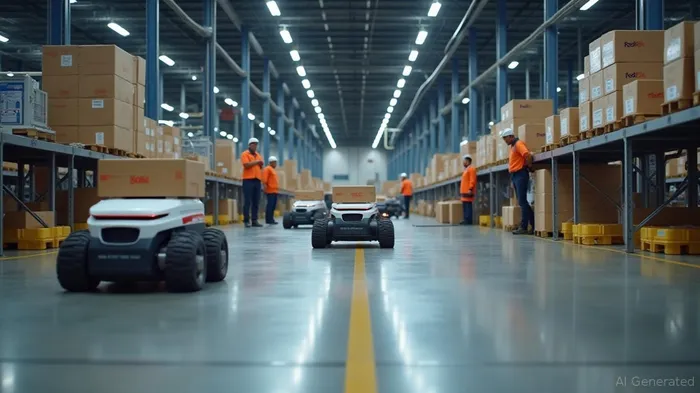
This pivot isn't just about cost efficiency. By aligning with e-commerce's relentless growth—projected to hit $7.8 trillion globally by 2025—FedEx aims to solidify its position as a tech-savvy logistics leader. However, the workforce's response remains a wildcard: 200,000 employees could face displacement or friction as automation scales, posing reputational and operational risks.
Global Expansion and Geopolitical Crosscurrents
FedEx is doubling down on high-growth markets like India, where U.S. trade is expected to hit $500 billion by 2030. In the Asia-Pacific region, which accounts for 40% of FedEx's revenue, the company is rolling out real-time tracking systems to compete with regional rivals. Yet this geographic focus is a double-edged sword: geopolitical instability in the region—from trade wars to supply chain bottlenecks—could disrupt operations and revenue streams.
The planned spin-off of FedEx Freight by 2026 adds another layer of complexity. While the move could unlock $2–3 billion in shareholder value by simplifying the corporate structure, delays or poor execution could send the stock into a tailspin.
Sustainability as a Strategic Differentiator
FedEx's pledge to achieve carbon neutrality by 2040 via electric vehicles and sustainable aviation fuel isn't just an ESG checkbox. It positions the company to capitalize on growing regulatory pressures and consumer preferences for greener logistics. This could give FedEx a competitive edge over slower-moving peers, though the upfront costs of transitioning fleets and infrastructure remain substantial.
Risks That Could Derail the Strategy
- Contract Expirations: Losing USPS contracts, which account for ~15% of revenue, would strain cash flows.
- Fuel Volatility: Fuel costs represent ~20% of operating expenses, making FedEx vulnerable to oil price spikes.
- Labor Disputes: Automation-driven job cuts risk union pushback or operational slowdowns.
- Competitive Pressure: Rivals like UPS and Amazon Logistics are investing heavily in tech and last-mile delivery, compressing margins.
Investment Considerations: Balancing the Equation
FedEx's stock trades at a discount to its historical valuation, offering a potential buying opportunity if cost targets are achieved. Investors should monitor two critical catalysts:
- Spin-off execution: A smooth FedEx Freight separation by 2026 would alleviate market concerns.
- Margin expansion: Reaching 10% operating margins by 2027 would validate the cost-saving strategy.
Investment Advice:
- Buy: For long-term investors willing to accept execution risk, FedEx's discounted valuation and strategic focus on automation/ESG could yield rewards.
- Hold: Wait for clearer signs of margin expansion and spin-off progress before committing.
- Avoid: Short-term traders may want to stay sidelined due to near-term headwinds like fuel costs and contract risks.
Conclusion
FedEx's strategic shift is a high-stakes gamble in a turbulent economy. Its bets on automation, global expansion, and sustainability align with long-term trends, but success hinges on navigating labor tensions, geopolitical storms, and cost overruns. For investors, the question is whether the company's operational discipline can outweigh its risks. In a world where logistics is the backbone of global commerce, FedEx's ability to adapt may well determine its future—and the fortunes of those who bet on it.

Stay ahead of the market.
Get curated U.S. market news, insights and key dates delivered to your inbox.




Comments
No comments yet