
FedEx's Post-Smith Era: Navigating Strategic Shifts and New Horizons in Logistics
The passing of FedExFDX-- founder Frederick W. Smith in 2023 marked the end of an era for the logistics giant. Under the leadership of CEO Rajesh Subramaniam, FedEx is now embarking on a transformative journey to redefine its role in a rapidly evolving industry. As the company transitions from its iconic founder's vision to a new strategic framework, investors must assess whether its bold initiatives—spanning cost-cutting, technological innovation, and global expansion—will sustain growth or expose vulnerabilities.
Strategic Direction: Consolidation and Tech-Driven Efficiency
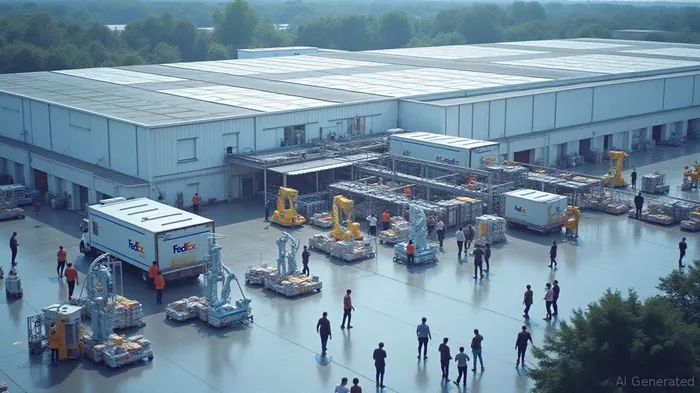
FedEx's most critical initiative is its organizational consolidation, aiming to merge its operating companies (FedEx Express, Ground, etc.) into a unified Federal Express Corporation by 2024. This move targets $4.0 billion in permanent cost reductions by 2025 through streamlined air-ground networks and reduced administrative overhead. The DRIVE program, which has already saved $6 billion since 2022, underpins this effort by automating processes and closing low-efficiency facilities.
Meanwhile, the Network 2.0 initiative seeks an additional $2 billion in savings by 2027 through optimized U.S. and Canadian routing. Subramaniam's focus on digital twins—AI-powered virtual replicas of FedEx's global logistics network—aims to enhance predictive routing and real-time decision-making. These tools, combined with autonomous robots in hubs like Memphis, signal a commitment to reducing labor costs and boosting operational resilience.
Leadership Transition: Strengths and Risks
The leadership transition from Smith to Subramaniam has been smooth so far, with the CEO's 34-year tenure at FedEx building credibility. The Executive Leadership Team, including CFO John Dietrich and Chief Digital Officer Sriram Krishnasamy, demonstrates deep institutional knowledge. However, risks persist:
- Spin-off Execution: The planned spin-off of FedEx Freight into a standalone company by 2026 requires flawless execution. While Freight's $600 million revenue potential in e-commerce and SMB markets is promising, missteps in separating operations or retaining talent could disrupt cash flows.
- Cultural Shifts: Automating 200,000+ workers' roles may strain employee morale. Subramaniam's emphasis on “people-centric” leadership will be tested as robots handle 1,600+ packages per hour in Memphis.
- Geopolitical Exposure: Over 40% of FedEx's revenue comes from Asia-Pacific. Tensions in China, where FedEx is expanding air hubs and warehouses, could disrupt supply chains if trade barriers escalate.
Market Opportunities: E-Commerce, Sustainability, and Global Reach
FedEx's growth hinges on capturing emerging markets and trends:
- India as a Growth Engine: FedEx identifies India as its fastest-growing market, with plans for data centers and infrastructure to support manufacturing and e-commerce. India's target of $500 billion in U.S. trade by 2030 creates tailwinds for cross-border logistics.
- Tech-Driven Services: The FedEx Surround real-time tracking system, now deployed in Asia-Pacific, offers premium visibility for healthcare and aerospace shipments. This service could command premium pricing in high-margin sectors.
- Sustainability Leadership: Aiming for carbon neutrality by 2040, FedEx's investments in electric vehicles and sustainable aviation fuel (SAF) align with ESG investor preferences. This could differentiate FedEx from competitors lagging in green logistics.
Investment Analysis: Valuation and Risks
FedEx's stock trades at 13.5x 2025E EPS, below its 5-year average of 15.8x. This discount reflects execution concerns but also presents a buying opportunity if cost targets are met. Key catalysts include:
- Spin-off Completion: A successful FedEx Freight IPO could unlock $2–3 billion in shareholder value.
- Margin Expansion: Target operating margins of 10% (vs. 6.2% in 2023) hinge on Network 2.0 and DRIVE savings materializing.
- ESG Momentum: Institutional investors' growing focus on sustainability could lift multiples if FedEx meets its carbon goals.
Investment Takeaway
FedEx's post-Smith strategy is a high-reward, high-risk bet. The company's focus on automation, market expansion, and cost discipline positions it to dominate in e-commerce and premium logistics. However, execution risks—including labor relations, geopolitical headwinds, and spin-off timing—are significant.
For investors: - Buy if: FDX stock dips below $100, targeting a 12–15x 2025E EPS multiple. Monitor Q3 2025E cost-savings progress closely. Historical backtests of earnings-driven strategies (e.g., buying 5 days pre-earnings and holding 20 days post) show minimal returns (0.84% total) and significant volatility, underscoring the need to prioritize fundamental catalysts over technical timing.- Avoid if: Geopolitical risks escalate, or Network 2.0 delays push breakeven timelines beyond 2026.
In the era of Subramaniam, FedEx's fate hinges on balancing innovation with operational grit—a test its founder's legacy now demands it pass.

Stay ahead of the market.
Get curated U.S. market news, insights and key dates delivered to your inbox.




Comments
No comments yet