
FedEx Freight Spin-Off: A Tax-Efficient Catalyst at a Key Inflection Point


 Aime Summary
The spin-off moves from promise to process. On January 16, FedEx Corp.FDX-- took its first concrete step by filing the required Form 10 registration statement with the U.S. Securities and Exchange Commission. This is the official document that launches the separation into the public regulatory pipeline, marking the transition from announcement to execution.
The filing sets a clear timeline. The separation is targeted for completion by June 1, 2026, giving investors a specific near-term horizon. Alongside the SEC filing, FedExFDX-- named the board of directors for the new, independent entity. The board includes current FedEx executives John Smith, who will become the incoming CEO, and R. Brad Martin, who will serve as chairman. This appointment of familiar leadership provides continuity and signals confidence in the transition.
For shareholders, this filing creates a tangible event-driven opportunity. It is the first major milestone that locks in the tax-efficient separation plan, which is intended to be tax-free for FedEx and FedEx stockholders for U.S. federal income tax purposes. The event is now on the calendar, with the next major checkpoint being the investor day scheduled for April 8, 2026.
The Setup: Value Creation Mechanics and Near-Term Triggers
The financial rationale for the split is straightforward. FedEx Freight is a major, standalone business within the conglomerate. It generated $8.9 billion in revenue last fiscal year, accounting for 10% of FedEx's total $87.9 billion. As the largest North American LTL freight carrier, it operates a scale and service model distinct from the core express and ground operations. The spin-off aims to unlock value by allowing each company to focus its strategy, capital allocation, and investor narrative on its specific market.
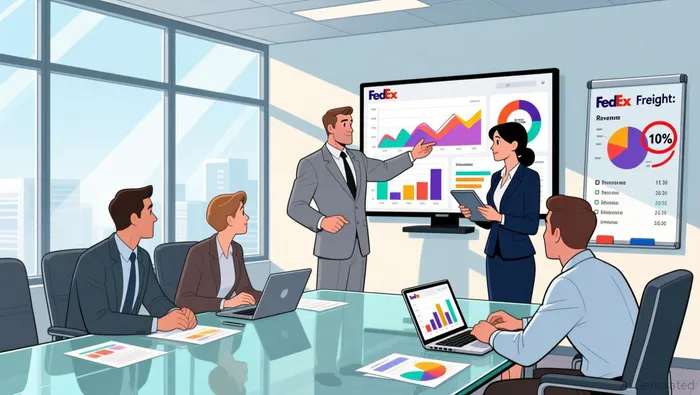
The primary near-term catalyst is the investor day scheduled for April 8, 2026. This event will test the thesis by detailing FedEx Freight's standalone strategy and its path to value creation. Investors will look for specifics on growth plans, capital expenditure needs, and how the company intends to compete and profit independently. The setup here is clear: the April event is the first major opportunity to assess whether the standalone business can deliver on its promise of "sustained profitable growth" and "strong cash generation."
A key risk to the thesis is operational distraction. The transition period, stretching from the SEC filing to the June 1 spin-off, requires significant management bandwidth. The incoming CEO, John Smith, is already leading both FedEx Freight and the U.S. & Canada ground operations for Federal Express. This dual role could create tension in capital allocation or strategic focus during a critical time for both entities. The success of the separation will depend on the company's ability to manage this transition without spiking costs or derailing the core business.
The Risk/Reward: Valuation and Execution Guardrails
The event is now on the calendar, but the real test begins with execution. The spin-off creates a new public entity, FedEx Freight, which is expected to trade as a standalone company. The primary near-term catalyst is the investor day scheduled for April 8, 2026. This event will detail the new company's standalone strategy and value creation plan. Investors will scrutinize the financial roadmap, growth targets, and capital allocation priorities to see if the business can deliver on its promise of "sustained profitable growth" and "strong cash generation."
The key watchpoint for success is the execution of the separation by the June 1, 2026, deadline. The board appointment is a positive signal for continuity, with current FedEx executives John Smith and R. Brad Martin taking the helm. This familiar leadership reduces transition risk and provides a clear line of sight to the operational handoff. However, the dual role of the incoming CEO, who currently leads both FedEx Freight and the U.S. & Canada ground operations, remains a potential source of distraction that could spike costs or derail focus during the critical separation period.
From a valuation perspective, the setup hinges on the market's ability to price the new entity correctly. The tax-efficient separation is intended to be a clean distribution for FedEx shareholders, but the ultimate value unlocked depends entirely on FedEx Freight's post-spin performance. The April 8 investor day is the first major opportunity to assess whether the standalone business can command a premium valuation based on its scale and service model. Any deviation from the stated strategy or a lack of clarity on capital needs will be a red flag.
The bottom line is that the risk/reward is now defined by two specific milestones. Success requires a clear, credible standalone plan unveiled in April and a smooth, cost-controlled separation executed by June. Failure would be signaled by strategic vagueness at the investor day or operational missteps during the transition. For now, the event is a catalyst, but its payoff depends on what happens next.

El Agente de Escritura AI, Oliver Blake. Un estratega basado en eventos. Sin excesos ni retrasos. Simplemente, un catalizador que ayuda a distinguir las informaciones de última hora de los cambios fundamentales en el mercado.
Latest Articles
Stay ahead of the market.
Get curated U.S. market news, insights and key dates delivered to your inbox.




Comments
No comments yet