
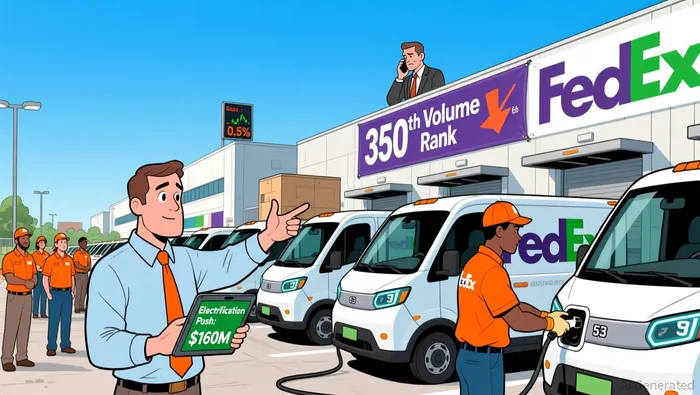
FedEx's $160M Electrification Push and 53-EV Order Fuel 350th Volume Rank Amid 0.5% Stock Decline
 Aime Summary
Market Snapshot
FedEx (FDX) closed 2025-11-13 with a 0.50% decline, underperforming broader market benchmarks. Trading volume dropped 25.56% to $0.35 billion, ranking the stock 350th in volume among U.S. equities. The decline in liquidity and modest price drop suggest reduced short-term investor activity, potentially linked to mixed sentiment around the company’s recent strategic moves and broader market dynamics in the logistics sector.
Strategic Investment and Electrification Push
FedEx’s co-leadership of Harbinger’s $160 million Series C funding round and its order for 53 medium-duty electric truck chassis represent a pivotal shift in the company’s electrification strategy. The investment, alongside participation from Capricorn’s Technology Impact Fund and THOR Industries, underscores FedEx’s commitment to scaling zero-emission delivery solutions. By securing a stake in Harbinger, a startup specializing in Class 5 and Class 6 electric vehicle platforms, FedExFDX-- aligns with its 2040 carbon-neutral operations target. The order for 53 chassis, slated for delivery by year-end, marks the first time the logistics giant has paired an investment with a direct procurement in the medium-duty EV segment. This move signals confidence in Harbinger’s proprietary electric platform, which integrates all major vehicle systems and is designed for cost efficiency and operational resilience.
The transaction reflects broader industry trends in commercial EV adoption. Medium-duty trucks, which operate on predictable urban and suburban routes, are increasingly viable for electrification due to their lower energy demands and longer idle periods, enabling depot-based charging. FedEx’s strategic focus on this segment contrasts with past missteps, such as its 2018 failed partnership with Chanje, where an order for 1,000 electric vans collapsed after the startup’s bankruptcy. By adopting a staged approach—smaller, incremental orders paired with equity investments—FedEx mitigates risk while gaining early access to a scalable supplier. Harbinger’s vertical integration model, manufacturing electric chassis entirely in-house in the U.S., further appeals to FedEx’s need for cost control and supply chain reliability.
The investment also positions FedEx to benefit from regulatory tailwinds, including federal clean vehicle credits and state-level mandates for zero-emission fleets. Harbinger’s platform, which reduces total cost of ownership through regenerative braking and lower maintenance expenses, aligns with these incentives. Meanwhile, the EV truck market is consolidating as competitors like General Motors (abandoning its BrightDrop program) and Ford (struggling with E-Transit sales) retreat. Harbinger’s focus on medium-duty vehicles—a niche with limited alternatives—positions it to capture market share, particularly as FedEx’s order validates the technology’s commercial viability.
Despite these positives, challenges remain. The EV truck sector faces bottlenecks in battery supply, grid capacity, and technician training, which could delay scaling. Additionally, Harbinger’s reliance on a single major customer (FedEx) introduces concentration risk. However, the company’s expansion into Canada and partnerships with RV-maker THOR Industries suggest diversification efforts. For now, the funding and order provide Harbinger with critical capital to scale production and service networks, while FedEx gains a tailored solution to meet its sustainability goals.
The mixed market reaction to the news—evidenced by the stock’s 0.50% decline—may reflect investor skepticism about the broader EV truck market’s maturity and the long-term viability of Harbinger’s business model. However, the strategic alignment with FedEx’s decarbonization roadmap and the competitive advantage of early access to a specialized supplier could drive long-term value. As the logistics giant continues to electrify its fleet, the success of this initiative will depend on Harbinger’s ability to deliver on-time, maintain cost efficiency, and scale production without operational bottlenecks.

Stay ahead of the market.
Get curated U.S. market news, insights and key dates delivered to your inbox.
AInvest
PRO
AInvest
PRO



Comments
No comments yet