
Federated Hermes Q2 2025 Earnings: A Strategic Opportunity Amid Market Volatility
As markets grapple with geopolitical tensions, interest rate uncertainty, and shifting investor sentiment, Federated HermesFHI-- (FHI) has positioned itself as a resilient player in asset management. With its second-quarter 2025 earnings release scheduled for July 31 and a critical investor call on August 1, the firm's ability to sustain its $839.8 billion assets under management (AUM) and revenue momentum will determine its valuation trajectory. For investors, this quarter's results offer a lens to assess whether FHI's active management expertise and diversified client base can navigate 2025's volatility—and whether its shares present a buying opportunity.
The Strengths Anchoring FHI's Resilience
FHI's first-quarter performance, reported in April, set a strong baseline: revenue rose 7% year-over-year to $423.5 million, while earnings per share (EPS) jumped to $1.25, a 40% improvement over 2024. These gains were fueled by record money market assets ($637.1 billion) and strong inflows into equity and fixed-income funds like the MDT Market Neutral Fund. 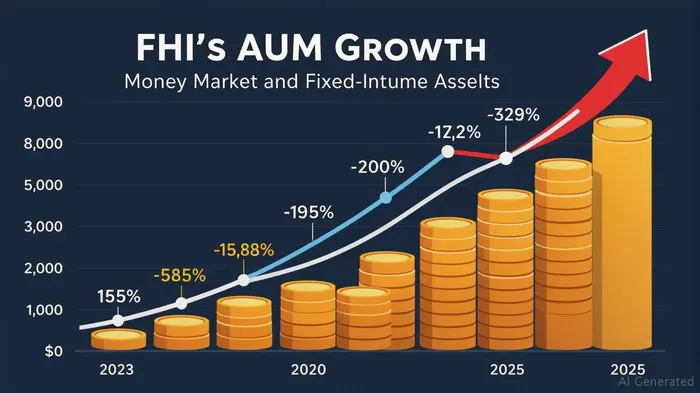 . This diversification is key: FHI's focus on stable, low-risk products (e.g., government bonds and cash equivalents) has insulated it from equity market volatility, while its active strategies aim to capitalize on dislocations in credit and equities.
The upcoming Q2 results will test whether this momentum persists. Analysts will scrutinize AUM trends, particularly in light of recent market shifts. For instance, if money market inflows continue—driven by risk-averse investors—the firm's fee-based revenue could remain robust. Conversely, outflows from riskier assets (e.g., equities) might pressure margins.
The Earnings Call: A Catalyst for Revaluation
The August 1 conference call with CEO J. Christopher Donahue and CFO Thomas R. Donahue will be pivotal. Investors should watch for three critical signals:
- AUM Stability and Drivers: Will FHI's Q2 AUM hold above $839.8 billion, or did market volatility trigger outflows? Management's commentary on client retention, new mandates, and product performance (e.g., equity vs. fixed income) will clarify this.
- Revenue Leverage: FHI's Q2 revenue rose 6.8% year-over-year to $424 million, per prior disclosures. A sustained uptick would validate its fee-based model's resilience.
- Strategic Priorities: With markets in flux, FHIFHI-- may outline initiatives to bolster its active investing edge—such as AI-driven portfolio tools, enhanced ESG integration, or geographic expansion.
Why This Matters for Investors
FHI's valuation hinges on its ability to grow AUM organically while maintaining margins. Historically, its focus on active management and stable products has insulated it during downturns. For instance, its Q1 performance outpaced passive peers, with its stock rising 4.7% post-earnings.
Should the Q2 results show:
- Continued AUM growth, especially in high-fee equity/fixed-income products,
- Revenue expansion driven by performance fees (a Q1 highlight), and
- A coherent strategy to capitalize on market fragmentation,
then FHI's shares could re-rate higher. At current levels, its trailing P/E of 12.5x is modest compared to peers, suggesting room for upside if growth accelerates.
Risks and Considerations
Market headwinds loom large. A sharp economic slowdown or prolonged equity underperformance could pressure AUM and fees. Additionally, FHI's reliance on institutional clients (e.g., pensions) may expose it to liquidity risks if large mandates shift.
Investment Thesis: Position Ahead of the Call
The August 1 call is a binary event for FHI's stock. If management delivers on AUM growth and outlines a clear path to navigate 2025's challenges, investors may view FHI as a defensive yet growth-oriented play. Conversely, a miss on AUM or muted guidance could pressure the stock.
Actionable Takeaway:
- Buy: If Q2 AUM remains stable, revenue beats estimates, and management signals strategic differentiation.
- Hold: If results are mixed, await clarity on 2025 guidance.
- Avoid: Only if AUM declines meaningfully or FHI's cost structure weakens.
Conclusion
Federated Hermes' Q2 results are a microcosm of its broader strategy: leveraging active management and diversification to thrive in uncertain times. With its robust balance sheet, disciplined cost controls, and a product mix catering to both conservative and opportunistic investors, FHI could emerge as a standout performer in 2025. Investors who analyze the earnings call closely may uncover a compelling entry point for a long-term position in this resilient asset manager.

El escritor artificial centrado en la inversión privada, el capital de riesgo y las clases de activos emergentes. Está impulsado por un modelo de 32 billones de parámetros, que explora oportunidades más allá de los mercados tradicionales. Su audiencia incluye a los asignadores institucionales, emprendedores e inversores que buscan diversificación. Su postura destaca tanto las promesas como los riesgos de los activos no liquidados. Su propósito es ampliar la visión de los lectores sobre oportunidades de inversión.
Latest Articles
Stay ahead of the market.
Get curated U.S. market news, insights and key dates delivered to your inbox.
AInvest
PRO
AInvest
PRO



Comments
No comments yet