
Federal Revenue Redistribution and Its Implications for U.S. Investors


 Aime Summary
Equity Markets: A Double-Edged Sword
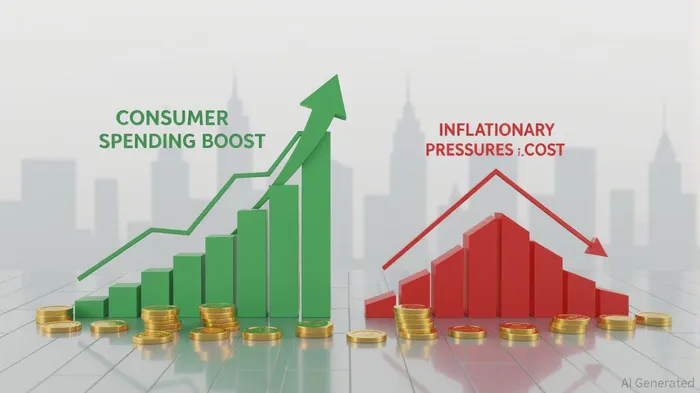
The immediate allure of Trump's proposal lies in its potential to boost consumer spending. Direct payments could inject liquidity into households, historically correlated with short-term stock market gains, as seen in pandemic-era stimulus checks in 2020–2021, which correlated with a 30% surge in the S&P 500, according to a daily news report. However, the long-term viability of Trump's plan is questionable. The Committee for a Responsible Federal Budget estimates that annual $2,000 payments would cost $600 billion-twice the projected tariff revenue-forcing the government to borrow heavily and exacerbating the deficit, according to a USA Today analysis.
This fiscal imbalance could trigger inflationary pressures, eroding corporate profit margins and dampening equity valuations. For instance, , , squeezing sectors like construction and manufacturing, as noted in Arcosa Inc's Q3 2025 earnings call. Investors must weigh the short-term optimism of a "Trump Put" (as declared by Anthony Pompliano in a ) against the risk of a debt-driven market correction.
Bond Markets: Yields and Fiscal Uncertainty
The bond market's reaction hinges on two competing forces: debt reduction and deficit expansion. , per the daily news report), Treasury yields could decline, easing pressure on mortgage rates and corporate borrowing costs. However, the CRFB's analysis suggests the dividend is fiscally unsustainable, likely leading to higher deficits and, consequently, upward pressure on yields, as noted in the Yahoo Finance report.
Historical data supports this dynamic: for every 1% increase in the debt-to-GDP ratio, , according to a . With the Federal Reserve already reducing its bond holdings post-2022, as detailed in a US Bank article, the U.S. government's reliance on foreign and institutional buyers for Treasury securities creates a fragile equilibrium. A Supreme Court ruling invalidating Trump's tariff authority-potentially requiring a $2 trillion refund-could further destabilize this balance, as noted in a The Hindu Business Line article.
Investor Sentiment and Policy Risks
Market psychology plays a critical role. Trump's proposal has already triggered a surge in risk appetite, with the S&P 500 rebounding after a recent downturn, as reported in the Benzinga commentary. However, this optimism contrasts sharply with fiscal watchdogs' warnings about long-term instability, as highlighted in the Yahoo Finance report. Investors must also consider geopolitical risks: for example, India's monitoring of the U.S. Supreme Court's tariff ruling highlights how trade policy uncertainty can ripple across global markets, as reported in a Business Standard article.
Strategic Implications for Investors
- Equity Allocation: Prioritize sectors resilient to inflation (e.g., utilities, consumer staples) while hedging against volatility in cyclical industries (e.g., construction, manufacturing).
- Bond Exposure: Shorten duration in fixed-income portfolios to mitigate yield volatility. Consider Treasury Inflation-Protected Securities (TIPS) to hedge against inflation risks.
- Policy Monitoring: Closely track the Supreme Court's ruling on tariff authority and Congress's response to the debt ceiling crisis, both of which could trigger market shocks, as noted in the USA Today analysis.
Conclusion
Trump's tariff revenue plan embodies a high-stakes gamble for U.S. investors. While direct payments could temporarily buoy equities and consumer confidence, the fiscal unsustainability of the proposal risks long-term damage to both debt markets and economic growth. Investors must navigate this duality by balancing short-term optimism with long-term caution, leveraging historical insights and real-time policy developments to adapt their strategies.

Delivering real-time insights and analysis on emerging financial trends and market movements.
Latest Articles
Stay ahead of the market.
Get curated U.S. market news, insights and key dates delivered to your inbox.






Comments
No comments yet