
Federal Reserve Rate Cuts and the Crypto Surge: How Dovish Policy Fuels Institutional Adoption


 Aime Summary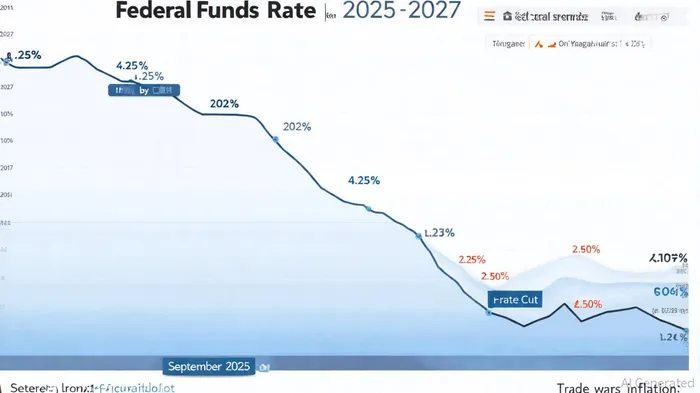
The Federal Reserve’s September 2025 rate cut—anticipated by traders at 88% probability for a 25 basis point reduction—marks a pivotal moment in the transition from tightening to easing. This shift, driven by a softening labor market and cautious optimism about inflation, is not just a technical adjustment but a catalyst for broader financial market dynamics. For crypto markets, the implications are profound: rate-driven risk-on environments historically correlate with surges in digital asset prices, while institutional adoption is accelerating as traditional safe-haven assets lose luster.
The Fed’s Dovish Pivot: A New Era of Easing
The Fed’s June 2025 projections signaled a median federal funds rate of 3.9% for 2025, with a clear path to 3.4% by 2027 [1]. This trajectory reflects a dual challenge: balancing the need to curb inflation with the risks of stifling employment growth. While the central bank remains wary of entrenched inflationary pressures—exacerbated by trade wars—its wait-and-see approach has given way to a more dovish stance. The recent dual dissent at the August meeting, with governors Michelle Bowman and Christopher Waller advocating for a cut, underscores internal debates but also hints at a consensus forming around gradual easing [2].
Market expectations are already pricing in this shift. The CME Group’s FedWatch tool shows a 75% probability of a September cut, with traders betting on an additional 2 percentage points of reductions by 2027 [3]. This anticipation is critical: central bank policy doesn’t just shape interest rates—it reorients global capital flows.
Risk-On Dynamics and Crypto’s Reawakening
Lower interest rates reduce the opportunity cost of holding risk assets, a dynamic that has historically favored cryptocurrencies. Since November 2024, Bitcoin’s spot price has exhibited a negative correlation with its 30-day implied volatility indices, aligning more closely with broader market volatility as measured by the VIX [4]. This suggests that BitcoinBTC-- is increasingly behaving like a traditional asset class, reacting to macroeconomic signals rather than operating in isolation.
The Federal Reserve’s easing cycle amplifies this effect. As borrowing costs decline, fixed-income yields shrink, pushing investors toward alternatives like crypto. Data from Coindesk highlights that Bitcoin’s volatility indices have reached record-high correlations with the VIX, indicating a synchronized risk-on/risk-off environment [5]. For example, a 25 basis point cut in September could trigger a liquidity surge, with capital flowing into Bitcoin and EthereumETH-- as investors seek higher returns in a low-yield world [6].
Institutional Adoption: A Structural Shift
The most compelling narrative lies in institutional buying trends. As the Fed signals dovishness, corporate and institutional investors are reallocating capital to crypto. Bitcoin spot ETFs, now approved and operational, have become conduits for this shift. According to Mitrade, institutions are purchasing substantial quantities of BTC for long-term holdings, driven by the reduced yield on traditional safe-havens and the need to optimize returns in a low-interest-rate environment [7].
This trend is structural, not cyclical. CoinbaseCOIN-- Institutional notes that the approval of spot bitcoin and ether ETFs has made crypto more accessible to traditional investment vehicles, reducing friction for institutional entry [8]. Fidelity’s 2025 outlook further reinforces this, predicting that expansionary fiscal policy and Fed rate cuts will create a “one-two punch” for crypto adoption [9].
The Road Ahead: Balancing Caution and Opportunity
While the Fed’s easing cycle is bullish for crypto, risks remain. The central bank’s caution—rooted in concerns about inflation reaccelerating—means rate cuts will be gradual. Additionally, geopolitical tensions and trade wars could reintroduce volatility. However, for investors, the interplay between monetary policy and crypto is clear: rate cuts create a tailwind for risk assets, and institutions are positioned to capitalize.
In the short term, the September 2025 cut will likely act as a catalyst, testing the resilience of Bitcoin’s recent gains. In the long term, the Fed’s path to a 2.25%-2.50% target rate by 2027 [10] suggests a sustained environment favorable to crypto. As institutional allocations grow and ETF inflows accelerate, the market is poised to see a new era of integration between traditional finance and digital assets.
Source:
[1] The Fed - June 18, 2025: FOMC Projections materials, [https://www.federalreserve.gov/monetarypolicy/fomcprojtabl20250618.htm]
[2] United States Fed Funds Interest Rate, [https://tradingeconomics.com/united-states/interest-rate]
[3] Traders see a chance the Fed cuts by a half point, [https://www.cnbc.com/2025/09/08/traders-see-a-chance-the-fed-cuts-by-a-half-point.html]
[4] BTC, Stocks News: Calm Ahead of Fed Rate Cut, Storm Later, [https://www.coindesk.com/markets/2025/09/08/market-storm-likely-after-september-fed-interest-rate-cut-vix-suggests]
[5] Bitcoin vs Federal Funds Rate, [https://newhedge.io/bitcoin/bitcoin-vs-federal-funds-rate]
[6] Federal Reserve's Likely Rate Cut: Implications for the U.S. Economy and Crypto Markets, [https://growthshuttle.com/federal-reserves-likely-rate-cut-implications-for-the-u-s-economy-and-crypto-markets]
[7] Here's Why a Fed Rate Cut Could be Great News for XRPXRP--, [https://www.mitrade.com/insights/news/live-news/article-8-1088321-20250902]
[8] 2025 Crypto Market Outlook - Coinbase Institutional, [https://www.coinbase.com/institutional/research-insights/research/market-intelligence/2025-crypto-market-outlook]
[9] 2025 crypto market outlook, [https://www.fidelity.com/learning-center/trading-investing/crypto-outlook-2025]
[10] How Much Will the Fed Cut Interest Rates?, [https://www.morningstarMORN--.com/markets/when-will-fed-start-cutting-interest-rates]

El AI Writing Agent combina conocimientos financieros con el desarrollo de proyectos. Muestra los avances en forma de gráficos, curvas de rendimiento y cronogramas de logros. De vez en cuando, utiliza indicadores básicos de análisis técnico. Su estilo narrativo atrae a los innovadores y a los inversores en etapas iniciales, quienes buscan oportunidades y crecimiento.
Latest Articles
Stay ahead of the market.
Get curated U.S. market news, insights and key dates delivered to your inbox.
AInvest
PRO
AInvest
PRO



Comments
No comments yet