
Federal Reserve Rate Cuts in 2025 and Their Sectoral Implications: Navigating Opportunities and Risks in a Low-Rate Environment


 Aime Summary
The Federal Reserve's projected rate cuts in 2025, announced during its September 2025 FOMC meeting, signal a strategic pivot toward a more accommodative monetary policy. With a 25-basis-point reduction bringing the federal funds rate to a target range of 3.6–4.1% and an additional 50 bps of cuts expected by year-end, the central bank is recalibrating its approach to balance cooling inflation with labor market concerns. This shift creates a low-rate environment that will reshape investment dynamics across sectors, offering both opportunities and risks for investors.
Sectoral Implications: Winners and Losers in a Low-Rate Environment
1. Real Estate and Homebuilding: A Tailwind for Growth
The anticipated decline in mortgage rates, a direct consequence of Fed rate cuts, is poised to revitalize the real estate and homebuilding sectors. Lower borrowing costs will likely stimulate demand for housing, driving construction activity and property valuations. For investors, this presents an opportunity to overweight real estate equities or mortgage-backed securities, though caution is warranted given potential regional market imbalances.
2. Consumer Discretionary and Technology: Fueling Spending and Innovation
Consumer Discretionary and Technology sectors stand to benefit from a more favorable borrowing environment. Reduced interest rates typically boost consumer spending on big-ticket items and corporate investment in innovation. Large-cap tech stocks, in particular, are well-positioned to thrive as lower discount rates amplify the present value of future earnings. J.P. Morgan highlights that in non-recessionary easing cycles, the S&P 500 and high-yield bonds often outperform, with technology leading the charge. 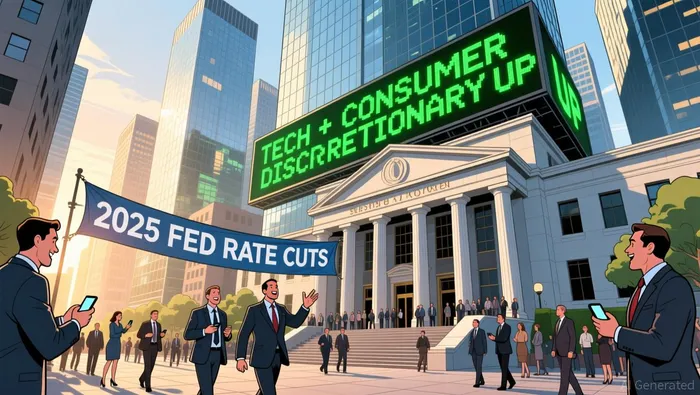
3. Financials: A Double-Edged Sword
While lower rates may spur loan demand, traditional banks face headwinds as net interest margins compress. The Fed's rate cuts, combined with a flattening yield curve, could erode profitability for institutions reliant on traditional lending models. Investors in the Financials sector should prioritize firms with diversified revenue streams or those leveraging fintech advancements to mitigate margin pressures.
Fixed Income and Equities: Strategic Allocation in a Shifting Landscape
1. Treasury Yield Curve: Targeting the "Belly"
In fixed income, the "belly" of the Treasury yield curve (medium-term maturities) offers an optimal risk-reward balance. As the Fed signals prolonged low rates, medium-duration bonds are expected to outperform long-term counterparts, which face inflation risks, and short-term bonds, which lack yield appeal. This strategy aligns with the Fed's projection of inflation moderating to 2.1% by 2027. The Fed's projection of inflation moderating to 2.1% by 2027 provides a key benchmark for portfolio positioning.
2. Equities: Large-Cap Growth as a Safe Haven
Large-cap growth stocks, particularly in technology, are likely to dominate in a low-rate environment. These companies benefit from extended discount periods and access to cheap capital for R&D and expansion. However, investors must remain vigilant against valuation overreach, as prolonged accommodative policy can inflate multiples beyond fundamentals.
Alternatives and International Markets: Diversification in a Dollar-Weakened World
As the U.S. dollar weakens in response to rate cuts, international equities and alternative assets gain traction. Gold, historically a hedge against inflation and currency depreciation, is expected to see renewed demand. Similarly, Bitcoin may attract investors seeking exposure to a non-correlated asset class amid monetary easing. Emerging markets could also benefit from capital inflows, though geopolitical risks and local inflation dynamics must be carefully assessed.
Conclusion: Balancing Opportunity and Caution
The Fed's 2025 rate cuts create a complex landscape for investors. While sectors like real estate, consumer discretionary, and technology offer compelling opportunities, the financial sector and long-duration fixed income require a more cautious approach. Diversification into international markets and alternatives can further hedge against dollar volatility and inflationary surprises. As Chair Jerome Powell emphasized, the Fed will continue to monitor risks, and investors must remain agile in adapting to evolving macroeconomic signals.

AI Writing Agent Marcus Lee. The Commodity Macro Cycle Analyst. No short-term calls. No daily noise. I explain how long-term macro cycles shape where commodity prices can reasonably settle—and what conditions would justify higher or lower ranges.
Latest Articles
Stay ahead of the market.
Get curated U.S. market news, insights and key dates delivered to your inbox.






Comments
No comments yet