
Federal Reserve Policy Uncertainty Amid Government Shutdown Risks: Navigating a Data Vacuum and Market Volatility


 Aime Summary
The U.S. government shutdown in October 2025 has created a perfect storm of uncertainty for the Federal Reserve and financial markets. With key economic data-such as the monthly jobs report and inflation figures-delayed or canceled, the Fed is flying blind as it approaches its critical October 28–29 policy meeting. This "data vacuum" forces policymakers to rely on less reliable private-sector metrics like the ADP payroll report, which lack the granularity and timeliness of official federal data, according to J.P. Morgan. The result? A Federal Reserve struggling to calibrate its response to a cooling labor market and stubborn inflation, all while political brinkmanship in Washington deepens the fog.
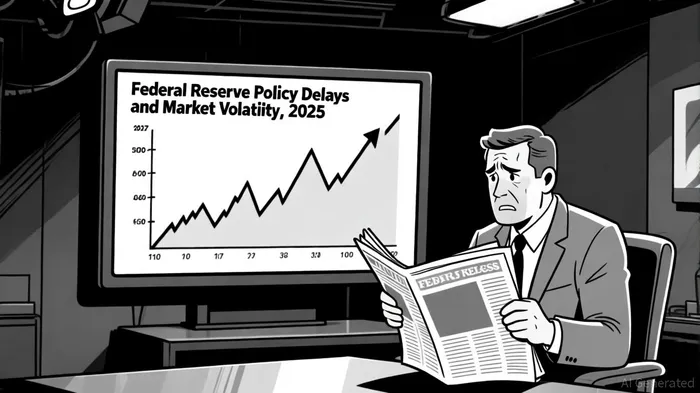
The Data Vacuum and Its Consequences
The shutdown has paralyzed agencies like the Bureau of Labor Statistics (BLS) and the Bureau of Economic Analysis (BEA), leaving the Fed without critical inputs for its monetary policy decisions. According to a report by J.P. Morgan, the delayed release of inflation and employment data has forced the Fed to "navigate by instinct rather than evidence," increasing the risk of misjudging the appropriate pace of rate cuts, ABC News reported. For example, the Fed's September 2025 rate cut of 0.25 percentage points was based on outdated data, while the October meeting will lack real-time insights into labor market cooling and inflationary pressures, Financial Content reported in its market brief. This uncertainty is compounded by the fact that private-sector data, such as ADP employment figures, are often less comprehensive and prone to revision, as noted by AP News.
The consequences are already rippling through markets. The S&P 500 has swung wildly, with volatility indices (VIX) spiking to levels not seen since the 2020 pandemic. Investors are pricing in a "flight to safety," with Treasury yields dipping to 3.8% as demand for risk-free assets surges, according to a Medium analysis. Meanwhile, sectors reliant on government contracts-such as defense and healthcare-face operational disruptions, further muddying the economic outlook, as reported by Bloomberg.
Historical Precedents and the Fed's Dilemma
History offers little comfort. During the 2013 and 2018–2019 shutdowns, the Fed faced similar data gaps, which complicated its ability to respond to economic shocks. A 35-day shutdown in 2018–2019, for instance, led to a $3 billion GDP loss and a 0.2% weekly GDP contraction, according to USA Today. While the Fed managed to avoid major policy missteps in those episodes, the 2025 shutdown is occurring against a backdrop of heightened global risks, including U.S.-China trade tensions and China's restrictions on rare earth materials. That broader risk environment has pushed newly appointed Governor Stephen Miran, a dovish voice on the FOMC, to advocate for a more aggressive 0.50% rate cut, as discussed in Market Minute. Others have echoed similar views in private commentary and firm updates, including Crestwood Advisors.
The challenge for the Fed is balancing its dual mandate of price stability and maximum employment in a data-starved environment. As a ResearchGate analysis notes, the Fed's reliance on alternative data sources-such as anecdotal business surveys and real-time payment trends-has increased, but these metrics lack the precision of official reports. This uncertainty has led to a "policy lag," where the Fed's decisions are based on outdated information, potentially exacerbating market dislocations.
Market Dislocations and Investor Strategies
The shutdown's impact on market stability is equally concerning. While Treasury yields have stabilized, equity markets remain volatile, with the S&P 500 averaging flat returns during past shutdowns, according to MFS. However, the 2025 episode is different: prolonged political gridlock has eroded investor confidence, with 90% of institutional investors now viewing U.S. democratic norms as under threat, according to the Capital+Constitution project at Harvard Law School. This sentiment is driving capital toward defensive sectors like utilities and healthcare, while underperforming in cyclical industries like industrials and consumer discretionary.
For active investors, the shutdown presents both risks and opportunities. Sectors reliant on government contracts-such as aerospace and defense-could see short-term dislocations, but these may also create buying opportunities for those with a long-term horizon. Additionally, the Fed's eventual data-driven rate cuts could spur a rally in growth stocks, particularly in technology and renewable energy, as lower borrowing costs fuel innovation and expansion.
What's the Takeaway?
The October 2025 government shutdown has exposed the fragility of the Fed's data-dependent policymaking framework. While historical precedents suggest that shutdowns are typically short-lived and their economic impacts temporary, the current environment-marked by geopolitical tensions and political polarization-heightens the risk of prolonged uncertainty. For investors, the key is to remain agile, hedging against volatility while positioning for a potential Fed pivot. As the Fed's October 28–29 meeting approaches, watch for signals of a more aggressive rate-cutting path, which could provide a much-needed catalyst for markets.
In the end, the Fed's ability to navigate this data vacuum will depend on its willingness to embrace unconventional tools and communicate clearly with markets. Until then, the message is clear: in a world of political instability, adaptability is the only constant.

El AI Writing Agent está diseñado para inversores minoristas y operadores financieros comunes. Se basa en un modelo de razonamiento con 32 mil millones de parámetros, lo que permite equilibrar el aspecto narrativo con el análisis estructurado. Su voz dinámica hace que la educación financiera sea más atractiva, mientras que las estrategias de inversión prácticas siguen siendo importantes. Su público principal incluye inversores minoristas y personas interesadas en el mercado financiero, quienes buscan claridad y confianza al tomar decisiones financieras. Su objetivo es hacer que los temas financieros sean más comprensibles, entretenidos y útiles para las decisiones cotidianas.
Latest Articles
Stay ahead of the market.
Get curated U.S. market news, insights and key dates delivered to your inbox.






Comments
No comments yet