
Federal Reserve Policy Tightening and Market Impact: Timing and Positioning for Equity and Bond Investors


 Aime Summary
The Federal Reserve's monetary policy decisions have long served as a barometer for global financial markets. As the central bank navigates the delicate balance between inflation control and economic stability, investors must decode the implications of tightening cycles for equities and bonds. From 2022 to 2025, the Fed's aggressive rate hikes and subsequent easing have reshaped asset valuations, yield curves, and investor behavior. This analysis explores how equity and bond investors can time their strategies and adjust positioning in response to these evolving dynamics, drawing on recent data and institutional insights.
Equity Market Volatility and Valuation Pressures
The Fed's tightening cycle from 2022 to mid-2023, aimed at curbing inflation, triggered significant equity market turbulence.
By September 2025, , . Despite this volatility, equities remained elevated relative to earnings, signaling stretched valuations. This divergence highlights the importance of sector-specific rotations and active management.
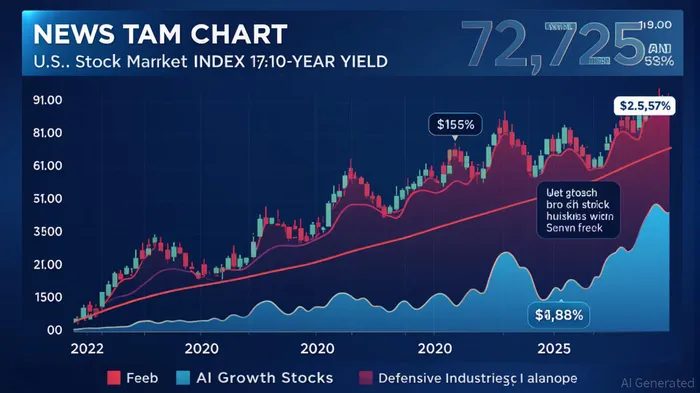
Investors have increasingly favored U.S. growth equities, particularly those tied to (AI) and capital expenditures,
which have shown resilience amid broader economic slowdowns. However, the unwinding of front-loaded activity in goods-producing industries and persistent inflation have prompted a more selective approach to growth stocks
as highlighted in recent reports. For instance,
BlackRock advised investors to prioritize alternative assets and international equities to diversify portfolios, as traditional correlations between stocks and bonds have weakened.
Bond Market Dynamics and Yield Curve Signals
Bond markets have responded to Fed policy with shifting yield curves and duration strategies. During the 2022–2023 tightening phase, Treasury yields across maturities surged above 15-year averages,
while the yield curve steepened as short-term rates fell. By late 2024,
the Fed's rate cuts-lowering the federal funds rate to 3.75–4.00% in October 2025-spurred a decline in bond yields, with the 10-year U.S. Treasury note dipping near 4.0%.
Investors are now favoring intermediate-duration bonds (3–7 years) over long-term Treasuries,
as this segment offers attractive yields with limited duration risk. This strategy reflects caution about inflation persistence and
the Fed's projected near 3%. Additionally, corporate bond spreads have widened, reflecting heightened risk perception, though they remain below historical medians
as noted in the latest report.
Timing Indicators: Leading Data and Yield Curve Signals
Leading economic indicators and yield curve dynamics provide critical timing signals for investors. ,
signaling slowing economic activity . Meanwhile, the , which inverted during the 2022–2023 tightening phase,
normalized to a positive spread . Historically, such inversions have preceded recessions, though
recent cycles show they are not infallible.
Labor market data also offers insights. , and
the . While localized labor market stress exists, widespread recession appears unlikely.
Investors should monitor these metrics closely, as the Fed has historically initiated rate cuts as a "risk management" measure when unemployment rises or yield curves signal instability.
Positioning Strategies: Sector Rotations and Duration Adjustments
For equity investors, sector rotations are key. The current cycle has seen a shift toward , but
selective exposure to defensive industries may be warranted as economic momentum slows.
BlackRock recommends diversifying into alternatives like commodities and digital assets to mitigate risks from structural changes in traditional asset correlations.
Bond investors, meanwhile, should prioritize intermediate-duration Treasuries and credit opportunities.
The Fed's projected , as long-term yields remain vulnerable to inflation surprises. Additionally, corporate bonds with strong credit fundamentals offer a balance of yield and risk mitigation
as reported in the latest analysis.
Conclusion: Navigating a Complex Policy Landscape
The Fed's 2022–2025 tightening and easing cycles underscore the need for active portfolio management. Equity investors must balance growth sector exposure with defensive positioning, while bond investors should favor intermediate-duration assets and credit opportunities. Timing strategies should incorporate leading indicators like the LEI and yield curve signals, while positioning decisions require adaptability to shifting correlations and policy normalization. As the Fed continues its data-driven approach, investors who align their strategies with these dynamics will be better positioned to navigate the evolving landscape.

Stay ahead of the market.
Get curated U.S. market news, insights and key dates delivered to your inbox.
AInvest
PRO
AInvest
PRO



Comments
No comments yet