
Federal Reserve Policy Shifts and Strategic Reallocation in 2025: Navigating Bond and Equity Markets Through Rate Cuts


 Aime Summary
The Federal Reserve's 2025 policy trajectory has been marked by a delicate balancing act: cutting interest rates to support a slowing labor market while remaining cautious about inflation and economic risks. By December 2025, the Fed had delivered its third consecutive 25-basis-point rate cut,
bringing the federal funds rate to 3.5%–3.75%, the lowest since 2022. This easing cycle, however, has been far from unanimous.
Three FOMC members dissented, reflecting deep divisions over the appropriate pace of monetary stimulus. As the central bank projects only one additional cut in 2026, investors must grapple with the implications of this "hawkish cut" approach for bond and equity markets.
The Paradox of Rising Bond Yields Amid Rate Cuts
Despite the Fed's aggressive easing,
10-year Treasury yields have defied expectations, climbing to 4.2% in late 2025. This divergence between policy rates and market yields has puzzled analysts.
According to a report by , the rise in yields reflects investor concerns about U.S. national debt, geopolitical tensions, and policy uncertainty, which have increased demand for compensation when holding Treasuries. Meanwhile, the Fed's dual mandate-prioritizing maximum employment and 2% inflation-has not yet translated into a significant downward pressure on yields,
suggesting that market forces are overpowering central bank interventions.
For bond investors, this environment demands a nuanced approach. Fixed-income strategies are increasingly favoring the "belly" of the yield curve-bonds with maturities of 3 to 7 years-to balance yield and duration risk. BlackRockBLK-- analysts argue that this segment offers a sweet spot for capturing higher yields without overexposing portfolios to long-term volatility. Additionally, long-dated government bonds and investment-grade credit are gaining traction, as their income premiums become more attractive in a low-growth, high-yield environment. However, investors must remain cautious: extending duration carries risks if the Fed reverses course or if inflation surprises to the upside.
Equity Market Reactions: Sector Rotation and Growth Equity Focus
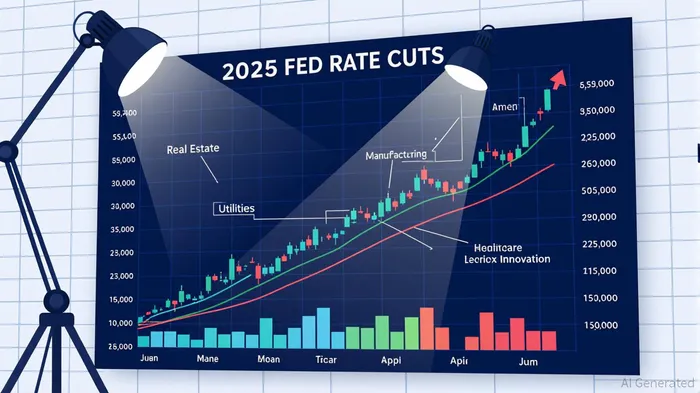 The equity market has responded more predictably to the Fed's rate cuts,
with rate-sensitive sectors like real estate, utilities, and manufacturing outperforming. Lower borrowing costs have
spurred corporate investment and consumer spending, particularly in industries reliant on credit. U.S. growth equities, especially those tied to artificial intelligence and healthcare innovation, have also gained momentum, as companies leverage cheaper capital to scale operations.
Yet, the optimism is tempered by macroeconomic uncertainties. While the Fed's rate cuts have bolstered market sentiment,
concerns about inflation persistence and a potential 2026 slowdown have led to a preference for defensive sectors with stable cash flows. International equities have also emerged as a strategic allocation, with investors capitalizing on a weaker U.S. dollar and diversification benefits. This shift aligns with broader trends of global capital reallocation, as emerging markets and developed economies outside the U.S. offer more attractive valuations.
Strategic Reallocation: Balancing Duration, Sectors, and Alternatives
The 2025 Fed rate cuts have created a unique opportunity for portfolio reallocation, but success requires a multi-asset approach. For bonds, the key is to extend duration selectively while hedging against rate volatility. As SVB's market insights note, investors must weigh the Fed's forward guidance against their liquidity needs,
avoiding overexposure to long-term bonds if rate cuts stall.
Beyond traditional assets, alternatives are gaining prominence. Liquid alternatives, commodities, and digital assets like gold and bitcoinBTC-- are being integrated to reduce correlations and capture uncorrelated alpha. While bitcoin's volatility remains a concern, its role as a diversifier in well-structured portfolios is increasingly acknowledged.
Conclusion: Preparing for a Cautious 2026
The Fed's 2025 rate cuts have reshaped the investment landscape, but the path forward remains uncertain. With the central bank signaling limited further easing in 2026, investors must adopt a balanced strategy that accounts for both bond and equity dynamics. Extending bond duration selectively, rotating into growth and international equities, and incorporating alternatives can help navigate the Fed's "hawkish cut" stance. As always, vigilance is key: the interplay between monetary policy, inflation, and global risks will dictate the next chapter of this reallocation story.

Stay ahead of the market.
Get curated U.S. market news, insights and key dates delivered to your inbox.
AInvest
PRO
AInvest
PRO



Comments
No comments yet