
Federal Reserve Policy Shifts and Market Implications: Strategic Asset Positioning in a Post-Rate Cut Era


 Aime Summary
The Federal Reserve's November 2025 decision to cut interest rates for the third consecutive meeting marked a pivotal shift in monetary policy, signaling a deliberate pivot toward easing amid softening labor market conditions and rising economic uncertainties. This move, while widely anticipated, revealed internal divisions within the (FOMC), underscoring the delicate balancing act between curbing inflation and supporting growth. For investors, the implications are profound, necessitating a recalibration of asset allocation strategies to navigate the evolving macroeconomic landscape.
Policy Analysis: A Cautious Easing Path
The Fed's rate cut in November 2025
, a move framed as a response to "rising downside risks to employment" and a cooling labor market
according to the New York Times. However, the decision was not unanimous. Three FOMC members, including Trump appointee Stephen I. Miran,
dissented, advocating for either a larger 50-basis-point reduction or maintaining the status quo. This divergence highlights the central bank's cautious approach, with forward guidance
emphasizing that future rate adjustments will hinge on the "extent and timing" of incoming economic data.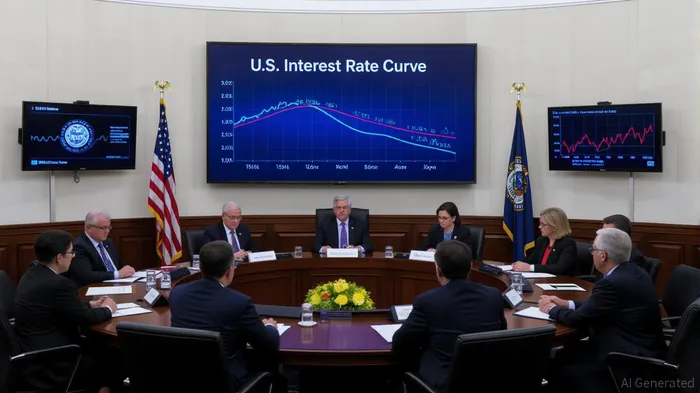 Such language, reminiscent of past periods of ,
suggests that further cuts in 2026 will require significant deterioration in or inflationary pressures.
Market Reactions: Equities Rally, Bonds Volatile
The market's immediate response to the rate cut was mixed but directionally positive. Global equities surged, with the rising 0.6% as investors embraced a "risk-on" sentiment
according to UBP analysis. Technology stocks, particularly the , led the charge, while defensive sectors lagged-a classic response to
as UBP reports. In fixed income, 10-year U.S. , reflecting a blend of rate volatility and hawkish sentiment driven by the Bank of Japan's anticipated tightening
according to UBP analysis. Meanwhile, the U.S. dollar weakened against major currencies, with investors pivoting to over long-duration Treasuries as carry costs declined
according to Reuters.
Investor sentiment in November also revealed a shift toward defensive positioning. Healthcare and consumer staples outperformed cyclical sectors,
according to JPMorgan. This divergence underscores a growing preference for stability over growth,
as Scotiabank notes in the Fed's conditional pause on further rate cuts.
: Navigating the New Normal
For investors, the November 2025 rate cut and subsequent market dynamics necessitate a of portfolios. Key considerations include:
: With the Fed signaling a data-dependent path for 2026,
investors are increasingly favoring intermediate-duration bonds to mitigate interest rate risk while capitalizing on lower . will be critical to capitalize on yield differentials and manage duration risk.: The underperformance of and the relative strength of healthcare and consumer staples suggest a shift in risk appetite. may offer resilience in a potential earnings slowdown,
persist.: The Fed's contrasts with tighter monetary policies in regions like Japan, creating opportunities in and high-yield bonds. However,
investors must remain vigilant to geopolitical risks and .: While the Magnificent 7 continue to dominate, the market's focus on earnings quality over momentum implies a need for disciplined . Cyclical sectors may rebound if the Fed's proves more enduring than anticipated
according to UBP analysis.
Conclusion: A Data-Dependent Outlook
The November 2025 rate cut reflects the Fed's commitment to a , balancing with labor market support. For investors, the path forward hinges on the central bank's ability to navigate a . must remain agile, prioritizing liquidity, , and to capitalize on evolving opportunities. As the Fed enters 2026 with
, the emphasis will shift from rate cuts to their efficacy in -a challenge that will define the year ahead.

Stay ahead of the market.
Get curated U.S. market news, insights and key dates delivered to your inbox.
AInvest
PRO
AInvest
PRO



Comments
No comments yet