
Federal Reserve Policy Shifts in Late 2025: Strategic Advantages in Treasury and Mortgage-Related Assets


 Aime Summary
The Federal Reserve's policy trajectory in late 2025 has marked a pivotal shift in monetary strategy, with three consecutive rate cuts since September 2025 culminating in a
0.25 percentage point reduction in December 2025, bringing the federal funds rate to 3.5–3.75%. This easing, though contentious within the Federal Open Market Committee (FOMC), signals a growing recognition of economic vulnerabilities, including slowing labor market growth and inflation persisting above the 2% target until 2028
according to the December 2025 report. For investors, these developments present a compelling case for strategic positioning in Treasury and mortgage-related assets, where the interplay of policy expectations, yield dynamics, and risk premiums offers both opportunities and risks.
Treasury Market Dynamics: Yield Divergence and Policy Uncertainty
The Fed's rate cuts have triggered a complex response in Treasury markets. Initially, yields across the curve fell in October 2025,
with 2-year, 5-year, 10-year, and 30-year maturities declining by 3–8 basis points. However, by late December,
10-year yields rebounded to 4.14% amid lingering economic uncertainty and the Fed's cautious "dot plot" projections of only two additional rate cuts by 2027. This volatility underscores a key insight: while short-term Treasuries have benefited from rate-cut expectations (e.g., 2-year yields dropping to 3.54% by late 2025),
long-term yields remain elevated due to structural factors such as inflation expectations and fiscal policy risks.
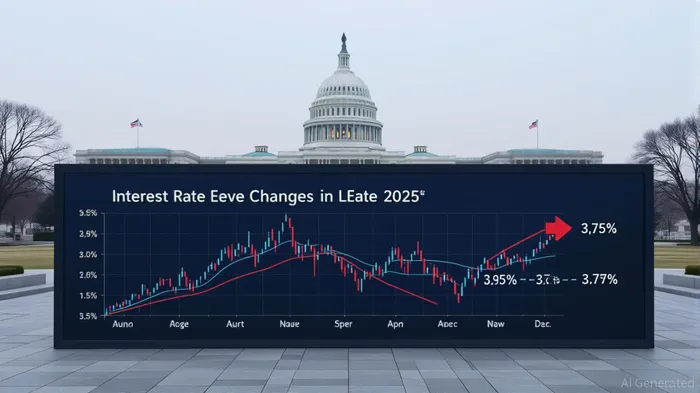 The divergence between short- and long-term yields has also led to a gradual steepening of the yield curve. Short-term instruments are increasingly priced on the assumption of further easing, whereas
long-term Treasuries reflect higher term premiums as investors demand compensation for inflation uncertainty and heavy Treasury issuance. For investors, this suggests a strategic advantage in allocating to intermediate-duration Treasuries, which balance sensitivity to rate cuts with resilience against inflation-driven yield pressures.
Mortgage-Backed Securities: Easing Credit Conditions and Supply-Demand Shifts
Mortgage-backed securities (MBS) have similarly responded to the Fed's easing cycle. In October 2025,
MBS returned 0.86%, reflecting improved credit conditions and expectations of lower mortgage rates. By late December,
prices were described as "moderately stronger", with some indicators pointing to a potential decline in mortgage rates as the Fed's rate cuts filtered through the system. However, the sector's performance has been uneven. For instance,
the October FOMC meeting's "hawkish rate cut"-marked by Chair Powell's cautious remarks-prompted a 10-basis-point rise in Treasury yields and a 4-basis-point widening of MBS spreads.
The resumption of Fed balance sheet expansion, including the end of quantitative tightening on December 1, 2025,
has added a layer of stability to MBS markets. Meanwhile, increased holdings by Fannie Mae and Freddie Mac have
improved supply-demand dynamics, potentially supporting investor demand. Yet risks remain, including prepayment volatility and geopolitical shocks, which could disrupt the sector's trajectory.
Strategic Positioning: Balancing Opportunity and Caution
The Fed's rate-cutting path, though modest, creates a favorable environment for Treasury and MBS investors. For Treasuries, the steepening yield curve suggests that intermediate-duration bonds may outperform, as they capture both the tailwinds of near-term easing and the relative safety of lower inflation risk compared to long-term instruments. In MBS, the combination of improved credit conditions and Fed-driven liquidity provides a buffer against near-term volatility, though investors must remain vigilant about prepayment risks and potential spread widening.
Moreover,
the Fed's resumption of Treasury purchases-a move aimed at stabilizing overnight funding markets-adds an additional tailwind for these assets. This intervention, coupled with the central bank's focus on labor market data as a trigger for further cuts, implies that policy support for fixed-income markets is likely to persist, at least in the near term.
Conclusion
The Federal Reserve's late 2025 policy shifts reflect a delicate balancing act between inflation control and economic resilience. For investors, the strategic advantages of positioning in Treasury and mortgage-related assets lie in their responsiveness to rate cuts, their role in diversifying portfolios against equity market volatility, and their potential to benefit from Fed-driven liquidity. However, these opportunities must be weighed against the risks of inflation persistence, fiscal uncertainty, and the political unknowns surrounding the upcoming Fed chair transition
according to the December 2025 report. In this environment, disciplined, duration-conscious allocations-particularly in intermediate Treasuries and high-quality MBS-offer a compelling path to navigate the Fed's easing cycle.

Stay ahead of the market.
Get curated U.S. market news, insights and key dates delivered to your inbox.


AInvest
PRO
AInvest
PRO



Comments
No comments yet