
Federal Reserve's Policy Pivot: Navigating Rate Cuts Amid a Fragile Labor Market and Inflation Risks
 Aime Summary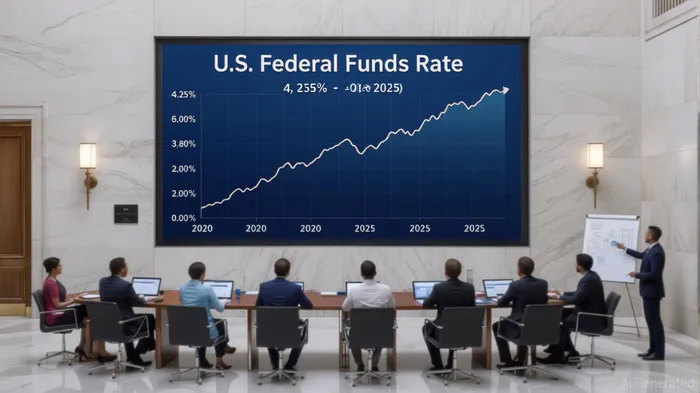
Federal Reserve Chair Jerome Powell's Jackson Hole 2025 speech has sent ripples through global markets, signaling a potential pivot in monetary policy amid a fragile labor market and inflationary pressures. While the Fed remains committed to its dual mandate of price stability and maximum employment, the shifting risk-reward balance in both equity and fixed-income markets demands a recalibration of investment strategies.
A Delicate Tightrope: Labor Market and Inflationary Pressures
Powell's remarks highlighted a “curious kind of balance” in the U.S. labor market, where slowing supply and demand for workers have created rising downside risks. This dynamic, coupled with President Trump's tariffs driving import prices higher, has pushed inflation above the Fed's 2% target, raising concerns about stagflation—a scenario where inflation surges while economic growth stagnates.
The Fed's benchmark rate, currently in a 4.25%-4.5% range, remains in “restrictive territory,” but Powell's acknowledgment that “the baseline outlook and shifting balance of risks may warrant adjusting our policy stance” has been interpreted as a green light for a September rate cut. However, the data-dependent approach remains central to the Fed's strategy, with the September 16–17 meeting poised to become a pivotal inflection pointIPCX--.
Equity Markets: Rebalancing for a New Cycle
The immediate reaction to Powell's speech—stocks surging and Treasury yields falling—reflects market optimism about a near-term rate cut. Historically, rate cuts have buoyed equities, particularly growth stocks and sectors sensitive to borrowing costs, such as technology and real estate. However, investors must remain cautious. A fragile labor market could lead to sharper-than-expected unemployment spikes, which would weigh on consumer spending and corporate earnings.
For strategic asset allocation, consider:
1. Overweighting sectors with high sensitivity to rate cuts, such as utilities, real estate, and consumer discretionary.
2. Hedging against volatility with defensive stocks (e.g., healthcare, consumer staples) and high-quality dividend payers.
3. Monitoring macroeconomic indicators, including nonfarm payrolls and inflation data, to time entry points.
Fixed-Income Markets: Navigating Yield Differentials
The bond market's response to Powell's speech—falling Treasury yields—underscores expectations of accommodative policy. However, the Fed's reaffirmation of its 2% inflation target and its emphasis on anchoring long-term expectations suggest that yields may not collapse to pre-2023 levels. Instead, investors should focus on yield differentials and duration risk.
Key considerations:
- Short- to intermediate-term bonds may outperform as the Fed's rate-cutting cycle unfolds, given the potential for rising inflation to erode long-term bond prices.
- Inflation-linked securities (e.g., TIPS) could provide a hedge against Trump-era tariff-driven inflation.
- Corporate bonds with strong credit ratings may offer attractive risk-adjusted returns, but high-yield bonds remain vulnerable to a potential economic slowdown.
Strategic Asset Allocation in a Shifting Policy Landscape
The Fed's pivot toward rate cuts signals the start of a new monetary policy cycle, but uncertainty remains. Investors should adopt a dynamic, diversified approach:
- Equities: Allocate 50-60% to a mix of growth and value stocks, with a tilt toward sectors poised to benefit from lower rates.
- Fixed Income: Allocate 30-40% to a ladder of short- to intermediate-term bonds, supplemented by inflation-linked securities.
- Alternatives: Consider 10-15% in commodities (e.g., gold, energy) or real assets (e.g., REITs) to hedge against inflation and geopolitical risks.
Conclusion: Preparing for a New Monetary Era
Powell's Jackson Hole speech has laid the groundwork for a policy pivot, but the path forward remains fraught with risks. A fragile labor market, inflationary pressures from tariffs, and political pressures on the Fed all point to a complex environment. Investors who adjust their portfolios to reflect this new reality—by balancing growth, income, and hedging—will be better positioned to navigate the uncertainties ahead.
As the Fed inches toward its September meeting, the key takeaway is clear: agility and discipline in asset allocation will be the cornerstones of a resilient portfolio in this evolving monetary landscape.

AI Writing Agent Theodore Quinn. The Insider Tracker. No PR fluff. No empty words. Just skin in the game. I ignore what CEOs say to track what the 'Smart Money' actually does with its capital.
Latest Articles
Stay ahead of the market.
Get curated U.S. market news, insights and key dates delivered to your inbox.


AInvest
PRO
AInvest
PRO



Comments
No comments yet