
Federal Reserve Policy and Its Impact on Fixed Income Markets: How the December 2025 Fed Rate Decision Is Reshaping Bond Yields and Investor Strategy


 Aime Summary
The Federal Reserve's December 2025 rate decision has sent ripples through fixed income markets, reshaping bond yields and investor strategies in ways that defy conventional expectations. While the central bank cut the federal funds rate by 25 basis points to a range of 3.5% to 3.75%, marking the third such reduction in 2025, the market's response has been anything but straightforward. Bond yields, particularly for Treasuries, have risen despite the easing, reflecting a complex interplay of inflationary concerns, policy uncertainty, and global monetary trends. This analysis unpacks the Fed's rationale, the market's divergent reaction, and the evolving strategies of fixed income investors in this new landscape.
The December 2025 Rate Cut: A Delicate Balancing Act
The Federal Reserve's decision to lower rates in December 2025 was driven by an evolving economic outlook.
According to the Fed's official statement, economic activity has been expanding at a "moderate pace," with the unemployment rate steady at 4.4%. However, inflation, though slightly elevated from earlier in the year, remains a key concern.
The central bank emphasized its commitment to achieving maximum employment and returning inflation to its 2% target, a dual mandate that has guided its policy adjustments.
Notably, the decision was not unanimous. Three members of the Federal Open Market Committee () dissented, highlighting internal divisions. Stephen I. Miran, a -appointed governor, , while Jeffrey R. Schmid and preferred maintaining the current rate
according to the Fed's official statement. This dissent underscores the Fed's delicate balancing act: addressing inflation risks while avoiding a tightening of financial conditions that could stifle growth.
The Paradox of Rising Yields in a Rate-Cutting Environment
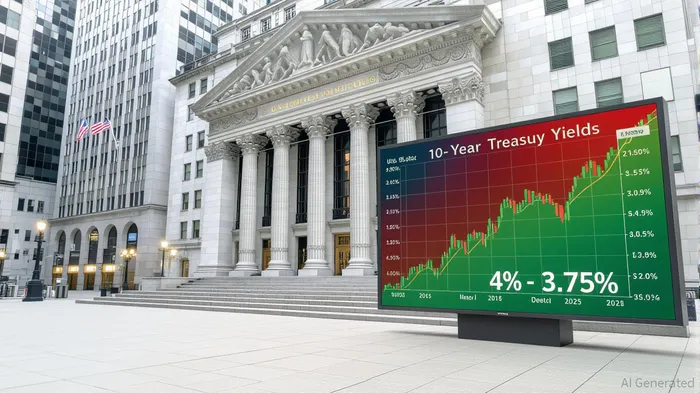
Despite the Fed's easing, bond yields have defied expectations. The 10-year Treasury yield
, even as markets had priced in the rate cuts weeks in advance. This divergence reflects broader investor concerns about inflation and the potential for a new Fed Chair-possibly , .
Such a scenario, investors fear, .
The rise in yields is also tied to global .
Central banks in the UK, Germany, and Japan have signaled reduced monetary easing, creating a synchronized shift in policy that has pushed yields higher across developed markets. In the U.S., this dynamic has been amplified by geopolitical tensions and the potential for inflationary pressures from tariffs, which have
further incentivized investors to demand higher returns for holding bonds.
Investor Strategy Shifts: , , and
The December 2025 rate decision has prompted a strategic reallocation within fixed income portfolios.
Investors are increasingly favoring longer-duration bonds, . This shift aligns with the 's recommendation to prioritize high-quality, .
Sector rotation has also been pronounced. While Treasuries and investment-grade corporates have underperformed, high-yield corporates and senior loans have gained traction, reflecting a nuanced risk appetite.
Nuveen's weekly commentary notes that investors are capitalizing on attractive yield spreads in high-yield markets, . Meanwhile, municipal bonds have held steady, supported by strong demand and robust reinvestment flows.
The Road Ahead: Policy Uncertainty and Market Adaptation
Looking forward, the Fed's forward guidance suggests a cautious approach.
The central bank has indicated it will monitor incoming data and the balance of risks before deciding on further rate adjustments. Some strategists, however, ,
according to market analysis. This uncertainty has led investors to adopt a more active approach to credit selection and duration management, as highlighted by
analysts at Nuveen and .
. , .
Conclusion
. Rising yields, despite easing, , . As the Fed navigates its dual mandate, .

Stay ahead of the market.
Get curated U.S. market news, insights and key dates delivered to your inbox.


AInvest
PRO
AInvest
PRO



Comments
No comments yet